Solving Mysteries: Must Have & Can’t Have for Past Deductions
Core PathWay
1 What is Deduction?
Have you ever looked at a situation and known exactly what happened, even though you didn’t see it? That’s called a deduction. It’s when you use evidence to make a logical guess. You are a detective in your daily life!
In English, we have special words for this.
When we are very sure about something in the present, we use must. When we are very sure something is NOT true, we use can’t. Imagine a phone starts ringing in a dark cinema. Everyone looks around. Someone whispers, “Whose phone is that?” You left yours on the kitchen table this morning, so you whisper back: “It can’t be mine — it must be someone else’s.”
Remember, this is different from using must for obligation, like “I must study tonight,” or can’t for ability, like “I can’t swim.” In deduction, we are making a smart guess, not talking about rules or skills. We use the evidence we see to understand the situation.
OK, that’s for Present Deductions, but what about Past Deductions? How do we talk about things we are sure happened (or didn’t happen) yesterday or last week?
2 Introducing Modal Perfects for the Past
To make deductions about the past, we use a special structure called the modal perfect. For strong positive deductions, we use must have + past participle. For strong negative deductions, we use can’t have or couldn’t have + past participle.
Here are four examples of must have for positive past deductions:
1. The ground is wet. It must have rained last night.
2. Sarah looks exhausted. She must have worked very late.
3. The cake is gone. Someone must have eaten it.
4. He missed the train. He must have left home too late.
And here are four examples of can’t have / couldn’t have for negative past deductions:
1. John says he saw a werewolf last night, but he can’t have seen one – they don’t exist.
2. You can’t have forgotten your keys; I saw you put them in your bag.
3. She couldn’t have called you; her phone is broken.
4. They couldn’t have finished the project so quickly; it takes a week.
Notice how we use the past participle (rained, worked, eaten, seen, forgotten, called) after ‘have’. This is what connects the deduction to the past.
3 Grammar Toolkit: Forming the Modal Perfect
The modal perfect is a powerful tool. It lets you talk about the past with confidence. Here is how to build it correctly. The structure is simple: modal verb + have + past participle. We can use this for finished actions or for actions that were in progress at a past time.
Focus
- Use ‘must have + past participle’ for a strong positive deduction about a past event.
- Use ‘can’t have’ or ‘couldn’t have + past participle’ for a strong negative deduction about a past event.
- Use the Simple form for a finished action and the Continuous form (‘been + -ing’) for an action that was in progress.
Rules
- Modal Perfect Simple: must / can’t / couldn’t + have + past participle (e.g., must have worked).
- Modal Perfect Continuous: must / can’t / couldn’t + have + been + present participle (e.g., must have been working).
- The continuous form is used when the action was happening over a period of time in the past.
Examples
- Simple: The floor is clean. She must have cleaned it this morning.
- Continuous: Her eyes are red. She must have been crying.
- Negative: He can’t have been sleeping when you called; he was in a meeting.
Common mistake
4 The Data Leak
Elena Marsh sat down in the empty conference room and spread the badge logs across the table.
“Someone must have accessed the Ferro file after hours,” she said. “The pricing figures reached Delvane by Tuesday morning.”
Nadia scrolled through the access record. “It can’t have been anyone from Legal. That floor was sealed off for the audit.”
“Agreed.” Elena tapped a line. “Six forty-seven. Someone badged into the server room and stayed forty minutes. That’s far too long to collect a printout. They must have been copying something.”
“That’s Vincent’s card,” Nadia said. “But Vincent was in Frankfurt on Monday.”
“Then he can’t have used it himself.”
Elena turned to the footage: a figure in a grey coat, head down, crossing the floor without hesitating. “Watch how she walks. She isn’t searching. She knows exactly which cabinet she wants. She must have been in that room dozens of times.”
Nadia said nothing for a moment. “Vincent keeps a spare card in his desk drawer. His assistant books his travel.”
“And she can’t have been staying late for the overtime,” Elena said. “She’s salaried.”
She closed the folder. “Book the small room. We’ll start with her.”
5 Your Turn: Write Like a Detective
Now it’s your turn to use your detective skills. You will write a short story about a small mystery. Use the modal perfects you have just learned to explain what you think happened.
**Think about:**
– Who might have been in your home?
– What were they doing while they were there?
– How long were they there?
– What can you rule out completely?
Use at least THREE different modal perfect forms in your paragraph, including at least one continuous form (must have been + -ing or can’t have been + -ing).
Start your response like this:
When I got home, I immediately noticed that something strange had happened.
Member-Exclusive Practice Bar
Access a wide range of integrated practice for this unit — from Vocabulary and Grammar activities to AI-curated Writing tasks and Thematic Chat practice.
This feature is available to YSP members.
Explore Membership BenefitsMember-Exclusive Vocabulary Review & Acquisition System
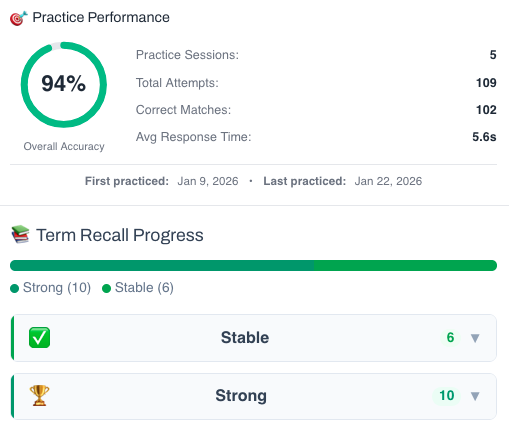
This isn’t a simple quiz — it’s a fully tracked learning system. You build knowledge through recognition, then recall, and your progress feeds directly into the Integrated Practice Bar (Writing tasks, AI Chat, and more).
- Practice sessions, accuracy, and response-time tracking
- Term strength levels (Learning → Stable → Strong)
- Personal progress history for each unit
This feature is available to YSP members.
Explore Membership Benefits🎮 Practice Games
Sentence Scrambler
Introduction to Modal Perfect: Deduction – Sentence Scramble
Member-Exclusive Sentence Builder
Reconstruct scrambled sentences to practice word order and develop your grammar intuition.
This feature is available to YSP members.
Explore Membership Benefits