Say It Like a Pro: From Simple to Modal Perfect
Core PathWay
1 Section 1. Expressing Certainty and Uncertianty at 'lower fluency levels'
If you are reading this B1 level page, you probably already know how to express certainty and uncertainty in English. Perhaps you already recognize the following:.
When we are sure something is true, we use expressions like ‘I’m sure that…’ or ‘I’m certain that…’. When we think something is impossible or highly unlikely, we say things like ‘It’s impossible that…’ or ‘There’s no way that…’. And when we are not so sure — when we are only guessing — we use words like ‘maybe’, ‘perhaps’, or ‘I think possibly…’.
Here are some clear examples of these simple forms. Notice how natural they sound:
— I’m sure that Alex took the keys. He always does.
— I’m certain that Sam was at the meeting. I saw her entering the meeting room.
— It’s impossible that Jordan forgot. He wrote it down.
— There’s no way that Chris sent that email. She was on holiday without internet.
— Maybe they left early because of the traffic.
— Perhaps he didn’t understand the instructions.
— I think possibly she missed the train.
These sentences are correct and natural. Native speakers use them every day. But there is another way to say all of these things — a way that sounds more fluent, more precise, and more like a confident B1 or B2 speaker. That is what this page is about.
Key Terms
2 Section 2. The Upgrade: from Simple Forms to Modal Perfect
Every simple expression from Section 1 has a more advanced partner. This partner uses the modal perfect form. The modal perfect looks like this:
modal verb + have + past participle
For example: must have taken, can’t have forgotten, might have left.
This is the form you studied on pages 1 and 2 of this series. Now let’s connect it directly to the simple language you already know. Think of this as a translation — from simpler everyday English into more fluent, natural English.
—
GROUP 1: Certainty — ‘I’m sure that…’ → MUST HAVE
When you are very sure that something happened in the past, use must have + past participle.
Simple: I’m sure that Alex took the keys.
Advanced: Alex must have taken the keys.
Simple: I’m certain that Sam was at the meeting. I saw her enter the meeting room.
Advanced: Sam must have been at the meeting. I saw her enter the meeting room.
Simple: I’m sure they received the message. They replied immediately.
Advanced: They must have received the message. They replied immediately.
Simple: I’m certain she worked very hard. The results are excellent.
Advanced: She must have worked very hard. The results are excellent.
—
GROUP 2: Impossibility — ‘It’s impossible that…’ → CAN’T HAVE
When you are sure that something did NOT happen — when it seems impossible — use can’t have + past participle.
Simple: It’s impossible that Jordan forgot. He wrote it down.
Advanced: Jordan can’t have forgotten. He wrote it down.
Simple: There’s no way that Chris sent that email. She was on holiday without internet.
Advanced: Chris can’t have sent that email. She was on holiday without internet.
Simple: It’s impossible that they finished already. It was a huge project.
Advanced: They can’t have finished already. It was a huge project.
Simple: There’s no way she understood. She looked completely confused.
Advanced: She can’t have understood. She looked completely confused.
—
GROUP 3: Uncertainty and Possibility — ‘Maybe / Perhaps…’ → MIGHT HAVE / MAY HAVE / COULD HAVE
When you are not sure — when you are only guessing — use might have, may have, or could have + past participle. All three are possible here. Might have is the most common in everyday speech.
Simple: Maybe they left early because of the traffic.
Advanced: They might have left early because of the traffic.
Simple: Perhaps he didn’t understand the instructions.
Advanced: He may not have understood the instructions.
Simple: I think possibly she missed the train.
Advanced: She could have missed the train.
Simple: Maybe Jordan took the wrong file by mistake.
Advanced: Jordan might have taken the wrong file by mistake.
Simple: Perhaps they forgot to book the room.
Advanced: They may have forgotten to book the room.
Simple: I think possibly the package got lost in the post.
Advanced: The package could have got lost in the post.
—
A quick note on negatives:
Negatives work slightly differently for each group. This is worth noticing.
— must have → there is no ‘mustn’t have’ form for negative deduction. Instead, use can’t have.
— can’t have or couldn’t have→ this is already the negative form.
— mightn’t have / may not have → both work for negative uncertainty.
Simple: Maybe she didn’t see the message.
Advanced: She mightn’t have seen the message.
Simple: Perhaps he didn’t arrive in time.
Advanced: He may not have arrived in time.
—
The Big Picture — Your Upgrade Table:
Simple form → Modal perfect form:
‘I’m sure X did it’ → X must have done it
‘It’s impossible X did it’ → X can’t have done it
‘Maybe X did it’ → X might have done it
‘Perhaps X did it’ → X may have done it
‘Possibly X did it’ → X could have done it
This is the core of the whole system. Once you see these pairs clearly, the modal perfect stops feeling strange — it feels like the natural next step.
Key Terms
3 Section 3. The Office Mystery — A Conversation
It’s Monday morning. Alex and Sam are in the office kitchen. They are talking about a strange situation: someone left a large box of expensive chocolates on the meeting room table over the weekend, and nobody knows who did it.
Watch how Alex uses simple, everyday language — and how Sam upgrades it each time into the more advanced modal perfect form. Can you spot the pattern?
—
Alex: I’m sure it was Jordan. He was the last person in the office on Friday.
Sam: Oh, you mean Jordan must have left them? Yes, that’s possible. But I’m not totally sure.
Alex: Well, it’s impossible that Chris did it. She was at a conference all weekend.
Sam: Right, so Chris can’t have left them. That makes sense.
Alex: Maybe the manager bought them to say thank you for the project.
Sam: Hmm, so the manager might have bought them as a thank-you gift? That would be nice!
Alex: Or perhaps someone from another team left them by mistake in the wrong room.
Sam: So they could have left them in the wrong room by accident. Yes, that’s also possible.
Alex: I think possibly Jordan forgot to tell us — he probably planned to explain on Monday.
Sam: So Jordan may have forgotten to leave a note. That sounds very like him, actually!
Alex: Well, it’s impossible that the chocolates just appeared on their own!
Sam: Ha! Yes, they can’t have appeared by magic. Someone definitely put them there.
Alex: I’m certain someone knows the answer. We just need to ask around.
Sam: Exactly — someone must know about this.
4 Section 4. Recap: The Upgrade in Three Steps
Let’s bring it all together. This page had one main job: to show you that the advanced forms you have been studying are not new ideas. They are the same ideas you already express — just in a more fluent, more natural way.
Step 1 — Certainty: When you want to say ‘I’m sure X happened’, upgrade to must have + past participle. This is your go-to form for confident deductions about the past.
Step 2 — Impossibility: When you want to say ‘It’s impossible that X happened’, upgrade to can’t have + past participle. This is strong — you are ruling something out completely.
Step 3 — Possibility: When you want to say ‘maybe’ or ‘perhaps’, upgrade to might have, may have, or could have + past participle. All three work, and they show that you are making a careful, considered guess.
The simple forms are not wrong. Native speakers use them too. But the modal perfect forms are more compact, more expressive, and they show real language awareness. They are the mark of a learner who is moving from B1 toward B2 — and that is exactly where you are heading.
From now on, when you catch yourself saying ‘I’m sure he did it’ or ‘I’m certain he has done it’ — pause for just a moment. Ask yourself: can I say he must have done it instead? The answer will almost always be yes.
Member-Exclusive Practice Bar
Access a wide range of integrated practice for this unit — from Vocabulary and Grammar activities to AI-curated Writing tasks and Thematic Chat practice.
This feature is available to YSP members.
Explore Membership BenefitsMember-Exclusive Vocabulary Review & Acquisition System
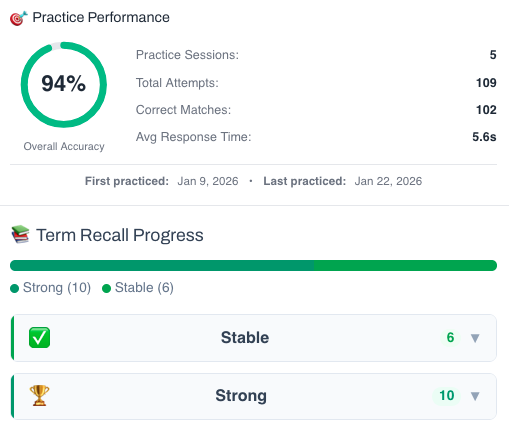
This isn’t a simple quiz — it’s a fully tracked learning system. You build knowledge through recognition, then recall, and your progress feeds directly into the Integrated Practice Bar (Writing tasks, AI Chat, and more).
- Practice sessions, accuracy, and response-time tracking
- Term strength levels (Learning → Stable → Strong)
- Personal progress history for each unit
This feature is available to YSP members.
Explore Membership Benefits🎮 Practice Games
Sentence Scrambler
Deduction and Supposition: comparing ‘simple’ and ‘more advanced’ forms. – Sentence Scramble
Member-Exclusive Sentence Builder
Reconstruct scrambled sentences to practice word order and develop your grammar intuition.
This feature is available to YSP members.
Explore Membership Benefits