REVIEW A Complete Guide for C1 Learners
Core PathWayGrammar Overview
Compound adjectives and nouns are formed by joining two or more words to create a single unit of meaning. English is unusually productive in this area — new compounds appear constantly in journalism, tech, business, and everyday speech. The challenge for learners is not just understanding what they mean, but knowing how to build them correctly: which words combine, where to place a hyphen, and how position in a sentence changes the form. This guide covers all the key patterns.
Structure Analysis
Structure: Noun + Noun Compound Nouns
Form: noun + noun → compound noun (open, closed, or hyphenated)
Function: Creates a new noun where the first noun describes or categorises the second
Usage Context: Extremely common in everyday English, business, journalism, and technology
Key Uses: Naming objects and concepts: coffee table, football, email, Categorising: software developer, tax return, airport security
- “The deadline for the tax return is next week.”
- “She landed a job as a software developer straight out of university.”
- “The coffee machine in the office has been broken for days.”
Structure: Adjective + Noun Compound Nouns
Form: adjective + noun → compound noun
Function: The adjective becomes a permanent part of the noun’s identity, not just a description
Usage Context: Common in everyday and professional English
Key Uses: Naming specific things: greenhouse, blackboard, smartphone, The meaning is often non-compositional — ‘greenhouse’ is not simply a green house
- “The greenhouse effect is one of the most discussed topics in environmental science.”
- “She wiped the blackboard clean before the lesson started.”
- “His smartphone died halfway through the presentation.”
Structure: Number + Noun Compound Adjectives
Form: number + noun (singular) + hyphen → compound adjective before a noun
Function: Describes a noun using a measurement or quantity
Usage Context: Very frequent in both spoken and written English, especially in planning, scheduling, and description
Key Uses: Describing duration: a three-hour meeting, a two-week holiday, Describing measurements: a six-foot fence, a four-bedroom house
- “We sat through a three-hour meeting without a single break.”
- “They’ve just moved into a four-bedroom house on the edge of town.”
- “It was a ten-minute walk from the station, which was perfect.”
Structure: Adverb/Adjective + Past Participle Compound Adjectives
Form: adverb or adjective + past participle → hyphenated compound adjective
Function: Describes a quality of a noun in a compact, precise way
Usage Context: Frequent in written English, journalism, academic writing, and professional contexts
Key Uses: Evaluative descriptions: well-known, highly-regarded, deeply-rooted, Descriptive precision: open-minded, broad-shouldered, soft-spoken
- “She’s a well-known figure in the tech industry, though she rarely gives interviews.”
- “His deeply-rooted scepticism made it difficult to convince him of anything.”
- “The open-minded approach they took to the project was genuinely refreshing.”
Structure: Noun + Past Participle Compound Adjectives
Form: noun + past participle → hyphenated compound adjective
Function: Describes how something was made, done, or affected
Usage Context: Common in product descriptions, journalism, and everyday conversation
Key Uses: Origin or method: hand-made, home-grown, machine-made, Effect or state: sun-dried, wind-swept, stress-related
- “She always buys hand-made chocolates from that little shop on the corner.”
- “The wind-swept coastline was breathtaking despite the cold.”
- “A lot of his health problems turned out to be stress-related.”
Structure: Attributive vs Predicative Position and Hyphenation
Form: Attributive (before noun): hyphen required. Predicative (after verb): hyphen often dropped.
Function: Signals whether the compound is modifying a noun directly or describing it via a linking verb
Usage Context: A critical rule for written accuracy at C1 and above
Key Uses: Attributive: ‘a well-known author’ (hyphen required), Predicative: ‘The author is well known’ (hyphen often omitted)
- “It was a thought-provoking documentary — I’d highly recommend it.”
- “The documentary was thought provoking, but a little too long.”
- “She gave a deeply-felt speech that moved everyone in the room.”
1 What Are Compound Adjectives and Nouns? The Big Picture
Let’s start with the basics — but not for long, because the really interesting stuff comes quickly.
A compound adjective is formed when two or more words work together as a single adjective to describe a noun. A compound noun is formed when two or more words combine to name a single thing, person, or concept.
The key idea is this: in both cases, the words are no longer working independently. They’ve joined forces to create a new unit of meaning.
Why does this matter?
Because English is obsessed with compounds. They appear in every register — from casual conversation (‘a last-minute excuse’) to professional writing (‘a results-driven approach’) to academic English (‘a thought-provoking argument’). If you can build and recognise compounds confidently, your English immediately sounds more natural and precise.
Three types of compound nouns (based on how they’re written):
⚠️ Here’s the honest truth: there is no single rule that tells you which type a compound noun is. Usage, convention, and dictionaries decide. The good news? The patterns are learnable, and exposure does most of the work.
Compound adjectives follow clearer rules — and those rules are what we’re going to focus on.
Key Terms
💬 So Wait — Do I Need a Hyphen or Not?
Maya and Dom are catching up over coffee. Maya has just been writing a work email and got confused about hyphenation.
2 Compound Nouns: The Patterns That Actually Work
You already know more compound nouns than you think. The challenge is understanding why they work the way they do — so you can build new ones with confidence.
The Golden Rule of Compound Nouns:
The first word always modifies (describes or categorises) the second word. The second word is the head noun — it tells you what kind of thing it is. The first word narrows it down.
> a car park = a type of park? No — a place specifically for cars. The head noun is ‘park’; ‘car’ tells you what kind.
This is the opposite of many other languages, where the modifier comes after the noun. This is one of the most common interference errors for learners.
The Main Patterns:
1. Noun + Noun
The most common pattern by far.
– coffee machine, football match, tax return, software developer, airport security
2. Adjective + Noun
Here, the adjective becomes ‘frozen’ — it’s no longer describing the noun in the usual way. The meaning is often non-compositional.
– greenhouse (not just a green house), blackboard (historically, not always black), smartphone
3. Verb + Noun / Noun + Verb
Less common but important:
– swimming pool, washing machine (verb + noun)
– sunrise, rainfall (noun + verb → often closed)
4. Verb + Particle / Particle + Verb
– check-in, takeaway, outbreak, bypass
Key Terms
💬 Three-Hour Meeting or Three-Hours Meeting?
Dom and Maya are still in the coffee shop. Maya is preparing for a presentation and wants to get her English exactly right.
3 Compound Adjectives: The Rules Are Clearer Here
Good news: compound adjectives follow more consistent rules than compound nouns. Master these patterns and you’ll be able to build new ones on the fly.
The Core Patterns:
1. Number + Noun (singular)
This is one of the most frequent patterns in everyday English.
– a three-hour meeting ✓ / a three-hours meeting ✗
– a four-bedroom flat ✓ / a four-bedrooms flat ✗
– a ten-minute walk ✓ / a ten-minutes walk ✗
2. Adjective + Noun
– a full-time job, a last-minute decision, a long-term plan, a short-sighted approach
3. Adverb / Adjective + Past Participle
– well-known, highly-regarded, deeply-rooted, open-minded, broad-shouldered
4. Noun + Past Participle
– hand-made, home-grown, machine-made, sun-dried, stress-related, wind-swept
5. Noun + Present Participle
– thought-provoking, record-breaking, mind-blowing, time-consuming, eye-catching
6. Adjective + Present Participle
– good-looking, easy-going, hard-working, slow-moving
⚠️ The hyphen disappears (or becomes optional) when the compound comes AFTER the verb:
– a well-known author → The author is well known.
– a thought-provoking film → The film was thought provoking.
Some very fixed compounds (like old-fashioned or absent-minded) often keep the hyphen in both positions. When in doubt, check a good dictionary.
Key Terms
💬 Car Park or Park Car? Word Order in Compound Nouns
Maya is looking at a map on her phone, trying to find parking. The conversation turns to how compound nouns work.
4 The Hyphenation Problem — Solved (Mostly)
Hyphenation is the part of compound adjectives that makes even native speakers second-guess themselves. Here’s a practical framework that works for the vast majority of cases.
The Three-Question Test:
Question 1: Is the compound before the noun?
If yes → use a hyphen.
– a well-organised event, a last-minute change, a record-breaking performance
Question 2: Is the compound after the verb?
If yes → the hyphen is usually dropped (though some fixed forms keep it).
– The event was well organised. The change was last minute. The performance was record-breaking.
Question 3: Does the compound include an adverb ending in -ly?
If yes → NO hyphen, even before the noun.
– a highly regarded professor ✓ / a highly-regarded professor ✗
– a beautifully written letter ✓ / a beautifully-written letter ✗
Quick Reference:
| Position | Example | Hyphen? |
|—|—|—|
| Before noun (attributive) | a well-known actor | ✓ Yes |
| After verb (predicative) | The actor is well known | Usually no |
| -ly adverb + adjective/participle | a highly respected figure | ✗ No |
| Fixed/dictionary compound | old-fashioned, absent-minded | ✓ Usually yes |
Key Terms
5 Compounds in Context: What They Actually Sound Like
Rules are only useful if you can hear them working in real language. Here are compound adjectives and nouns in action — notice how naturally they slot into everyday speech and writing.
In conversation:
> ‘It was a last-minute decision — we hadn’t planned it at all.’
> ‘She’s really easy-going, which makes her great to work with.’
> ‘The whole thing was mind-blowing, honestly.’
In professional writing:
> ‘We are seeking a results-driven individual with a proven track record in client management.’
> ‘The open-plan office design was intended to foster collaboration, though the reality proved somewhat more complicated.’
In academic writing:
> ‘The deeply-rooted assumptions underlying this framework have rarely been subjected to rigorous scrutiny.’
> ‘This thought-provoking study challenges widely-held beliefs about motivation in the workplace.’
Compounds that have shifted register over time:
Some compounds that once felt fresh and informal have now become standard professional vocabulary:
– user-friendly (tech → mainstream)
– ground-breaking (journalism → academic)
– time-consuming (informal → formal)
Key Terms
6 Common Mistakes — And How to Avoid Them
These are the errors that appear most often at C1 level. Recognising them is half the battle.
Mistake 1: Plural noun in a number compound
– ✗ a three-hours meeting
– ✓ a three-hour meeting
Mistake 2: Missing hyphen before the noun
– ✗ a well known author
– ✓ a well-known author
Mistake 3: Hyphen with -ly adverbs
– ✗ a highly-skilled professional
– ✓ a highly skilled professional
Mistake 4: Reversing the word order in compound nouns
– ✗ a park of cars (as a compound noun)
– ✓ a car park
Mistake 5: Treating a compound noun as two separate words that can be modified independently
– ✗ a very black board (meaning ‘blackboard’)
– ✓ a blackboard (the compound is a fixed unit)
Mistake 6: Using a hyphen after the verb when it’s not needed
– ✗ The film was thought-provoking. (acceptable but increasingly avoided)
– ✓ The film was thought provoking.
Member-Exclusive Practice Bar
Access a wide range of integrated practice for this unit — from Vocabulary and Grammar activities to AI-curated Writing tasks and Thematic Chat practice.
This feature is available to YSP members.
Explore Membership BenefitsMember-Exclusive Vocabulary Review & Acquisition System
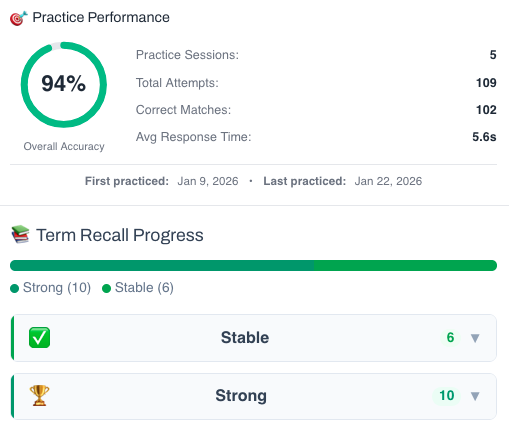
This isn’t a simple quiz — it’s a fully tracked learning system. You build knowledge through recognition, then recall, and your progress feeds directly into the Integrated Practice Bar (Writing tasks, AI Chat, and more).
- Practice sessions, accuracy, and response-time tracking
- Term strength levels (Learning → Stable → Strong)
- Personal progress history for each unit
This feature is available to YSP members.
Explore Membership Benefits