Comparative Adjectives in Action: HR, Airport Safety & Procurement
Core PathWay
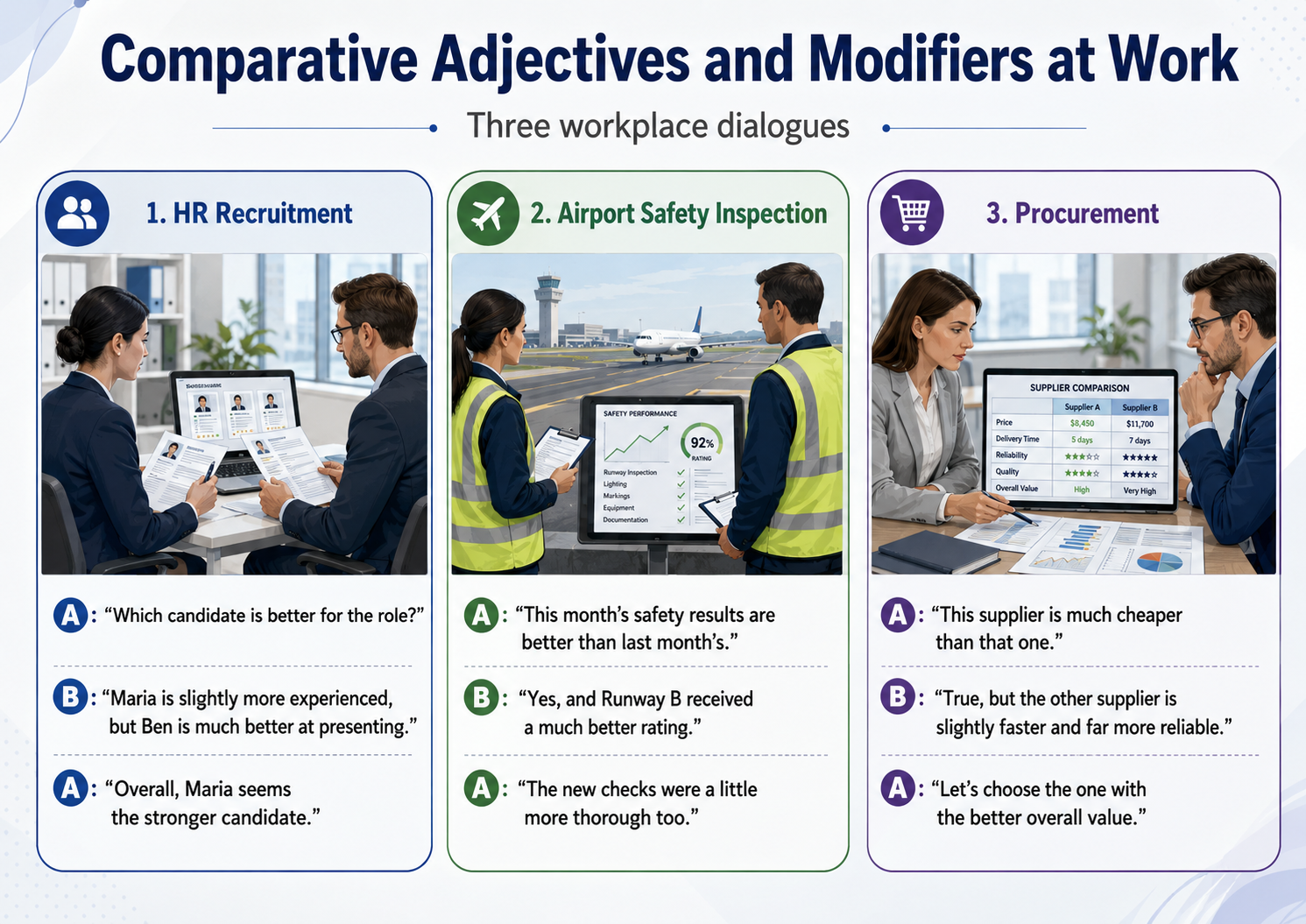
1 Section 1. You Already Know the Tools — Now Hear Them in Action
You already know how to form comparative adjectives. You know the rules — add -er, use more, and watch the irregular forms. You also know how to show the size of a difference. Use much, far, a lot or lots for a big difference. Use slightly, a little, a bit, not much or a little bit for a small difference.
Now it is time to hear these tools in real conversations. In this lesson, you will listen to three sets of dialogues. The first is about Human Resources — two managers compare job candidates. The second is about airport safety inspections — two officers compare the results of two inspections. The third is about procurement — two employees compare two possible suppliers.
Listen carefully. Notice how the speakers use comparative adjectives and their modifiers to make their points clear.
Key Terms
2 Section 2. Dialogue: Comparing Candidates in HR
Listen to two HR managers. They are comparing two candidates for a job. Notice how they use comparative adjectives and modifiers to talk about the differences.
💬 Dialogue 1: Which Candidate Is Right for the Job?
Two HR managers, Sam and Jordan, are in a meeting room. They are reviewing two candidates: Alex and Chris.
Sam: “Okay Jordan, let’s talk about the two candidates. Alex and Chris are both strong, but they are very different. Alex has much more experience than Chris. Alex worked in HR for eight years. Chris only worked in HR for two years. What do you think about that?”
Jordan: “Yes, Alex is much more experienced than Chris. But I looked at the test scores. Chris scored slightly better than Alex on the skills test. It is not a big difference, but it is there.”
Sam: “That is a good point. The test score difference is small — only three points. So yes, slightly better is the right way to say it. Now, what about the interviews? I watched both interviews again this morning.”
Jordan: “Alex was a lot more confident in the interview. Chris seemed nervous and gave short answers. Alex spoke clearly and gave good examples. That is a big difference for me.”
Sam: “I agree completely. Alex was a lot more confident. Now let’s talk about salary. Alex is asking for fifty-two thousand. Chris is asking for forty-nine thousand. Alex’s request is a little bit higher. But the difference is not much — only about five percent. Does that change things for you?”
Jordan: “No, I think the salary is not much different. Five percent is small. I am more interested in who is the better fit for the team. And I think Alex is far more suitable for this role. The job needs someone with real leadership skills.”
Sam: “I think so too. Alex is far more suitable. But I want to be fair to Chris. Chris is slightly younger and has fresh ideas. And Chris’s test scores show strong technical skills. Chris is more qualified in some areas. We should not ignore that.”
Jordan: “That is true. Chris is more qualified on the technical side. But this role is about managing people, not just technical work. Alex has stronger leadership experience. Alex is a stronger candidate overall for what we need.”
Sam: “So your view is that Alex is the better fit for this specific role?”
Jordan: “Yes. Alex is the better fit for this role. The experience is much more relevant, and Alex is a lot more confident with people. Chris is great, but for this job, Alex is the stronger choice. I recommend we offer Alex the position.”
Key Terms
3 Section 3. Dialogue: Comparing Airport Safety Inspection Results
Listen to two airport safety officers. They are comparing the results of a recent inspection with the results of the last one. Notice the modifiers they use.
💬 Dialogue 2: This Inspection vs. Last Time
Two airport safety officers, Morgan and Riley, are in an office. They are looking at the results of this month’s inspection and comparing them to the previous inspection.
Morgan: “Riley, I have the new inspection results here. Let’s go through them together. The overall score this time is much better than last time. We went from 61 to 84. That is a big jump. I am really pleased. What is your first reaction?”
Riley: “That is great news. The score is much better this time. I think the training we did in January really helped. The team worked hard. Which area improved the most?”
Morgan: “Security checks, without a doubt. The security checks are far more thorough now. Last time, inspectors found gaps in the bag screening process. This time, there were no gaps at all. That is a very big improvement.”
Riley: “Yes, the security checks are far more thorough now. The new screening procedure is stricter too. Officers follow every step without missing anything. That makes the whole process a lot safer for passengers.”
Morgan: “Exactly. The process is a lot safer now. And the emergency exits — did you see that section of the report? The emergency exits are slightly cleaner than last time. It is a small improvement, but we still note it.”
Riley: “Yes, the exits are slightly cleaner. It is a small change, but it matters for safety. And I saw that staff response times are a little bit faster than before. Not a huge difference, but the team is more efficient now.”
Morgan: “Good observation. The team is definitely more efficient. And staff are more compliant with the safety rules too. Last time, some staff skipped steps. This time, almost everyone followed the full procedure. What about the equipment scores? Did you check those?”
Riley: “Yes, I checked. The equipment scores are not much different from last time. We went from 74 to 76. That is only a two-point change. The equipment is okay, but it is not a big area of improvement this time.”
Morgan: “Right. Not much different on equipment. We need to look at that area next month. But overall, this is a very positive report. The airport is a lot safer than it was six months ago. That is the most important thing.”
Riley: “I agree. The airport is a lot safer now. Security is far more thorough, the team is more efficient and more compliant, and the overall score is much better. We should share these results with the whole team. They worked hard for this.”
Key Terms
4 Section 4. Dialogue: Comparing Suppliers in Procurement
Listen to two procurement officers. They are comparing two possible suppliers. They look at costs, delivery times, and how far each supplier can reach.
💬 Dialogue 3: Supplier A vs. Supplier B — Which One Do We Choose?
Two procurement officers, Dana and Lee, are in a meeting. They are comparing two suppliers: Supplier A and Supplier B. They need to choose one.
Dana: “Lee, let’s make a decision today. We have the full data on both suppliers now. Let’s start with price. Supplier A is much cheaper than Supplier B. The price difference is significant — we are talking about twenty percent less. That is a big saving. What do you think about that?”
Lee: “Yes, Supplier A is much cheaper. That is a big advantage. But price is not everything. We need to think about delivery too. Supplier B’s delivery times are far more reliable than Supplier A’s. Last year, Supplier A was late on four out of ten orders.”
Dana: “That is a serious point. Supplier B is far more reliable on delivery. And I know our clients need products on time. A late delivery can cause big problems for us. What about their reach? Can Supplier B cover all our locations?”
Lee: “Yes, Supplier B’s network reach is a lot wider than Supplier A’s. Supplier B delivers to forty countries. Supplier A only delivers to twenty-two. That is a very big difference. For our international clients, Supplier B is a much stronger option.”
Dana: “Good point. Supplier B is stronger on reach. But I want to talk about quality now. I looked at the quality ratings. Supplier A’s quality ratings are slightly lower than Supplier B’s. It is not a big gap — 82 percent versus 86 percent. So the difference is small.”
Lee: “Yes, the quality ratings are slightly lower for Supplier A. But there is not much difference between 82 and 86 percent. Both suppliers pass our minimum quality standard. So quality alone does not decide this for me.”
Dana: “I agree. The quality gap is small — not much difference there. What about the contract terms? I read that Supplier A’s contract terms are a little bit more flexible. They let us change order sizes each month. Supplier B has fixed order sizes.”
Lee: “That is true. Supplier A is a little bit more flexible on contract terms. That is useful. But Supplier B has a lot more experience in our industry. They worked with companies like ours for over fifteen years. Supplier A only started five years ago.”
Dana: “That is a very good point. Supplier B has a lot more experience. Experience matters a lot in procurement. And overall, do you think Supplier B offers better value, even at a higher price?”
Lee: “Yes, I think Supplier B offers better value overall. The price is higher, but Supplier B is far more reliable, a lot wider in reach, and has a lot more experience. Supplier A is more competitive on price and a little bit more flexible, but that is not enough. I recommend Supplier B.”
5 Section 5. Recap: Comparatives in the Real World
Well done! You have now heard comparative adjectives and their modifiers in three real workplace situations.
Remember: use much, far, a lot or lots when the difference is big. Use slightly, a little, a bit or not much when the difference is small. These small words make your comparisons much more natural and precise.
You heard these tools in HR conversations, in airport safety discussions, and in procurement meetings. The grammar is the same in every situation — only the topic changes. Keep listening and keep noticing how speakers use these forms to make their points clear and professional.
Member-Exclusive Practice Bar
Access a wide range of integrated practice for this unit — from Vocabulary and Grammar activities to AI-curated Writing tasks and Thematic Chat practice.
This feature is available to YSP members.
Explore Membership BenefitsMember-Exclusive Vocabulary Review & Acquisition System
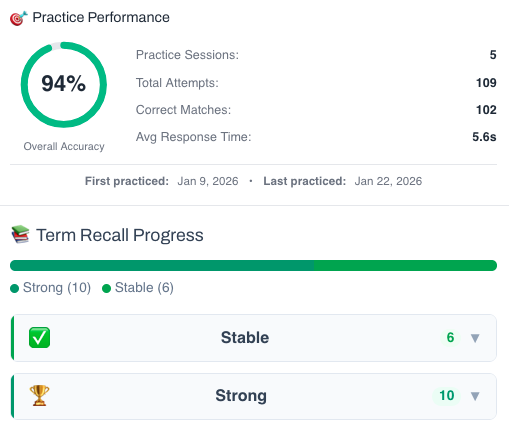
This isn’t a simple quiz — it’s a fully tracked learning system. You build knowledge through recognition, then recall, and your progress feeds directly into the Integrated Practice Bar (Writing tasks, AI Chat, and more).
- Practice sessions, accuracy, and response-time tracking
- Term strength levels (Learning → Stable → Strong)
- Personal progress history for each unit
This feature is available to YSP members.
Explore Membership Benefits