Getting Worse and Worse: How to Talk About Progressive Change
Core PathWay
1 Section 1. It Just Keeps Getting Worse…
Have you ever tried to say ‘it’s getting hotter’ but wanted to show that it keeps getting hotter — every day, every week, all summer long? English has a neat pattern for exactly this.
We use comparative + and + comparative to show that something is changing continuously. The change doesn’t stop — it keeps going in the same direction. Look at these examples:
‘Prices are getting higher and higher.’
‘The weather is becoming more and more unpredictable.’
‘It usually gets hotter and hotter from June to August, then cools down.’
Many learners try to say things like ‘it gets always more hot in August’ or ‘it is more and more hot’ — but these don’t sound natural. The pattern needs the comparative form repeated: hotter and hotter, not ‘more hot and more hot’.
This structure works for all kinds of progressive change — the kind that builds up over time. Weather, prices, technology, society — wherever things are shifting, this pattern is your go-to tool.
2 Section 2. How to Form the Pattern
You already know how to make comparative adjectives. This section shows you one extra step: how to repeat them to show continuous change. The rules are simple once you see the pattern clearly.
Focus
- Short adjectives (one syllable): use -er + and + -er. Example: ‘cold → colder and colder’
- Long adjectives (two or more syllables): use ‘more and more’ + adjective. Example: ‘expensive → more and more expensive’
- Irregular adjectives follow their own comparative forms: ‘good → better and better’, ‘bad → worse and worse’
- For decreasing change, use ‘less and less’ + adjective. Example: ‘less and less affordable’
- Native speakers sometimes triple the form for strong emphasis: ‘It’s getting hotter, and hotter, and hotter.’ This is dramatic but natural in speech.
Rules
- RULE 1 — Short adjectives: repeat the -er form. ‘cheap → cheaper and cheaper’. Do NOT say ‘more and more cheap’.
- RULE 2 — Long adjectives: use ‘more and more’ once before the adjective. Do NOT repeat the adjective: ‘more and more expensive’ ✓ — NOT ‘more expensive and more expensive’ ✗.
- RULE 3 — Irregular forms: use the correct comparative, not the base form. ‘worse and worse’ ✓ — NOT ‘worst and worst’ ✗ and NOT ‘bad and bad’ ✗.
- RULE 4 — ‘Less and less’: place it before the adjective only. ‘less and less reliable’ ✓ — NOT ‘less reliable and less reliable’ ✗.
- RULE 5 — Never mix ‘more and more’ with an -er form: ‘more and more bigger’ ✗ — say ‘bigger and bigger’ ✓.
Examples
- The summers are getting hotter and hotter — it’s hard to sleep at night.
- Food is becoming more and more expensive, and people are finding it harder to manage.
- People are doing less and less physical activity, and it’s affecting their health.
Common mistake
3 Section 3. Tenses That Show Change in Progress
The comparative + comparative pattern works with different tenses. The tense you choose tells the listener when the change is happening. Two tenses are especially useful here.
Focus
- Present simple: describes seasonal or cyclical change — things that happen regularly. Example: ‘It usually gets busier and busier in December.’
- Present continuous (is/are + -ing): describes a change happening right now, in this moment or period. Example: ‘Traffic is getting worse and worse — let’s take a different route.’
- Present perfect continuous (has/have been + -ing): describes a change that started in the past and is still continuing now. Example: ‘Rents have been getting higher and higher for the past three years.’
Rules
- Use present simple for regular or seasonal patterns: ‘Prices always get higher and higher in summer.’
- Use present continuous for a change happening now or in the current period: ‘Life is becoming more and more stressful.’
- Use present perfect continuous to connect past and present: ‘Things have been getting more and more expensive since last year.’ This shows the change started before now and hasn’t stopped.
Examples
- It usually gets colder and colder from November onwards, then warms up again in March. [present simple — seasonal cycle]
- The cost of living is getting higher and higher — many families are really struggling now. [present continuous — change happening now]
- Salaries have been getting less and less competitive compared to inflation over the past decade. [present perfect continuous — ongoing change from the past]
Common mistake
4 Section 4. Isn’t Everything Just Getting Worse?
Two friends — Sam and Jordan — meet for coffee. They start talking about life today. Neither of them is very happy about it.
💬 Dialogue 1: Everything’s Getting Worse
A coffee shop. Two friends catching up on a weekday morning.
Sam: “Honestly, have you noticed how expensive everything is getting? My weekly shopping bill is getting higher and higher — it’s almost double what it was two years ago.”
Jordan: “Tell me about it. And it’s not just food. Rent, transport, energy bills — everything is becoming more and more unaffordable. I don’t know how people manage.”
Sam: “Exactly. And the cost of living just keeps going up. I’ve started checking every price before I buy anything. It’s getting more and more stressful just to do basic things.”
Jordan: “Same here. I used to save a little money every month, but that’s becoming harder and harder. Last month I actually had nothing left at the end of the month. Nothing.”
Sam: “And the streets feel less and less safe at night. I used to walk home without thinking about it. Not anymore. I take a taxi now, which costs even more money, of course.”
Jordan: “It’s a vicious circle, isn’t it? Everything is connected. The cost of living goes up, people have less money, and life becomes worse and worse for ordinary families. It really worries me.”
Sam: “And working life isn’t helping either. My commute is getting longer and longer because I had to move further out of the city. I’m spending more and more time just getting to work and back.”
Jordan: “I hear you. And people are becoming less and less patient with each other because of all this pressure. Have you noticed that? Everyone seems more stressed than before.”
Sam: “Definitely. I just hope things don’t keep getting worse and worse. At some point, something has to change. Anyway, at least this coffee is still good — and it had better stay that way.”
5 Section 5. Or Is Life Actually Getting Better?
Not everyone agrees that things are getting worse. Here, a journalist interviews a guest who has a more optimistic view of modern life.
💬 Dialogue 2: The Case for Optimism
A podcast interview. The host, Alex, talks to a researcher named Chris about whether modern life is really as bad as people think.
Alex: “So Chris, everyone seems to be saying that life is getting worse and worse. Do you actually believe that?”
Chris: “Not at all. I think we focus on the negatives too much. Take travel, for example. Flights are becoming more and more affordable, so people are able to see the world in a way that simply wasn’t possible for previous generations. Low-cost travel has completely changed people’s lives.”
Alex: “That’s an interesting point. But what about work? A lot of people feel that jobs are getting more and more stressful. How do you respond to that?”
Chris: “That’s a fair point, and I won’t pretend stress isn’t real. But think about what technology has done for flexibility. Work is becoming less and less routine. People can work from home, choose their hours, and use tools that make their jobs easier. That’s a real improvement in quality of life for many people.”
Alex: “You mentioned technology. Some people worry that automation is making jobs disappear. Is that getting worse and worse, or is there another way to look at it?”
Chris: “Automation is a real change, yes. But historically, new technology has always created new kinds of work. And the tools themselves are getting better and better — they are helping people do more creative and meaningful work, rather than replacing them completely. I think the picture is more complex than people fear.”
Alex: “What about connection? Some researchers say people are becoming more and more isolated, even though we have more technology than ever. What’s your view on that?”
Chris: “That’s a really important question. Yes, loneliness is a problem in some communities. But globally, people are becoming more and more connected. We can communicate instantly with someone on the other side of the world. Communities are forming online around shared interests. I think connection is actually easier and easier to find — if you know where to look.”
Alex: “So your overall view is that quality of life is actually getting better and better, even if it doesn’t always feel that way?”
Chris: “Exactly. I’m not saying everything is perfect — far from it. But the data shows that on many important measures, life has been improving steadily. We live longer, we travel more, we are more and more connected to each other. The challenge is to keep that progress going and make sure everyone benefits from it, not just some people.”
6 ✍️ Writing Task
– Is the cost of living getting higher and higher where you live? What is becoming more and more expensive?
– Can you think of something in your life that has been getting better and better recently? What about something that is getting worse and worse?
– Some people say modern life is becoming more and more stressful. Do you agree, or do you think things are getting easier and easier in some ways?
Try to use the structure 'comparative adjective + and + comparative adjective' (e.g. better and better, more and more difficult) at least three times in your paragraph.
Write around 100 words.
Start your response like this:
In some ways, modern life is getting better and better, but in other ways,
7 Recap: What You’ve Learned
Here’s a quick summary of the key ideas from this page.
The comparative + and + comparative pattern shows that something is changing continuously — it doesn’t stop. Short adjectives repeat the -er form: hotter and hotter, cheaper and cheaper. Long adjectives use more and more before the adjective — just once: more and more expensive, not more expensive and more expensive. For things that are decreasing, use less and less: less and less affordable.
The tense you use matters. Present simple describes regular or seasonal patterns. Present continuous shows a change happening right now. Present perfect continuous shows a change that started in the past and is still going.
And remember — the pattern works in both directions. Things can get worse and worse, but they can also get better and better. The structure is the same; only the adjective changes.
Member-Exclusive Practice Bar
Access a wide range of integrated practice for this unit — from Vocabulary and Grammar activities to AI-curated Writing tasks and Thematic Chat practice.
This feature is available to YSP members.
Explore Membership BenefitsMember-Exclusive Vocabulary Review & Acquisition System
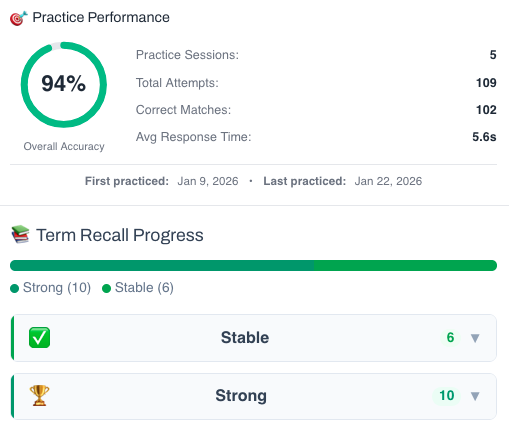
This isn’t a simple quiz — it’s a fully tracked learning system. You build knowledge through recognition, then recall, and your progress feeds directly into the Integrated Practice Bar (Writing tasks, AI Chat, and more).
- Practice sessions, accuracy, and response-time tracking
- Term strength levels (Learning → Stable → Strong)
- Personal progress history for each unit
This feature is available to YSP members.
Explore Membership Benefits