The Language of Agricultural Buildings
Core PathWay
1 Section 1. Welcome to the Farm — The Heart of It All
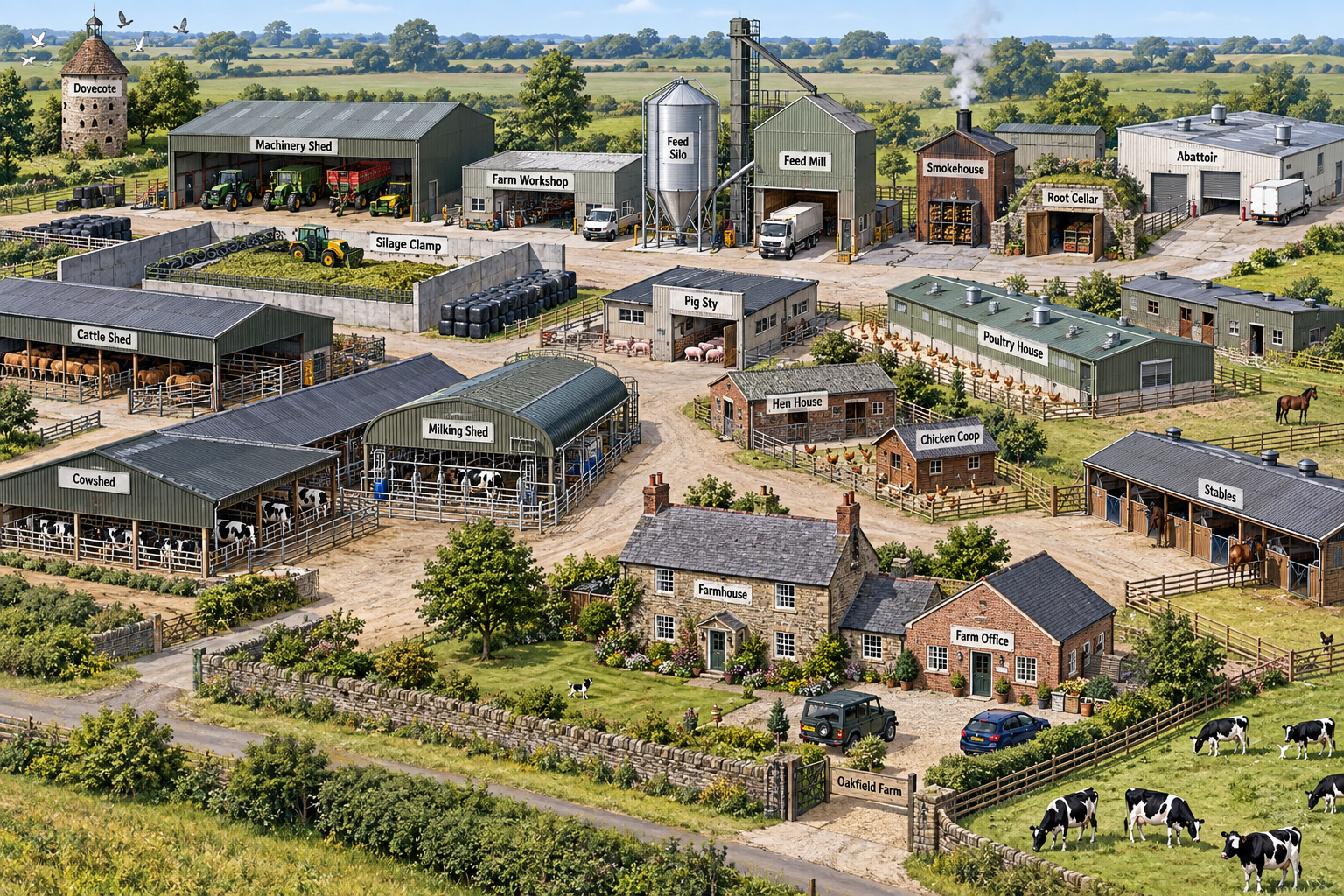
Ready to build your vocabulary for agricultural buildings? Here’s where we start. Every working farm has a central building where the farming family lives. This is the farmhouse. It is usually the oldest building on the farm, and it sits at the centre of all farm activity. Close to the farmhouse, you will often find a farm office. This is where the farmer manages paperwork, keeps records, and runs the business side of farming. Think of it as the admin hub of the whole operation. Farmers also need somewhere to repair tractors and other equipment. That place is the farm workshop. It usually has tools, spare parts, and a workbench. Next to it, or nearby, you will often see a machinery shed — also called an equipment shed. This is a large, open-sided building where tractors, ploughs, and other big machines are stored when they are not in use. These four buildings — the farmhouse, office, workshop, and machinery shed — form the core of most farm sites. They keep the people, the paperwork, and the machines all in one place.
2 Section 2. Housing the Animals — Livestock Buildings
Farms that keep animals need the right buildings for each type of animal. A stable is a building for horses. Horses are kept in individual stalls inside the stable, and each stall has bedding and a feeding area. For cattle — cows and bulls — farmers use a cowshed, also called a cattle shed. This is where cattle shelter, eat, and rest, especially in winter. When it is time to collect milk from dairy cows, the farmer moves them to a milking parlour. This is a specialist room with milking equipment attached to each cow. The fresh milk then goes to the dairy, which is a room or small building where milk is cooled, stored, and sometimes processed into butter or cheese. Pigs live in a pigsty — a small, enclosed pen that is easy to clean. Chickens and other birds need their own space too. A hen house — also called a chicken coop — is a small shelter where hens sleep and lay eggs. For larger numbers of birds kept for eggs or meat, farmers use a poultry house. When the birds are raised specifically for meat, the building is called a broiler house. This is a long, controlled-environment building where temperature and light are carefully managed.
3 Section 3. Storing the Harvest — Crop and Feed Buildings
After harvest, farmers need safe places to store what they have grown. A granary is a traditional building used to store grain — wheat, barley, or oats, for example. Granaries are often raised off the ground to keep the grain dry and away from rats. A more modern solution is the silo. A silo is a tall, cylindrical tower used to store grain or other dry materials. You will often see several silos standing together on large farms. For very large amounts of grain, especially at a regional or commercial level, farmers use a grain elevator. This is a tall facility that lifts grain upward using mechanical equipment, so it can be loaded into storage or transport vehicles. Not all stored crops are dry. Farmers also store silage — fermented grass or other green crops used as animal feed. Silage is kept in a silage clamp, which is a large, open-sided concrete bay covered with plastic sheeting to keep air out. Root vegetables like potatoes, carrots, and turnips are stored in a root cellar. This is an underground or partly underground room that stays cool and dark, which keeps the vegetables fresh for months. Animal feed that is mixed and processed on the farm is produced in a feed mill — a building with grinding and mixing machinery.
4 Section 4. Processing and Specialist Buildings
Some farm buildings are used to process or prepare products rather than just store them. A smokehouse is a small building where meat or fish is preserved by exposing it to smoke for a long time. Smokehouses are traditional structures, and many are still used on small farms today. A corn crib is a traditional American farm building used to store ears of corn. It has slatted walls — walls with gaps — so that air can pass through and dry the corn naturally. An oast house is a very distinctive building, especially in the south of England. It has a round or square tower with a cone-shaped roof. Oast houses were used to dry hops — a plant used in making beer. Many oast houses today have been converted into homes. A dovecote is a small, decorative structure built to house doves or pigeons. Historically, doves were kept for their meat and their eggs. Dovecotes are often made of stone or brick and have many small holes for the birds to enter. Finally, an abattoir — also called a slaughterhouse — is a facility where animals are killed and prepared for meat production. This is a regulated, professional environment, and it is not always located on the farm itself.
5 Section 5. Growing Under Cover — Protected Cultivation Structures
Not all farm structures are made of brick or wood. Some are designed to protect growing plants from cold weather, wind, or pests. A polytunnel is a large tunnel-shaped structure covered with thick plastic sheeting. Farmers use polytunnels to grow vegetables, fruit, and flowers in a controlled environment. They are cheaper to build than glass structures, and they extend the growing season significantly. A greenhouse — also called a glasshouse — is a permanent structure with glass or clear plastic walls and roof. Greenhouses are used to grow plants that need warmth and light all year round, such as tomatoes, cucumbers, and ornamental plants. The key difference between a polytunnel and a greenhouse is the material and the permanence. A polytunnel is temporary and flexible. A greenhouse is a fixed building. Both are common on modern farms and market gardens. Notice that British farmers tend to say glasshouse while the word greenhouse is more widely used internationally — both refer to the same type of structure.
6 Section 6. Shelter and Support — Field and Welfare Structures
Away from the main farm buildings, animals in fields also need protection. A field shelter is a simple, three-sided structure placed in a field to give animals — usually horses or cattle — protection from rain, wind, and strong sun. It has no door, so animals can walk in and out freely. Field shelters are often made of wood and can sometimes be moved to a different part of the field. This is useful because it stops one area of ground from becoming muddy and worn. Field shelters are not the same as stables or sheds — they are much simpler and are designed for animals that live outdoors most of the time. Together, all the buildings on this page form a complete picture of a working farm. Each structure has a specific job, and the words that name them are used every day by farmers, vets, agricultural students, and rural planners. Now you have met all 26 terms. You are ready to hear them in action.
7 Section 7. Now Hear It in Use
You have met all the key terms for agricultural buildings. Now hear them working in a real conversation. Listen to how two speakers use these words naturally as they discuss a farm inspection, and pay attention to how the building names come up in context.
💬 Dialogue 1: The Farm Inspection
Priya is an agricultural surveyor visiting Callum’s farm for a routine inspection. They are walking around the farm site together, checking buildings and making notes for an official report.
Priya: “Right, Callum, let’s start with the main site. I can see the farmhouse and what looks like a machinery shed over to the left — is that where you keep the tractors?”
Callum: “Yes, that’s right. The big one holds the tractors and the plough. There’s a farm workshop attached to the back — that’s where we do all the repairs. It saves us a lot of time in busy periods.”
Priya: “Good. And the grain storage — I noticed two silos on the way in. Do you also use a granary, or has that been taken out of use?”
Callum: “The silos are our main storage now — we put the wheat and barley straight in there after harvest. The old granary is still standing, but we only use it for smaller amounts of seed grain that we keep back for planting. It’s a listed building, so we can’t knock it down even if we wanted to.”
Priya: “Understood. I’ll need to inspect both. Now, moving on to the livestock side — I can see a large building over there near the yard. Is that the cowshed?”
Callum: “That’s the cattle shed, yes. We keep the beef herd in there over winter. The milking parlour is the smaller building just behind it — we milk twice a day, so it gets a lot of use. I had it refitted about three years ago.”
Priya: “Good. I’ll check the drainage in the milking parlour — that’s usually where we find the most issues. What about silage? I didn’t see a silage clamp on the plan I was given.”
Callum: “It’s around the back, on the north side of the yard. We built a new silage clamp two years ago — it’s a covered one, which keeps the quality much better. The old open clamp is still there, but we stopped using it.”
Priya: “I’ll add both to the site plan. Now, I noticed a polytunnel further up the track — is that used for crops, or does it serve another purpose?”
Callum: “We use it for growing salad crops and early vegetables — it extends the season by about six weeks. There’s also a pigsty just behind it, which might look a bit out of place, but the pigs help clear the ground between growing cycles. It’s a small operation, just twelve sows.”
Priya: “That’s actually a good system. One last thing for this part of the inspection — I can see a small open-sided structure in the far field. Is that a field shelter for the horses?”
Callum: “Yes, that’s right. We have four horses, and they use that field shelter when the weather turns. There’s one more thing I should mention — we don’t have an abattoir on site. We use a licensed facility about twelve miles away for all our slaughter work. I know that sometimes comes up in these reports.”
Member-Exclusive Practice Bar
Access a wide range of integrated practice for this unit — from Vocabulary and Grammar activities to AI-curated Writing tasks and Thematic Chat practice.
This feature is available to YSP members.
Explore Membership BenefitsMember-Exclusive Vocabulary Review & Acquisition System
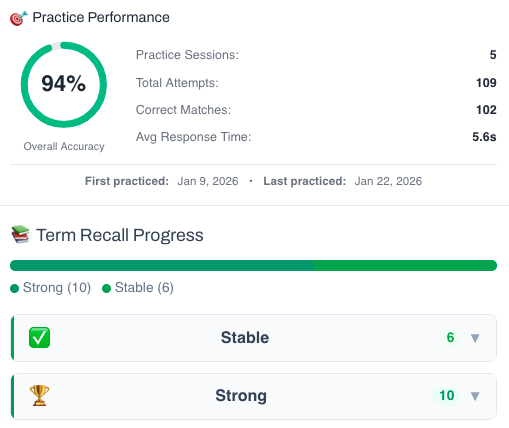
This isn’t a simple quiz — it’s a fully tracked learning system. You build knowledge through recognition, then recall, and your progress feeds directly into the Integrated Practice Bar (Writing tasks, AI Chat, and more).
- Practice sessions, accuracy, and response-time tracking
- Term strength levels (Learning → Stable → Strong)
- Personal progress history for each unit
This feature is available to YSP members.
Explore Membership Benefits