The Language of Ports and Harbours
Core PathWay
1 Section 1. Welcome to the Port — The Big Picture
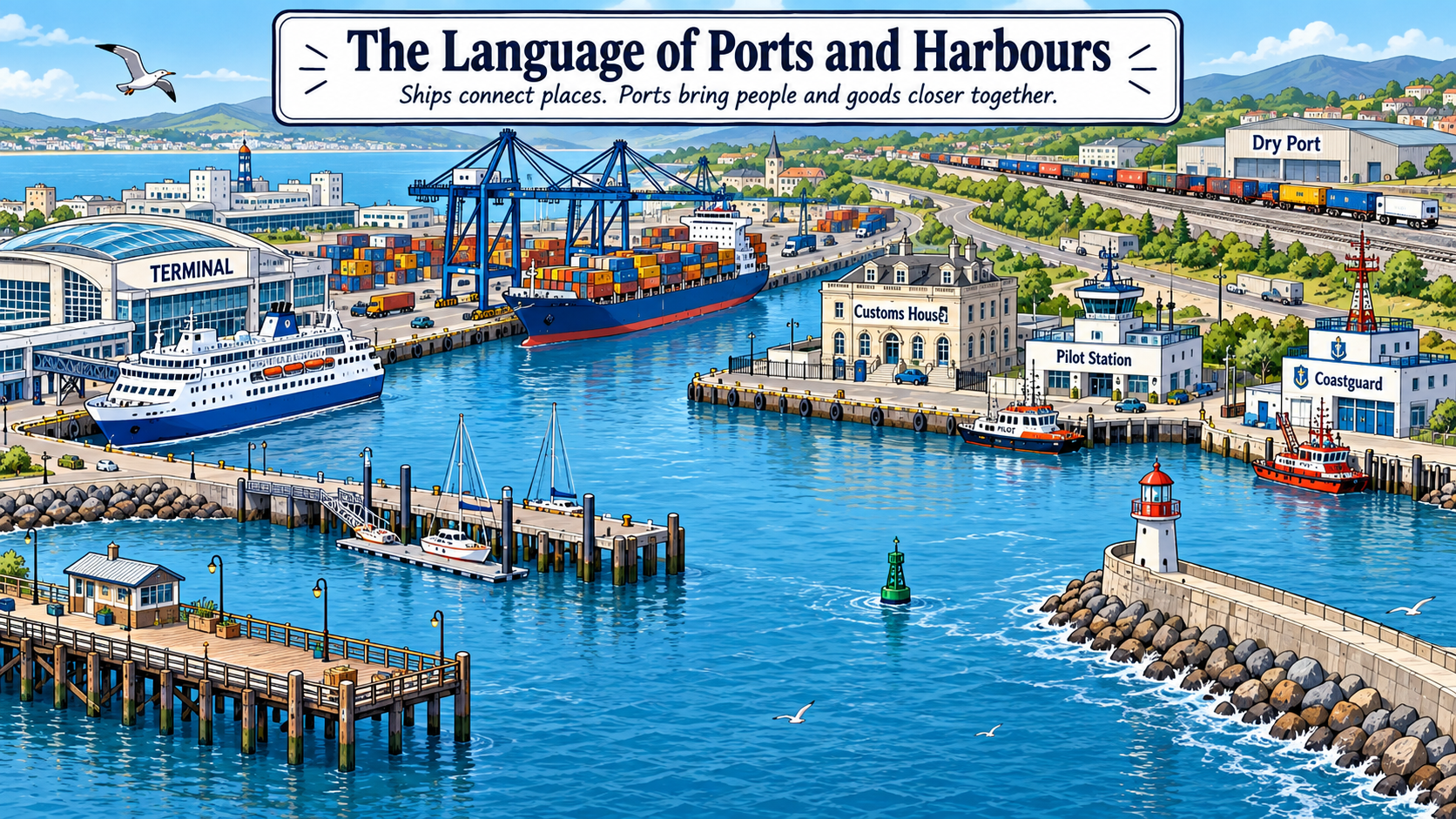
Ready to build your vocabulary for ports and harbours? Here is where we start. First, let’s look at the two most important words. A harbour is a sheltered area of water where ships can stay safely. It is protected from wind and waves. A port is bigger. A port is a harbour that has the facilities for loading and unloading cargo or passengers. In other words, all ports are harbours, but not all harbours are ports. Think of a harbour as the safe water, and a port as the working place around that water. Commercial ports are busy, organised places. They have many different zones and buildings, each with a specific job. The next sections will walk you through those zones, one group at a time.
2 Section 2. Where Ships Come In — Terminals and Berths
When a ship arrives at a port, it goes to a terminal. This means a dedicated area of the port where a specific type of cargo or passenger service is handled. Large ports often have several terminals. A container terminal is where containers — the large metal boxes used to transport goods — are loaded and unloaded. A bulk terminal handles loose cargo such as grain, coal, or ore. A ro-ro terminal is for roll-on, roll-off ships. These are ships that carry vehicles, which drive on and off the ship directly. The name ‘ro-ro’ comes from this action. Inside each terminal, a ship needs a place to stop and tie up. That place is called a berth. The berth is the specific spot where a ship docks. A ship is said to be ‘at berth’ when it is tied up and ready to load or unload. A ferry terminal is a special type of terminal for passenger ferries. It often includes waiting areas, ticket offices, and vehicle lanes.
3 Section 3. Along the Water’s Edge — Quays, Wharves, Piers, and Jetties
The edge of the water at a port has several names, and each one is slightly different. A quay is a flat, solid platform built along the edge of the water. Ships tie up alongside a quay to load and unload. The word quayside simply means the area next to the quay — the ground beside it. A wharf is very similar to a quay. It is also a platform where ships dock, but the word ‘wharf’ is more common in older ports and in some regions. In practice, ‘quay’ and ‘wharf’ are often used to mean the same thing. A pier is a structure that goes out into the water from the shore. Ships can tie up on both sides of a pier. A jetty is smaller. It is a short structure that sticks out into the water, often used for smaller boats or for guiding ships into a harbour entrance. The key difference to remember: a quay runs along the shore, while a pier or jetty goes out into the water.
4 Section 4. Keeping Ships Safe — Walls, Lights, and Locks
Ports need strong structures to protect ships from the sea. A breakwater is a large barrier built in the water. It blocks strong waves and keeps the harbour calm. A seawall is similar, but it is built along the shore. It protects the land and the port buildings from the sea. A harbour wall is the solid wall that encloses the harbour. It keeps the water inside calm and safe. At the entrance to a harbour, you will often see a lighthouse. This is a tall tower with a bright light at the top. It warns ships of danger and helps them find the harbour entrance at night or in bad weather. Some ports also have a sea lock, which is also called a ship lock. This is a structure that controls the water level between the sea and the harbour. Ships enter the lock, the water level is adjusted, and then the ship moves into the harbour. This is useful in places where the sea level changes a lot with the tide. A quay crane — also called a container crane — is the large machine used to lift containers on and off ships at a container terminal. These cranes are very tall and are one of the most recognisable features of a modern port.
5 Section 5. Behind the Scenes — Yards, Warehouses, and Inland Depots
Not everything at a port happens at the water’s edge. There are important areas and buildings further inside the port. A container yard is an open area where containers are stored while they wait to be loaded onto a ship or collected by a truck. It is often a very large, busy space with rows of containers stacked on top of each other. A bonded warehouse is a secure storage building. Goods inside a bonded warehouse have not yet gone through customs. This means the owner has not yet paid import tax on them. The goods are ‘bonded’ — held securely — until customs duties are paid. A dry port — also known as an inland container depot — is a facility that is not at the coast. It is located inland, away from the sea. It works like a port terminal, but goods travel to and from the sea port by road or rail. Dry ports help to reduce congestion at busy sea ports.
6 Section 6. The People in Charge — Offices and Stations
A busy port needs many people and organisations to keep it running safely. The customs house is the official building where customs officers work. They check what is coming into or going out of the country and collect any taxes or duties. The harbour master’s office is where the harbour master works. The harbour master is the person in charge of the whole port. They control the movement of ships in and out of the harbour. The pilot station is where maritime pilots wait. A pilot is an expert who boards a ship and guides it safely into or out of the harbour. Pilots know the local waters very well — the shallow areas, the currents, and the best routes. The coastguard station is where the coastguard team is based. The coastguard is responsible for safety at sea. They respond to emergencies, rescue people in danger, and monitor shipping in the area.
7 Section 7. Now Hear It in Use
You have met all 25 terms. Now hear them working in a real conversation. Listen to how two port professionals use this vocabulary naturally — notice which terms come up, and how they fit into everyday professional talk.
💬 Dialogue 1: A Tour of the New Terminal
Marta, a logistics coordinator, is visiting a large commercial port for the first time. She is being shown around by Dan, a port operations manager. They are walking through the port and Marta is asking questions about the facilities.
Dan: “Welcome, Marta. Let’s start at the container terminal — it’s the busiest part of the port. Those cranes you can see are our quay cranes. They run around the clock.”
Marta: “They’re enormous. So is each crane assigned to a specific berth, or do they move along the quayside?”
Dan: “Each crane covers two or three berths, depending on the size of the vessel. Over there is the container yard — that’s where boxes wait after they come off the ship. Some go straight to the bonded warehouse if customs clearance isn’t finished yet.”
Marta: “I see. So the bonded warehouse is basically a holding area for cargo that hasn’t cleared customs yet? And who controls access to it — port staff or customs officers?”
Dan: “Both, in practice. Customs officers have authority over what goes in and out, but our port staff manage the day-to-day operations inside. If you need to release cargo from the bonded warehouse, you have to submit the right documentation first. Now, shall we walk along the quayside towards the ro-ro terminal? It’s quite different from what you’ve seen so far.”
Marta: “Yes, let’s. I’ve heard the term ro-ro before, but I’m not completely sure what makes it different from a standard container terminal. Could you explain?”
Dan: “Of course. Ro-ro stands for roll-on, roll-off. Vehicles — cars, trucks, heavy machinery — are driven directly onto the ship and driven off again at the other end. There are no cranes involved. You can see the ramps at the end of each berth over there. It’s a much faster process for that type of cargo.”
Marta: “That makes sense. So the ro-ro terminal handles vehicles and wheeled cargo, while the container terminal handles boxes that are lifted by crane. What about bulk cargo — things like grain or coal? Is there a separate terminal for that?”
Dan: “Good question. Yes, we have a bulk terminal on the eastern side of the port. It handles dry bulk like grain and fertiliser, and we also have capacity for liquid bulk — fuel and chemicals, mainly. It’s completely separate from the container and ro-ro operations. Now, before we head over there, let me show you the harbour master’s office. It’s just up here on the right.”
Marta: “Is the harbour master responsible for the whole port, or just for vessel movements? And is there a pilot station nearby? I noticed a small boat heading out earlier and wondered if that was a pilot vessel.”
Dan: “The harbour master oversees all vessel movements and safety within the port. The pilot station is right next to the harbour master’s office — that’s where the marine pilots wait before they board incoming ships to guide them in. The breakwater out there protects the harbour entrance, so conditions inside are usually calm enough for safe navigation. We also work closely with a dry port about fifteen kilometres inland — cargo can be transferred there by rail for customs processing and onward distribution.”
Marta: “So the dry port is essentially an inland extension of the port — cargo can be cleared and distributed from there without coming back through here? That would make a big difference for our supply chain. I think I have a much clearer picture of how everything fits together now. Thank you, Dan.”
Member-Exclusive Practice Bar
Access a wide range of integrated practice for this unit — from Vocabulary and Grammar activities to AI-curated Writing tasks and Thematic Chat practice.
This feature is available to YSP members.
Explore Membership BenefitsMember-Exclusive Vocabulary Review & Acquisition System

This isn’t a simple quiz — it’s a fully tracked learning system. You build knowledge through recognition, then recall, and your progress feeds directly into the Integrated Practice Bar (Writing tasks, AI Chat, and more).
- Practice sessions, accuracy, and response-time tracking
- Term strength levels (Learning → Stable → Strong)
- Personal progress history for each unit
This feature is available to YSP members.
Explore Membership Benefits