Airports: The Built Infrastructure
Core PathWay
1 Section 1. The Heart of the Airport: Terminals and Concourses
Ready to build your vocabulary for airport infrastructure? Here’s where we start.
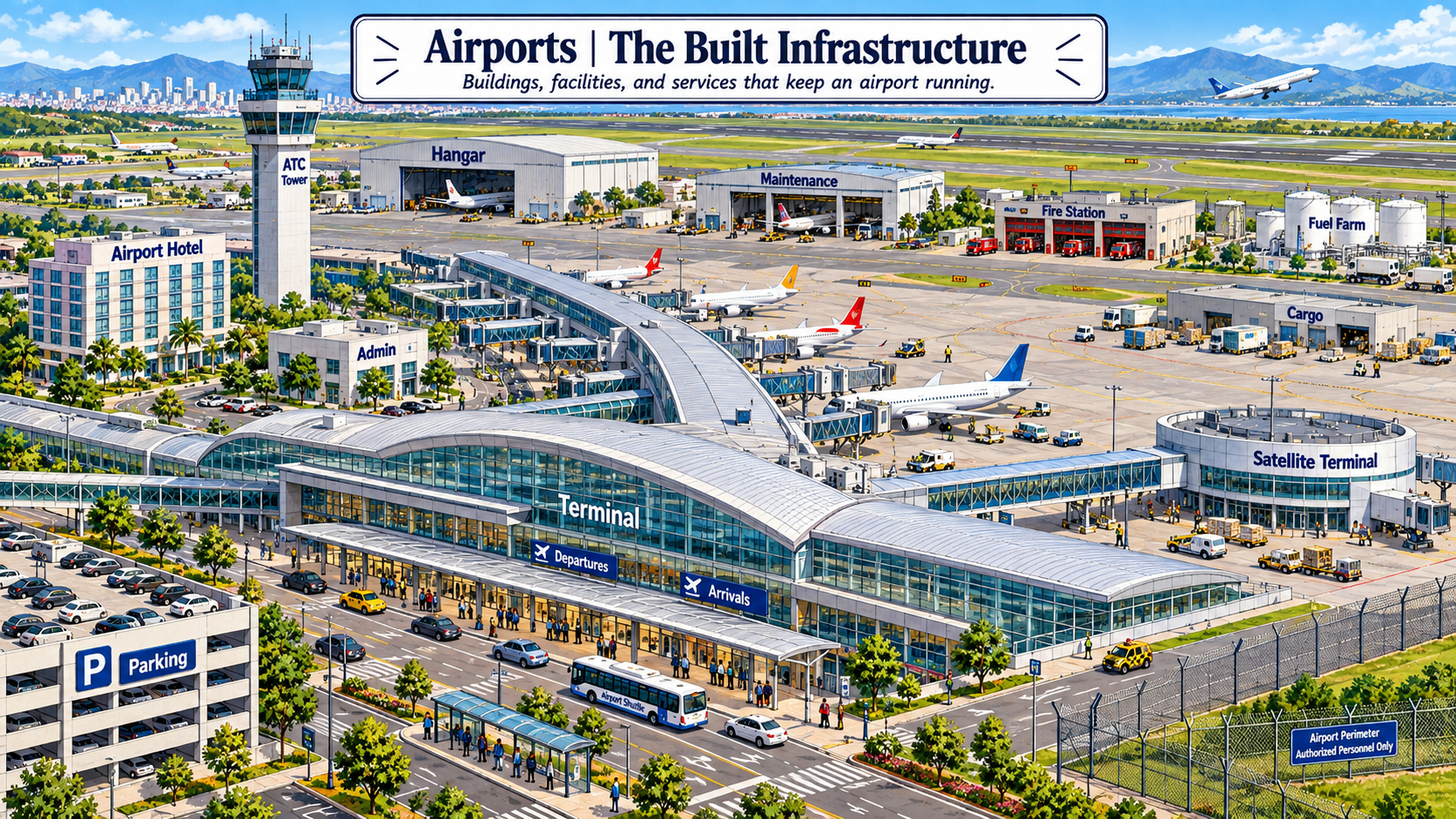
Every airport has at least one terminal. This is the main building where passengers check in, go through security, and wait for their flights. Large airports often have more than one terminal.
Inside the terminal, you will usually find a concourse. This is a long corridor or open area with gates on both sides. Passengers walk through the concourse to reach their departure gate.
Some airports are very large. They use a finger pier to connect the concourse to the aircraft parking area. A finger pier is a long, narrow extension of the terminal building. It has gates along its sides.
When an airport is too big for one building, it may have a satellite terminal. This is a separate building away from the main terminal. Passengers travel to it by bus, train, or underground walkway.
Smaller airports or airports with many private and charter flights often have a general aviation terminal. This is a separate building for private aircraft, not commercial airline flights.
For very important passengers — government officials or business executives, for example — some airports have a VIP terminal. This is a private, quiet building with special services and separate security.
2 Section 2. Getting on the Plane: Jetways and the Apron
So passengers are at the gate. How do they actually get onto the plane?
The answer is usually a jetway. This is a covered, moveable bridge that connects the terminal gate directly to the aircraft door. Passengers walk through it without going outside. You might also hear it called a ‘jet bridge’ or ‘airbridge’ — these all mean the same thing.
Not every airport uses jetways. At some airports, passengers walk across the apron — the open area outside — and climb steps to board the plane. This is common at smaller airports.
High above the terminal and apron, you will see the control tower. This tall building is where air traffic controllers work. They use radio and radar to guide aircraft safely in and out of the airport. The control tower has a clear view of the runways and apron.
Nearby, you will often find a fire station. Airport fire stations are not the same as city fire stations. They have special vehicles and equipment designed to deal with aircraft emergencies quickly. At busy airports, the fire station must be very close to the runways.
3 Section 3. Keeping Aircraft Flying: Hangars and Maintenance
Aircraft need regular care and repair. Several important buildings exist just for this purpose.
A hangar is a very large building where aircraft are stored or worked on. The word comes from an old French word meaning ‘shelter’. Hangars have very wide doors so that aircraft can move in and out easily.
Some hangars are used for serious technical work. An MRO facility is a building — or a group of buildings — where engineers carry out maintenance, repair, and overhaul work on aircraft. ‘MRO’ stands for Maintenance, Repair and Overhaul. Airlines send their aircraft here when they need detailed technical checks.
Another specialist building is the de-icing hangar. In cold weather, ice can form on an aircraft’s wings and body. This is dangerous. The de-icing hangar is where aircraft go to have ice removed before departure. Special fluid is sprayed onto the aircraft to clear the ice and stop it forming again.
For smaller private aircraft and charter operations, the airport may also have an FBO building. FBO stands for Fixed Base Operator. This building provides fuel, parking, and other services for private and business aircraft. Think of it as a private terminal combined with a service centre.
4 Section 4. Moving Cargo and Fuel: Freight and Supply Facilities
Airports are not just for passengers. A large amount of goods travels by air every day.
The air freight terminal is the building where cargo — goods sent by air — is processed. Staff here check, weigh, and record packages and shipments before they are loaded onto aircraft.
Connected to this, or nearby, you will find a cargo warehouse. This is a large storage building where goods are kept before or after a flight. Some cargo warehouses are temperature-controlled for food or medicine.
Aircraft also need a lot of fuel. Airports store this fuel in a fuel farm. This is an area — usually away from the main terminal for safety — where large fuel tanks are kept. Fuel is pumped from here through underground pipes to the aircraft parking stands.
Passengers need food and drink on their flights too. This is prepared in a catering facility. This large kitchen building produces thousands of meals every day. Delivery vehicles take the food from here directly to the aircraft before departure.
5 Section 5. Passenger Services: Getting There and Staying There
Modern airports offer a lot more than just flights. Several buildings exist to make the passenger experience easier.
Most passengers arrive by car. A multi-storey car park gives them a place to leave their vehicle. This building has several floors, which means it can hold many cars in a small area of land. You will often find it connected to the terminal by a covered walkway.
If passengers need a car at their destination, they can visit the car rental centre. This is a building — or a dedicated area — where companies rent cars to travellers. Many airports have moved their car rental centres away from the terminal to save space, with a shuttle bus connecting the two.
For passengers with early morning or late-night flights, an airport hotel is very useful. This is a hotel built on or very close to the airport site. Some airport hotels are connected directly to the terminal building.
Finally, some airports have an observation deck. This is an open or glass-enclosed area, usually on the roof of the terminal, where visitors can watch aircraft take off and land. Observation decks are popular with aviation enthusiasts and families.
6 Section 6. Behind the Scenes: Operations and Support Buildings
A lot of work happens at an airport that passengers never see. Several buildings support the day-to-day running of the airport.
The baggage handling facility is where luggage is sorted and sent to the correct aircraft. This building contains a complex system of conveyor belts and scanners. When you check in a bag, it travels through this facility before it reaches the plane.
The administration building is where the airport’s management team works. This is the office building for the people who run the airport — managers, planners, finance teams, and HR staff. It is usually separate from the terminal.
Airports also need accurate weather information. A weather station on the airport site measures temperature, wind speed, visibility, and other conditions. This information is used by air traffic controllers and pilots to make safe decisions about flights.
Finally, the airport rail station connects the airport to the wider public transport network. Many major airports have their own railway or metro station, often built directly under or beside the terminal. This makes it easy for passengers to travel between the city and the airport without a car.
7 Section 7. Now Hear It in Use
You have met all 25 terms. Now hear them working in a real conversation. Listen to how two airport professionals use this vocabulary naturally as they plan a facility tour — notice especially how they describe the purpose and location of each building.
💬 Dialogue 1: The Facility Tour
Sara is a new airport operations manager. Marcus is a senior facilities coordinator who is showing her around the airport site for the first time. They are planning the route for a full facility tour.
Marcus: “OK Sara, welcome to the site. I thought we’d start at the main terminal and work our way out from there — is that fine with you?”
Sara: “That works for me. I’d especially like to see the baggage handling facility and the cargo warehouse — I’ve read about the new sorting system but I haven’t seen it yet.”
Marcus: “Absolutely, we’ll get to both of those. We should also stop by the MRO facility on the east side — the engineering team is doing a full overhaul on one of the wide-body aircraft this week, so it’s a good time to see it in action.”
Sara: “Great. And what about the concourse? I noticed on the site map that there are two of them. Do they both connect directly to the terminal building?”
Marcus: “Yes, exactly. The concourses extend out from the main terminal like arms — passengers walk through them to reach the gates. Each gate has a jetway attached, so passengers can board the aircraft directly without going outside. You’ll see that clearly when we get there.”
Sara: “That makes sense. I also want to get a look at the control tower at some point. Is it possible to go inside, or is access restricted?”
Marcus: “Access to the control tower is restricted to air traffic control staff, so we won’t be going inside. But we can stop near the base — it gives you a good view of the whole airfield, and you can see how it sits at the centre of the operation. Everything is coordinated from up there.”
Sara: “That’s fine. And I saw a large building on the north side when I drove in — it looked like it might be a hangar. Is that where aircraft are stored overnight?”
Marcus: “Good eye. That’s our main hangar — some aircraft are stored there overnight, but it’s also used for scheduled maintenance checks. Just next to it is the de-icing hangar, which is separate because the de-icing process needs its own controlled space. In winter, that building is extremely busy.”
Sara: “Interesting. And the fuel farm — where does that sit on the site? I’d imagine it has to be kept well away from the main buildings.”
Marcus: “You’re right — the fuel farm is on the far south side, well away from the terminal and the hangars. It has to meet strict safety regulations, so the location is carefully chosen. There are underground pipelines that carry fuel directly to the aircraft stands, which makes the whole process much faster than using tanker trucks.”
Sara: “That’s really efficient. OK, I think I have a good picture of the layout now. Shall we start at the terminal and work through the list from there?”
Member-Exclusive Practice Bar
Access a wide range of integrated practice for this unit — from Vocabulary and Grammar activities to AI-curated Writing tasks and Thematic Chat practice.
This feature is available to YSP members.
Explore Membership BenefitsMember-Exclusive Vocabulary Review & Acquisition System
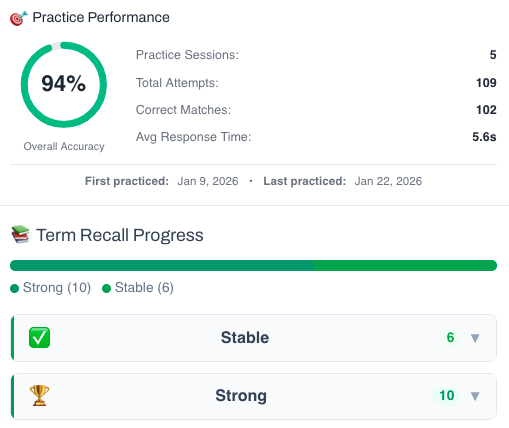
This isn’t a simple quiz — it’s a fully tracked learning system. You build knowledge through recognition, then recall, and your progress feeds directly into the Integrated Practice Bar (Writing tasks, AI Chat, and more).
- Practice sessions, accuracy, and response-time tracking
- Term strength levels (Learning → Stable → Strong)
- Personal progress history for each unit
This feature is available to YSP members.
Explore Membership Benefits