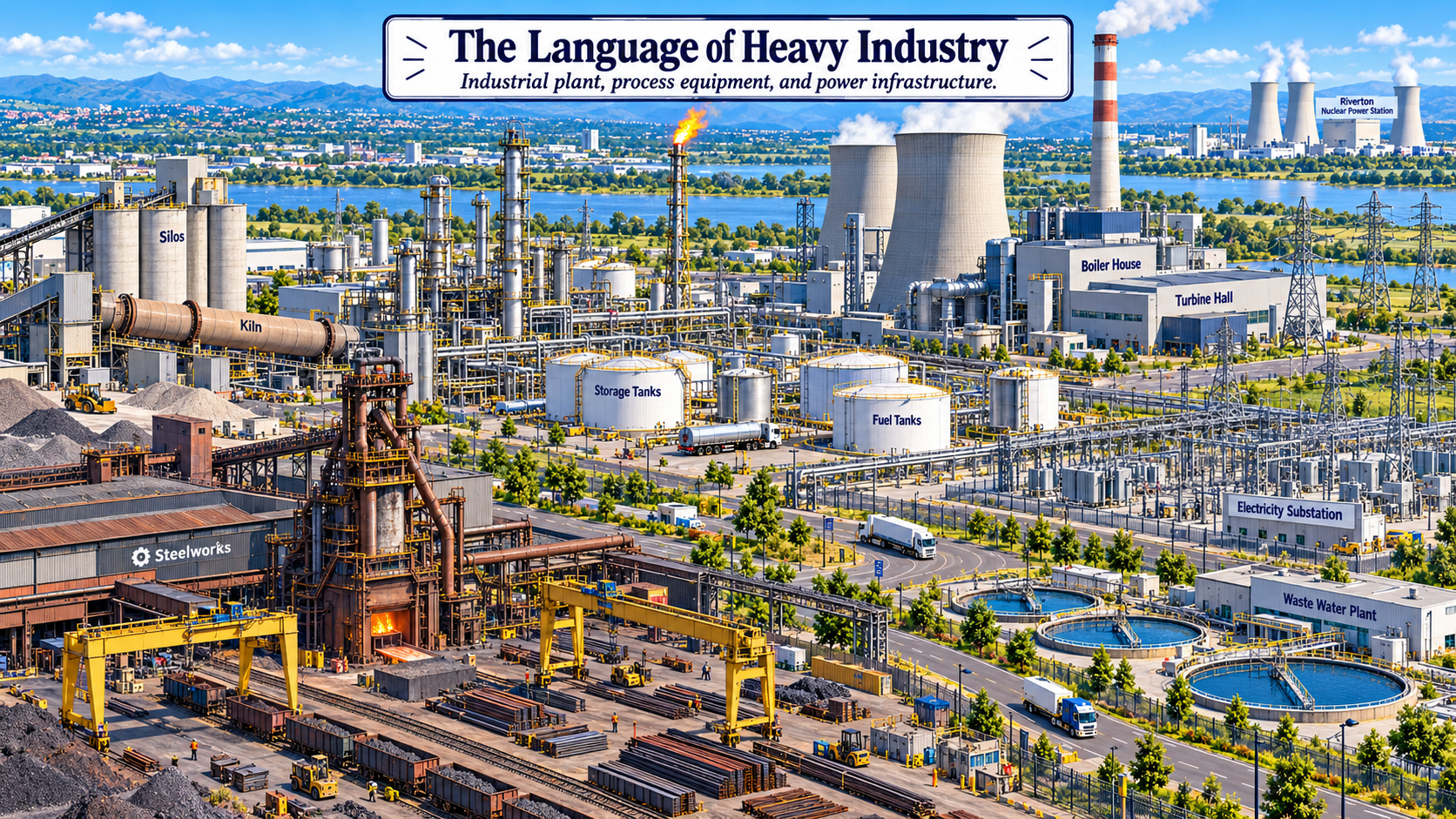
Fixed Plant, Machinery & Structures: The Language of Industrial Sites
Core PathWay
1 Section 1. Welcome to the Industrial Site
Ready to build your vocabulary for fixed plant, machinery, and structures? Here is where we start.
Large industrial sites have many different buildings, towers, and machines. Each one has a specific job. When you know the right names, you can talk about these places clearly and professionally.
Let’s begin at the top — literally. Look up at any power station or refinery and you will probably see a cooling tower. This is a very large structure, often shaped like a wide cylinder. It removes heat from water that has been used in industrial processes. The steam you see rising from it is mostly water vapour.
Nearby, you might see a smokestack. This is a tall chimney that releases gases from burning fuel. It is sometimes called a chimney stack. On oil and gas sites, you will also see a flare stack. This is different. A flare stack burns off excess gas safely, so that pressure does not build up to dangerous levels.
These three structures — the cooling tower, the smokestack, and the flare stack — are often the tallest things on a site. They are easy to spot from a distance.
2 Section 2. Storing and Moving Materials
Many industrial processes need large amounts of liquid or gas stored safely on site. Two key structures do this job.
A storage tank is a large container, usually made of steel, that holds liquids such as water, chemicals, or oil. A fuel tank is a specific type of storage tank. It holds fuel — diesel, petrol, or another fuel — that is used to run engines and generators on site.
For dry materials like grain, cement, or coal powder, sites use a silo. This is a tall, narrow tower that stores bulk materials. You open the bottom to release what is inside.
To move materials from one place to another, many sites use a conveyor belt. This is a moving belt — like a very long, flat escalator — that carries materials along a fixed route. It is used in mines, factories, and ports.
For lifting very heavy loads, sites use a gantry crane. This is a large crane that runs on rails or tracks, usually above a loading area or along a quayside. It can lift and move containers, machinery, or other heavy objects.
Finally, a pipeline carries liquids or gases over long distances through a system of connected pipes. Pipelines can run underground or above ground.
3 Section 3. Heat, Processing, and Separation
Some of the most important equipment on industrial sites uses very high heat to change materials.
A blast furnace is a very large industrial oven. It uses extremely high temperatures to melt iron ore and produce liquid metal. You find blast furnaces at steelworks and metal production plants.
A kiln is also a type of high-temperature oven, but it is used for different materials. Kilns are used to harden bricks, dry ceramics, or process cement. The word comes from an old English word for oven.
A distillation tower is a tall column used in refineries. It separates crude oil into different products — such as petrol, diesel, and kerosene — by heating the oil and collecting the vapours at different levels. This process is called distillation.
A scrubber is a piece of equipment that cleans gases before they are released into the air. It removes harmful particles and chemicals from the gas stream. This is important for environmental protection.
A boiler house is a building that contains large boilers. Boilers heat water to produce steam. That steam is then used to generate power or heat other parts of the site.
A settling tank is a large container where liquids are left to stand so that solid particles can sink to the bottom. This separates the solid waste from the liquid. You find settling tanks in water treatment plants and refineries.
4 Section 4. Power, Energy, and Transmission
Industrial sites need large amounts of electricity. Several structures are involved in generating and moving that power.
A turbine hall is a large building that contains turbines. Turbines are machines that spin to generate electricity, usually powered by steam or water. In power stations, the turbine hall is one of the most important buildings on site.
In nuclear power stations, you will hear about two specific buildings. The reactor building is where the nuclear reactor is housed. It is a very strong, thick-walled structure. The containment building is the outer protective shell around the reactor building. It is designed to contain any release of radioactive material in an emergency.
Electricity generated on site needs to travel to where it is used. A pylon is a tall metal tower that supports high-voltage electricity cables across long distances. You see pylons in lines across the countryside.
Before electricity reaches homes and businesses, it passes through an electricity substation. This is a facility that changes the voltage of electricity — either stepping it up or stepping it down — so it can be used safely.
A compressor station is a facility that increases the pressure of gas in a pipeline. This keeps the gas moving over long distances. Without compressor stations, gas pressure would drop and the gas would stop flowing.
5 Section 5. Site Operations and Support Structures
Every large site also needs structures that support the daily work of the people there.
A control room is where operators monitor and manage the whole site. It contains screens, computers, and control panels. From here, workers can see what is happening across the entire plant and respond quickly to problems.
A maintenance workshop is a building where engineers repair and service equipment. It contains tools, spare parts, and workbenches. When a machine breaks down, the maintenance workshop is where the repair work happens.
A loading bay is an area where vehicles — usually lorries or trucks — can park to load or unload goods. It is often a raised platform so that the lorry floor is at the same level as the warehouse floor.
A weighbridge is a large scale built into the ground. Lorries drive onto it so their total weight can be measured. This is important for checking that vehicles are not carrying more than the legal limit.
A water tower is a raised tank that stores water at height. The height creates water pressure, which pushes water through pipes to where it is needed. Water towers are common on industrial sites and in towns.
Finally, a derrick is a type of crane or lifting frame. On oil and gas sites, a derrick is the tall structure above a drill hole. It supports the drilling equipment and is used to raise and lower the drill string.
6 Section 6. Putting It All Together
Now you have met all the key structures. Let’s look at how they connect.
A large power station, for example, might have a turbine hall where electricity is generated, a boiler house that produces the steam to drive the turbines, a cooling tower that removes heat from the water after it has passed through the system, and a smokestack that releases gases from combustion.
A refinery might have a distillation tower to separate crude oil, a storage tank to hold the finished products, a flare stack to burn off excess gas safely, a scrubber to clean the exhaust gases, and a settling tank to treat waste water.
Across the site, a conveyor belt might move raw materials, a gantry crane might lift heavy equipment, and a pipeline might carry fuel or chemicals between buildings.
The whole site is managed from the control room. When something goes wrong, the team in the maintenance workshop responds. Lorries arrive at the loading bay and are weighed on the weighbridge before they leave.
On a nuclear site, the reactor building and containment building are the most protected structures. Power leaves the site through pylons and passes through an electricity substation before reaching the grid.
Sites in remote areas might also have a compressor station to keep gas flowing through a pipeline, a water tower for water supply, a silo for storing dry materials, and a derrick if drilling is part of the operation.
Knowing these terms means you can describe almost any heavy industrial site clearly and accurately.
7 Section 7. Now Hear It in Use
You have met the words. Now hear them working. Listen to how these two site workers use them naturally as they walk through a new facility together — notice which structures they name and how they describe what each one does.
💬 Dialogue 1: First Day on Site
Marcus is a new site engineer on his first day at a large industrial facility. Priya is a senior engineer who is giving him a site orientation walk. They are standing outside, looking across the plant.
Priya: “Right, Marcus, welcome to the site. Let’s start out here so you can get a feel for the layout. That tall structure over there — the one with the steam coming off the top — that’s our cooling tower. It handles the heat exchange for the whole west processing block.”
Marcus: “Got it. And the thinner one next to it — is that a smokestack or a flare stack? I always get those two mixed up.”
Priya: “Good question, and it matters. The smokestack is for combustion gases — it just releases them at height. The flare stack is the one with the pilot flame at the top. That burns off any excess gas from the distillation tower when pressure gets too high. You’ll see it light up at night sometimes.”
Marcus: “That makes sense. So the distillation tower is the tall cylindrical one further back — the one with all the pipework running up the side?”
Priya: “Exactly right. That’s where we separate the crude fractions — it runs continuously, twenty-four hours a day. The pipeline you can see running along the ground connects it to the storage tanks on the south side of the site. Those tanks hold the separated products before they go out for distribution.”
Marcus: “I can see a cluster of large cylindrical tanks over there. Are those the storage tanks you mean? And is there a separate fuel tank for the site’s own energy supply?”
Priya: “Yes, those are the main storage tanks for product. The fuel tank is smaller — it’s around the back of the boiler house. It feeds the site’s own heating system. Now, let’s walk towards the main building. I want to show you the control room first, because that’s where you’ll spend a lot of your time monitoring the processes.”
Marcus: “Good idea. Is the control room inside the main building, or is it in a separate structure?”
Priya: “It’s on the ground floor of the main building, yes — you can see the whole plant from the windows, which is useful. Before we go in, though, have a look up at that gantry crane above the loading bay. We use it to move heavy components between the workshop and the delivery vehicles. It saves a huge amount of manual handling.”
Marcus: “That’s impressive. And the large building just to the right of the loading bay — is that the maintenance workshop?”
Priya: “It is, yes. The maintenance workshop handles all the routine servicing and repairs for the site — everything from pump overhauls to electrical work. There’s also a weighbridge just inside the main entrance gate. Every delivery vehicle has to stop there so we can record the load weight. It’s a legal requirement.”
Marcus: “Right, so the weighbridge is the first stop for any vehicle coming onto the site. That’s good to know. I think I’m starting to get a picture of the layout — cooling tower, smokestack, flare stack, distillation tower, storage tanks, the pipeline, the control room, the gantry crane, the maintenance workshop, and the weighbridge. That’s quite a lot to take in on day one.”
Member-Exclusive Practice Bar
Access a wide range of integrated practice for this unit — from Vocabulary and Grammar activities to AI-curated Writing tasks and Thematic Chat practice.
This feature is available to YSP members.
Explore Membership BenefitsMember-Exclusive Vocabulary Review & Acquisition System

This isn’t a simple quiz — it’s a fully tracked learning system. You build knowledge through recognition, then recall, and your progress feeds directly into the Integrated Practice Bar (Writing tasks, AI Chat, and more).
- Practice sessions, accuracy, and response-time tracking
- Term strength levels (Learning → Stable → Strong)
- Personal progress history for each unit
This feature is available to YSP members.
Explore Membership Benefits