On the Ground: The Language of Airfield Infrastructure
Core PathWay
1 Section 1. Welcome to the Airfield
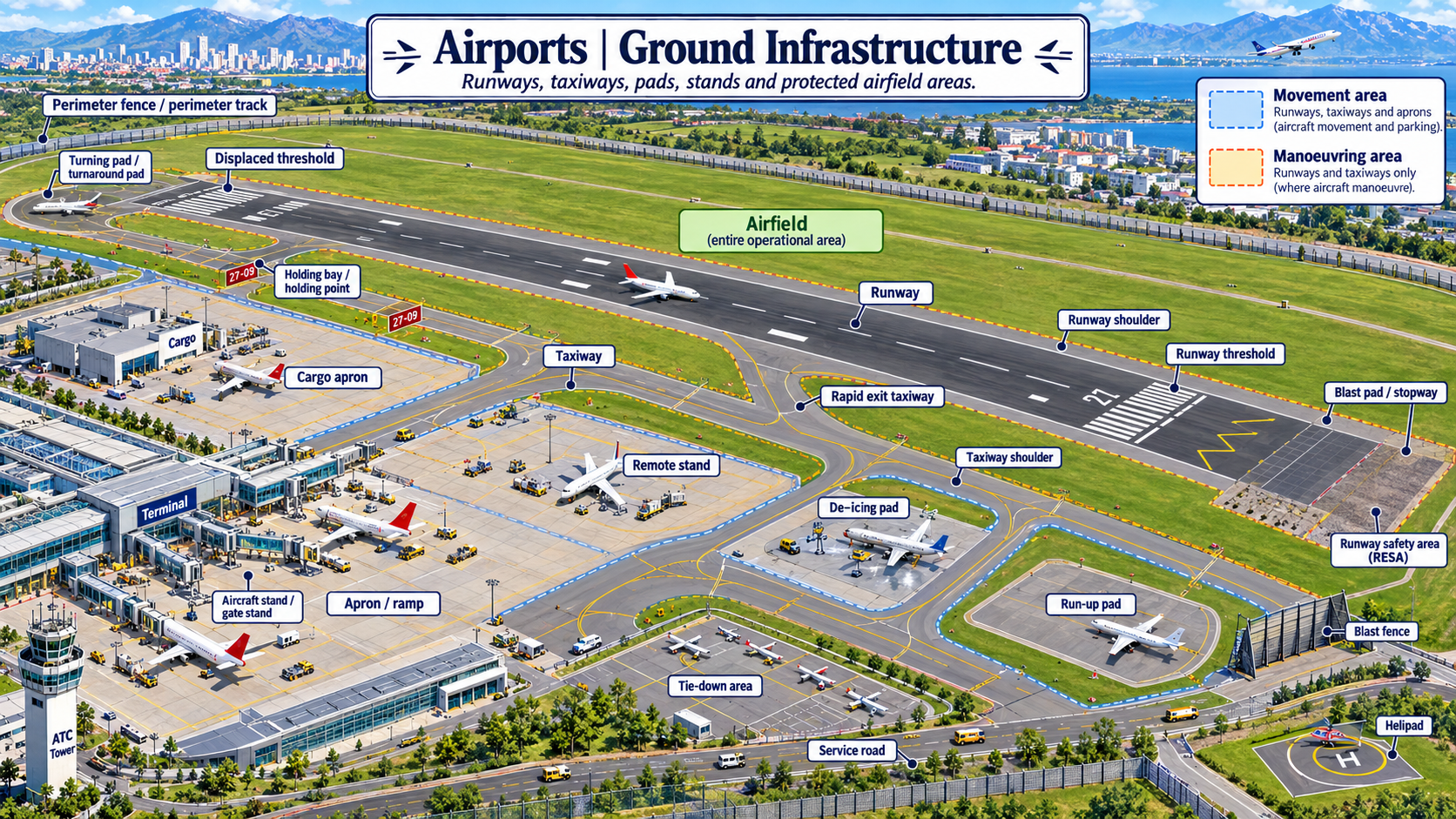
Want to talk confidently about airports? It starts with these words. The word airfield refers to the whole area used for aircraft operations — runways, taxiways, buildings, and everything in between. When we talk about the movement area, we mean the part of the airfield where aircraft actually move: the runways, taxiways, and aprons. Inside the movement area, there is a smaller zone called the manoeuvring area. This is the part where aircraft taxi, take off, and land — but it does NOT include the aprons where planes park. So the movement area is the big picture, and the manoeuvring area is the part inside it where aircraft are actively moving. Notice this difference — it comes up often in aviation contexts.
2 Section 2. Runways — More Than Just a Strip of Tarmac
The runway is the long, hard surface where aircraft take off and land. But a runway is not just one simple strip — it has several important parts. The runway threshold is the beginning of the runway — the point where landing aircraft can first touch down. Sometimes, though, the usable part of the runway does not start right at the physical beginning. In that case, there is a displaced threshold, which means the touchdown point is moved further along the runway, away from the start. Beyond the runway itself, there is the runway shoulder — a strip of ground on each side that gives extra support and prevents erosion. At the end of the runway, there may be a stopway, which is a prepared area where an aircraft can stop safely if a take-off has to be abandoned. Further out, the runway safety area (RESA) provides an extra buffer zone beyond the stopway. It is designed to reduce the risk of damage if an aircraft overruns the runway.
3 Section 3. Taxiways — The Roads of the Airfield
After landing, an aircraft does not stay on the runway — it moves off as quickly as possible. The paths it uses are called taxiways. Think of taxiways as the roads of the airfield. Like runways, taxiways also have a taxiway shoulder — a strip on each side that provides a firm edge and prevents the surface from breaking up. When an aircraft lands and needs to leave the runway quickly, it uses a rapid exit taxiway. This is a taxiway that branches off the runway at an angle, so the aircraft can turn off without slowing down too much. This keeps the runway clear for the next aircraft. Before entering a runway, aircraft sometimes wait in a holding bay — a designated area where they pause until they receive clearance from air traffic control.
4 Section 4. Aprons and Stands — Where Aircraft Park
When an aircraft finishes taxiing, it arrives at the apron. The apron is the large paved area where aircraft park, are loaded and unloaded, refuelled, and prepared for their next flight. Within the apron, each aircraft parks at a specific location called an aircraft stand. There are different types of stand. A gate stand is connected directly to the terminal building, so passengers can walk from the plane straight into the building. A remote stand is further away from the terminal — passengers usually travel to and from the aircraft by bus. Airports that handle a lot of freight have a separate cargo apron, which is a dedicated area for aircraft carrying goods rather than passengers.
5 Section 5. Special Zones and Safety Features
Airfields have several special-purpose areas that serve important safety and operational functions. A de-icing pad is a designated area where aircraft are treated to remove ice and snow before take-off. This is critical in cold weather. A helipad is a marked area designed for helicopters to land and take off. A run-up pad is a hard-standing area where pilots can test their engines at full power before taxiing to the runway. A turning pad — also called a turnaround pad — is an area at the end of a runway where an aircraft can turn around if it needs to backtrack. A blast fence is a solid barrier placed behind an aircraft stand or run-up area to redirect the powerful jet blast away from people, vehicles, and other aircraft. Finally, a tie-down area is a section of the apron where aircraft are secured to the ground with cables or straps, usually to protect them from strong winds.
6 Section 6. Boundaries and Access — Keeping the Airfield Safe
Airfields are carefully controlled environments. The perimeter fence is the security barrier that runs around the entire airfield, separating the operational area from the public. Running alongside or near the fence, there is often a perimeter track — a road that allows vehicles to travel around the edge of the airfield for security patrols and maintenance access. Inside the airfield, service roads provide routes for ground vehicles such as fuel trucks, catering vehicles, and baggage carts. These roads are separate from the taxiways and aprons used by aircraft. Together, these features help keep aircraft operations safe and orderly, and they ensure that only authorised people and vehicles can access the airfield.
7 Section 7. Now Hear It in Use
You have met the words. Now hear them working. Listen to this conversation between two airport operations staff as they discuss a problem on the airfield — notice how naturally these terms come up in real working talk.
💬 Dialogue 1: A Problem on the Apron
Two airport operations officers, Priya and Dan, are in the operations room. A ground vehicle has been reported in the wrong area of the airfield. They need to identify where it is and decide what to do.
Priya: “Dan, we have a report of an unauthorised vehicle somewhere near the cargo apron. Ground crew spotted it about ten minutes ago.”
Dan: “Right. Is it on the apron itself or has it moved onto a taxiway? If it is anywhere near the manoeuvring area, we need to act immediately.”
Priya: “The last sighting was near the rapid exit taxiway at the southern end. It looks like the driver came through a gap in the perimeter fence.”
Dan: “That is serious. If the vehicle is close to the rapid exit taxiway, it could move onto the manoeuvring area at any moment. We need to contact the control tower right now and report the exact position. Can you get eyes on it — is there a camera covering that section of the perimeter fence?”
Priya: “Camera four covers the southern perimeter fence. I can see the vehicle on screen — it is on the service road that runs alongside the cargo apron, but it has not crossed onto the apron itself yet. It looks like it is heading towards the remote stand on the eastern side.”
Dan: “Good — so it is still on the service road. We have a little time, but not much. I will alert the control tower and ask them to hold any aircraft that are taxiing towards that area. Is there an aircraft on the remote stand right now?”
Priya: “Yes, there is a freighter on the remote stand — it finished loading about twenty minutes ago and it is waiting to push back. The crew are on board. I am also checking whether any aircraft are currently in the holding bay near the southern threshold.”
Dan: “Right. If there is traffic in the holding bay as well, we need to stop everything in that zone until the vehicle is secured. I have informed the tower — they are stopping all ground movement in the southern sector. Can you get security to the perimeter fence breach point and to the service road at the same time?”
Priya: “Security are on their way. Two vehicles are approaching from the perimeter track — they should reach the service road in about three minutes. I am also checking whether the vehicle has gone past the aircraft stand adjacent to the cargo apron. If it has, it could be very close to the apron edge.”
Dan: “Understood. Keep watching the camera feed. If the vehicle moves onto the apron or gets any closer to the aircraft stand, we declare an airside incursion immediately. What is the status of the runway safety area at the southern end? I want to make sure no aircraft are anywhere near that zone.”
Priya: “The runway safety area is clear — the tower confirmed that two minutes ago. And I have good news: security have stopped the vehicle on the service road. The driver is out of the vehicle and security are with him now. It looks like he was a contractor who used the wrong access point through the perimeter fence.”
Dan: “That is a relief. Right — let us keep the service road closed until security have completed their check, and let us make sure the gap in the perimeter fence is reported and sealed before we resume normal operations. I will update the tower and clear the hold on the aircraft in the holding bay and on the remote stand. Good work, Priya.”
Member-Exclusive Practice Bar
Access a wide range of integrated practice for this unit — from Vocabulary and Grammar activities to AI-curated Writing tasks and Thematic Chat practice.
This feature is available to YSP members.
Explore Membership BenefitsMember-Exclusive Vocabulary Review & Acquisition System
This isn’t a simple quiz — it’s a fully tracked learning system. You build knowledge through recognition, then recall, and your progress feeds directly into the Integrated Practice Bar (Writing tasks, AI Chat, and more).
- Practice sessions, accuracy, and response-time tracking
- Term strength levels (Learning → Stable → Strong)
- Personal progress history for each unit
This feature is available to YSP members.
Explore Membership Benefits