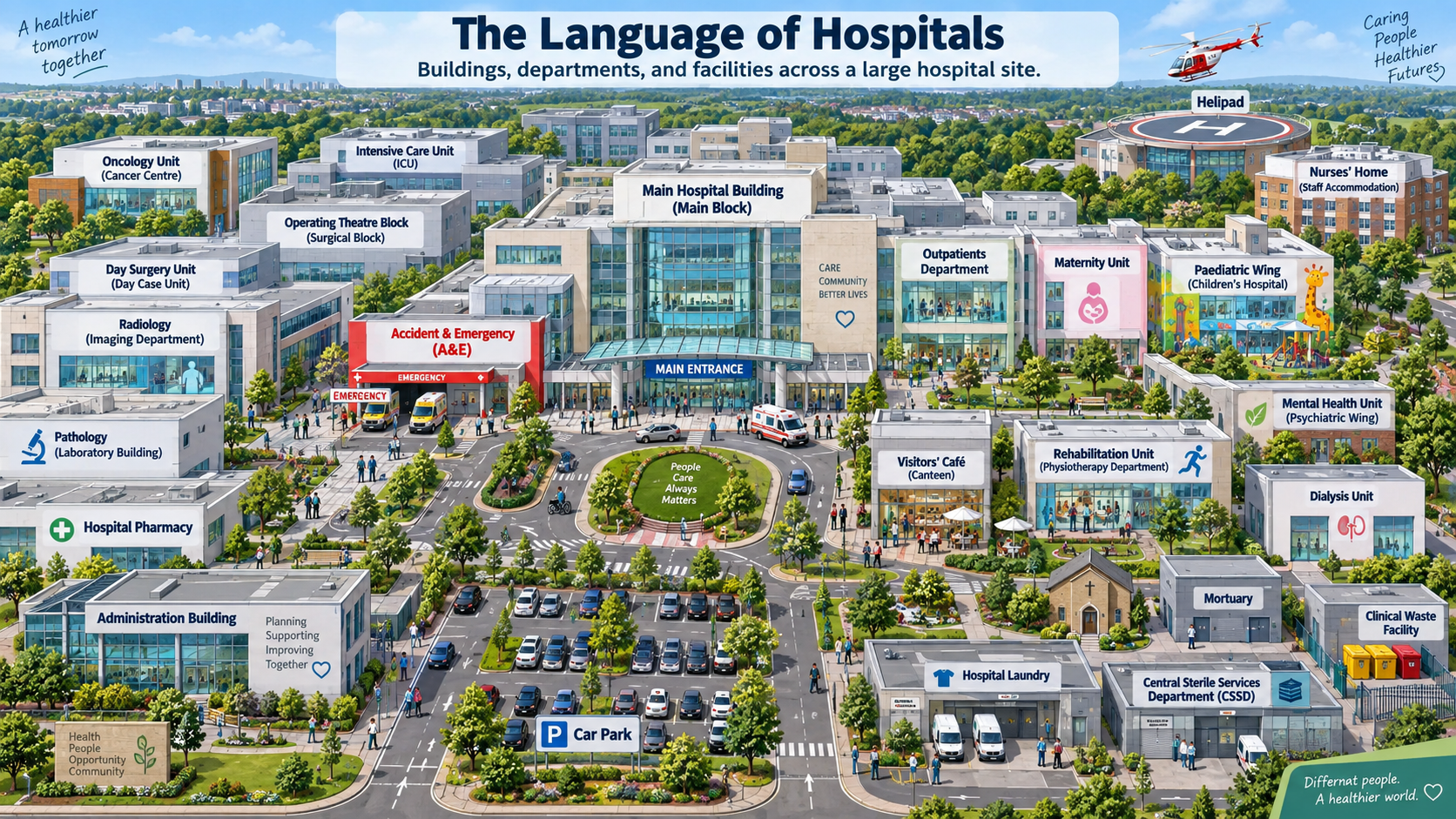
Around the Hospital: Buildings, Wings, and What They Do
Core PathWay
1 Section 1. The Heart of the Hospital
Ready to build your vocabulary for hospital buildings and spaces? Here is where we start.
Every hospital has a centre. This is the main hospital building. It is the largest structure on the site. Most departments and services connect to it in some way.
The busiest part of any hospital is usually the accident and emergency (A&E) department. This is where people go when they have a sudden illness or a serious injury. It is open 24 hours a day, seven days a week. In American English, this department is called the emergency room, or ER. In British English, A&E is the standard term.
Not every patient needs emergency care. Many people visit the outpatients department instead. This is where patients come for appointments but do not stay overnight. A patient who does stay overnight is called an inpatient. The outpatients department handles a large number of visits every day.
These three spaces — the main building, A&E, and the outpatients department — are the parts of a hospital that most people know. In the next sections, we look at the more specialist areas.
2 Section 2. Wings for Specialist Care
Large hospitals are often divided into wings. A wing is a section of a building, or a separate building connected to the main one. Each wing usually focuses on a specific type of patient or treatment.
The maternity wing is where babies are born and where mothers receive care before and after birth. It is one of the most recognisable parts of any hospital.
Children have different medical needs from adults, so hospitals have a paediatric wing. This is the area dedicated to the care of babies, children, and teenagers. Staff who work here have specialist training in child health.
Some patients need the highest level of medical care. They are treated in the intensive care unit (ICU) wing. This is where patients with life-threatening conditions are monitored very closely, usually with machines that support their breathing or heart function.
Patients with mental health conditions are treated in the psychiatric wing. This area provides a safe, structured environment. The staff here include psychiatrists, psychologists, and specialist nurses.
Notice the pattern: we use the word wing for large, specialist sections of a hospital. The word unit tends to describe a smaller, more focused department — you will see this in the next section.
3 Section 3. Specialist Units
As well as wings, hospitals have many specialist units. These are smaller departments that focus on one type of treatment or patient group.
The day surgery unit is where patients have operations and go home on the same day. They do not need to stay overnight. This type of care has become much more common in recent years.
Patients who are recovering from illness, injury, or surgery often spend time in the rehabilitation unit. Here, physiotherapists and other specialists help patients regain strength and movement.
Some patients have kidney failure and cannot clean their own blood. They need regular treatment in the dialysis unit. This process is called dialysis, and patients may attend several times a week.
Cancer patients receive treatment in the oncology unit. Oncology is the branch of medicine that deals with cancer. Treatment here can include chemotherapy, radiotherapy, and other specialist care.
These four units — day surgery, rehabilitation, dialysis, and oncology — are good examples of how hospitals organise care around specific conditions and treatments. Each one has its own team of specialist staff.
4 Section 4. Diagnosis, Surgery, and Support Services
Some hospital buildings are not where patients stay — they are where tests are done, operations are carried out, or support services run.
Doctors often need to see inside the body before they can diagnose a problem. This is done in the radiology/imaging department. This department uses equipment such as X-ray machines, CT scanners, and MRI scanners. The images help doctors understand what is happening inside a patient’s body.
When a patient needs an operation, they go to the operating theatre block. This is a separate building or section that contains several operating theatres. The word theatre here does not mean a place for plays — it means a specially equipped room for surgery.
Blood samples and other tests are analysed in the laboratory building. Lab results help doctors make accurate diagnoses and monitor a patient’s progress.
Medication for patients is prepared and dispensed in the hospital pharmacy. Pharmacists check that prescriptions are correct and that medicines are safe for each patient.
Finally, the central sterile services department (CSSD) is where surgical instruments and equipment are cleaned and sterilised. Sterilised means completely free from bacteria and other harmful organisms. Without the CSSD, operations could not take place safely. It is one of the most important support services in any hospital.
5 Section 5. Facilities for Staff, Visitors, and the Site
A hospital is not just a medical building — it is a large, complex site with many different facilities. Some of these serve patients. Others serve staff or visitors.
Hospitals employ a huge number of people, and some of them live on site. Staff accommodation refers to the housing provided for employees, often nurses or junior doctors, who live near the hospital.
Visitors and staff need somewhere to eat and rest. The visitors’ café is a place inside the hospital where people can buy food and drinks. It is usually open to everyone — patients, relatives, and staff.
For spiritual support, many hospitals have a chapel. This is a small room or building used for prayer and quiet reflection. It is usually open to people of all faiths.
When a patient dies, their body is taken to the mortuary. This is a secure, controlled room where bodies are kept until they can be collected by a funeral director or examined by a pathologist.
The hospital site also needs practical infrastructure. The car park provides parking for staff, patients, and visitors. For emergency air transport, some hospitals have a helipad — a flat area on the roof or ground where helicopters can land. The administration building is where the hospital’s management and office staff work. They handle finances, staffing, planning, and communications.
6 Section 6. Behind the Scenes: Essential Services
Some of the most important work in a hospital happens in places that patients rarely see.
Every day, a hospital produces enormous amounts of dirty linen — bed sheets, towels, uniforms, and gowns. All of this is washed and processed in the hospital laundry. Clean linen is essential for infection control.
Hospitals also produce a large amount of waste that cannot go into ordinary bins. Used needles, contaminated materials, and other dangerous items are collected and processed by the clinical waste facility. This is a specialist area that handles waste safely so that it does not cause harm to people or the environment.
These two services — the hospital laundry and the clinical waste facility — work quietly in the background, but they are critical to keeping the hospital clean and safe.
Take a moment to think about the full picture. A modern hospital is a small city. It has specialist medical units, diagnostic buildings, surgical facilities, accommodation, catering, transport infrastructure, and waste management. Every part has a name, a function, and a team of people responsible for it. You now have the vocabulary to describe all of it.
7 Section 7. Now Hear It in Use
You have met all 24 terms. Now hear them working in a real conversation. Listen to how two hospital staff members use this vocabulary naturally as they discuss a site tour for a new colleague. Pay attention to how they name different buildings and explain what each one does.
💬 Dialogue 1: The Site Tour
Priya is a senior facilities manager at a large NHS hospital. Marcus is a newly appointed hospital administrator who is joining her team. Priya is taking Marcus on a walking tour of the hospital site on his first day. They need to agree on which areas to prioritise for a site review report due at the end of the week.
Priya: “Right, Marcus, welcome to the site. We have a lot to cover today, so let’s start at the main hospital building and work our way out from there.”
Marcus: “Sounds good. I reviewed the site map last night, but I think seeing it in person is going to be very different. Where does most of the patient traffic come in?”
Priya: “The accident and emergency department takes the highest footfall — it never closes, so there are always people coming in. But the outpatients department is actually busier in terms of total appointments across the week. A&E handles emergencies, while outpatients manages planned visits — things like follow-up consultations and routine tests.”
Marcus: “That’s a useful distinction. So A&E is the unplanned, urgent side, and the outpatients department is more scheduled. Should both of those go into the site review report, or are we focusing on specific areas?”
Priya: “Both should be in the report, yes. And we also need to include the operating theatre block — that’s on the second floor of the main building. It’s a restricted area, so we won’t go inside today, but I want you to know where it sits on the site. Any maintenance issues there go straight to the top of the priority list.”
Marcus: “Understood. And what about imaging? I know radiology is usually a high-traffic area. Is the radiology and imaging department connected directly to the main building?”
Priya: “It is — it’s on the ground floor, just off the main corridor. Radiology gets referrals from almost every other department, so the location is important. It’s one of the areas I want us to look at closely for the report, actually. There have been some concerns about patient waiting times in that corridor.”
Marcus: “Good to flag that early. What about the ICU? I imagine that’s also in the main building. Is the intensive care unit wing something we need to cover in the report as well?”
Priya: “Yes, the ICU wing is on the third floor. It’s a specialist area, so it has its own maintenance schedule and its own set of compliance checks. We don’t manage it directly, but we need to include it in the overview. After the main building, I want to take you over to the administration building — that’s where your office will be, and it’s where we’ll be writing the report.”
Marcus: “Perfect. And is the hospital pharmacy in the administration building, or is that separate? I noticed it on the map but I wasn’t sure where it fitted in.”
Priya: “The pharmacy is in the main building, on the ground floor near the outpatients department — patients often collect their medication straight after an appointment, so the location makes sense. The administration building is purely office space. One more thing we should look at today is the clinical waste facility. It’s at the back of the site, away from the patient areas, and it needs to be in the report because there’s a scheduled inspection next month. Oh, and I should point out the helipad on the way — it’s on the roof of the A&E block, and air ambulances use it several times a week.”
Marcus: “Right, so the helipad is directly above A&E — that makes sense operationally. And I’ll make sure the clinical waste facility and the inspection date go into the report. This has been really helpful, Priya. I feel like I have a much clearer picture of how the site is organised now. Shall we start walking?”
Member-Exclusive Practice Bar
Access a wide range of integrated practice for this unit — from Vocabulary and Grammar activities to AI-curated Writing tasks and Thematic Chat practice.
This feature is available to YSP members.
Explore Membership BenefitsMember-Exclusive Vocabulary Review & Acquisition System

This isn’t a simple quiz — it’s a fully tracked learning system. You build knowledge through recognition, then recall, and your progress feeds directly into the Integrated Practice Bar (Writing tasks, AI Chat, and more).
- Practice sessions, accuracy, and response-time tracking
- Term strength levels (Learning → Stable → Strong)
- Personal progress history for each unit
This feature is available to YSP members.
Explore Membership Benefits