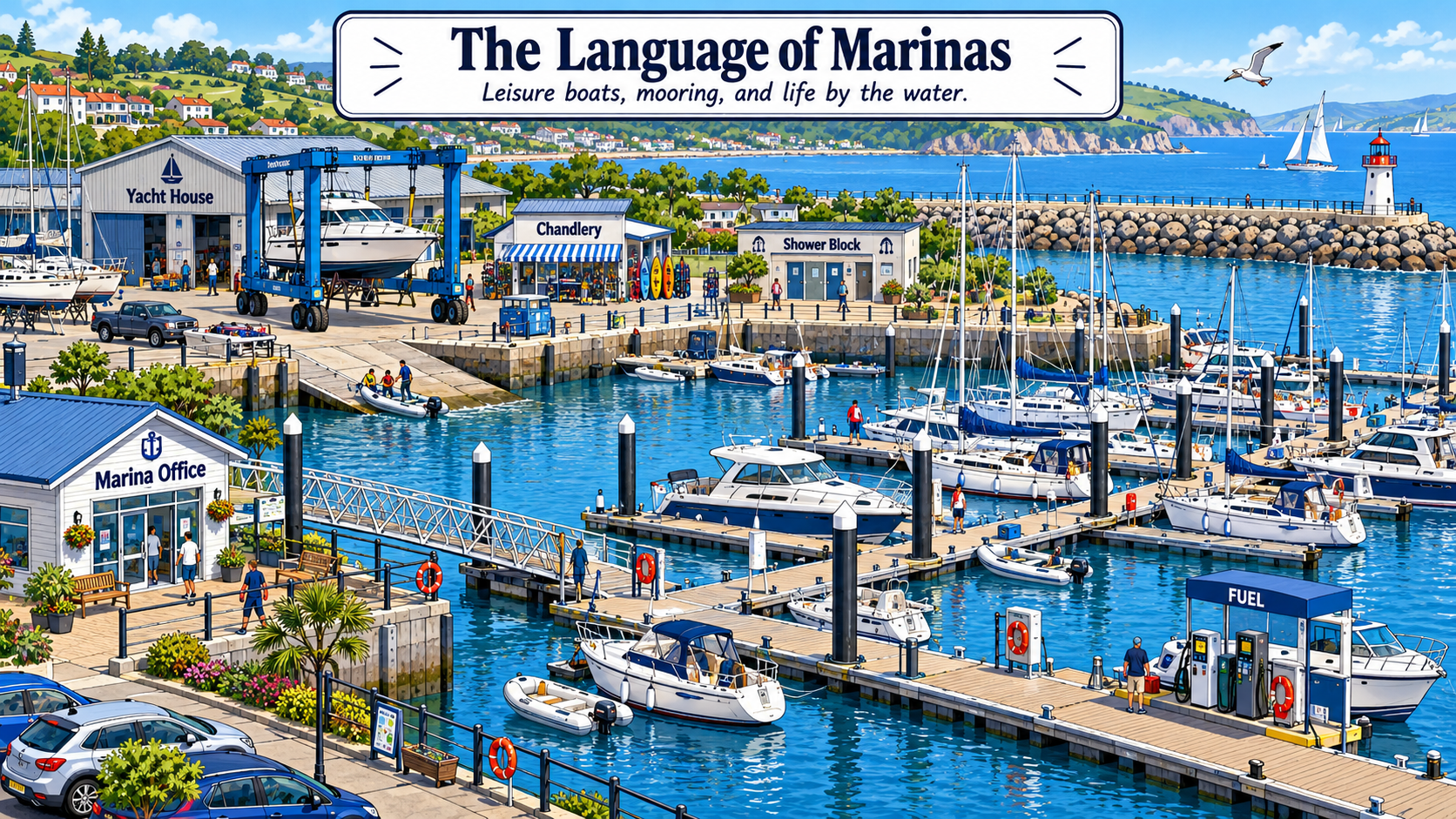
The Language of Marinas: Places, Structures, and Services
Core PathWay
1 Section 1. Welcome to the Marina
Want to talk confidently about marinas? It starts with these words.
A marina is a place where people keep their boats. It is built for private and leisure use — not for large cargo ships. The centre of the marina is the marina basin. This is the area of water where boats float and are kept safe from waves and strong currents.
Around the basin, you will find floating platforms where boats tie up. These are called pontoons. A pontoon is a flat, floating structure that sits on the water. Boats park alongside it.
Sometimes, a pontoon has smaller arms that stick out sideways. Each arm is called a finger pontoon, and the space where a single boat parks next to one is called a finger berth. Think of it like a parking space — but on water.
To get from the land onto a pontoon, you walk down a gangway. This is a sloped or flat bridge that connects the shore to the floating platform. It moves up and down with the tide.
A larger, fixed platform used for loading, unloading, or docking is called a floating dock. It is similar to a pontoon but is often bigger and used for different purposes.
2 Section 2. Storing and Moving Boats
Not all boats stay in the water. Marinas offer several ways to store and move them.
A boat hoist is a machine that lifts boats out of the water. It is used to move a boat from the water onto land, or to put it back in. You might hear someone say: ‘We need to book the boat hoist for Thursday morning.’
The area on land where boats are repaired and maintained is called a boatyard. Workers in a boatyard fix engines, repaint hulls, and carry out safety checks. Many boatyards are next to the marina basin.
Some marinas offer dry stack storage. This means boats are kept on land — stacked in large shelving units — when they are not being used. When an owner wants to go out on the water, a forklift brings the boat down and launches it. This saves space in the water and protects the boat.
To launch a boat from land into the water, you use a boat ramp. This is a sloped surface that goes from the shore into the water. Boat owners drive their trailer down the ramp and slide the boat off into the basin.
3 Section 3. Services and Facilities on Shore
A marina is not just about the water. There are many useful services on land too.
If you need equipment, ropes, safety gear, or navigation tools for your boat, you go to the chandlery. This is a shop that sells everything a boat owner might need. The word is old, but the shop is very useful.
When a boat needs more fuel, it goes to the fuel dock. This is a special docking area where boats can fill up with petrol or diesel. It works a little like a petrol station — but on the water.
After a long trip, sailors often want a shower. The shower block is the building at the marina where sailors can wash and use the toilets. Most marinas charge a small fee or include it in the mooring cost.
Many marinas also have a yacht club. This is a social and sporting organisation for people who sail. The yacht club often has a bar, a restaurant, and meeting rooms. Members meet there to plan races and social events.
Some boats have their own permanent building called a boat house. This is a structure built over or next to the water where a single boat — or a small number of boats — is stored. A boat house is usually private.
4 Section 4. Safety, Moorings, and Water Structures
Some marina vocabulary is about keeping boats — and people — safe.
A mooring field is an area of open water where boats anchor or tie to fixed buoys. It is not inside the marina basin. Boats in a mooring field sit out in the water and owners use a small dinghy to get to shore.
A bulkhead is a strong wall built along the edge of the water. It holds back the land and stops the shore from collapsing into the water. You will often see boats tied up alongside a bulkhead.
A boat slip is a narrow space in the water where a single boat parks. It is similar to a finger berth, but the term ‘boat slip’ is more common in American English. The boat reverses into the slip and ties up there.
To protect the marina basin from large waves, engineers build a wave attenuator. This is a long, floating barrier that sits at the entrance to the marina. It reduces the size of waves before they reach the boats inside.
A lifeboat station is a building near the water where a rescue lifeboat and its crew are based. In an emergency at sea, the lifeboat launches quickly to help people in danger. Many marinas are located near a lifeboat station.
5 Section 5. Now Hear It in Use
You have met all 20 terms. Now hear them working in a real conversation. Two people are discussing a marina — listen for how naturally these words appear when someone is actually talking about a place they know well.
💬 Dialogue 1: A Tour of the Marina
Carla is a marina manager showing Tom, a new boat owner, around the facility for the first time. Tom has just bought a sailing boat and is deciding whether to keep it at this marina.
Carla: “Welcome, Tom. So, you’ve just bought your first boat — congratulations. Let me show you around the marina basin first, and then we can talk about where your boat would actually sit.”
Tom: “Thanks, Carla. I have to be honest — I don’t really know the difference between a pontoon and a finger berth yet. This is all quite new to me.”
Carla: “Don’t worry — it makes much more sense when you can see it. Those long floating platforms out there are the pontoons. Each smaller arm coming off them is a finger pontoon, and the space where your boat would park alongside one is your finger berth. That one on the left could be yours.”
Tom: “I see — so the finger berth is basically the parking space for the boat, and the finger pontoon is the small walkway next to it? And how do you actually get from the shore out onto the pontoons?”
Carla: “Exactly right. And to answer your question — you use the gangway. It’s that sloping walkway you can see connecting the shore to the main pontoon. It moves up and down with the tide, so you always have safe access to your boat.”
Tom: “That’s a good design. What happens if my boat needs to come out of the water — for repairs or painting, for example?”
Carla: “Good question. We have a boat hoist over on the east side of the marina — it lifts vessels straight out of the water. Once your boat is out, it goes into our boatyard, which is the hard-standing area just behind it. That’s where the maintenance and repair work is carried out.”
Tom: “So the boatyard is like a workshop area on land? Is there also somewhere I can buy equipment and supplies — things like ropes, fenders, that sort of thing?”
Carla: “Yes, that’s right. And for supplies, we have a chandlery right here on site — it’s the shop that sells everything a boat owner needs. Ropes, fenders, navigation equipment, safety gear — if you need it on a boat, they probably have it. It’s just past the car park on your right.”
Tom: “Perfect — that’s really useful. What about fuel? I assume I can’t just use a petrol station on the road.”
Carla: “No, definitely not. We have a fuel dock at the entrance to the marina basin — you bring your boat alongside it and fill up there, just like a petrol station but on the water. We also have a boat ramp nearby if you ever need to launch a small dinghy or a tender. And of course there’s a shower block for when you’ve been out on the water all day.”
Tom: “This all sounds really well set up. I think I’ve seen everything I need to. The finger berth on the left, the gangway, the boat hoist, the chandlery — it’s a lot to take in, but I have to say, I’m very impressed. I think this could be the right place for my boat.”
Member-Exclusive Practice Bar
Access a wide range of integrated practice for this unit — from Vocabulary and Grammar activities to AI-curated Writing tasks and Thematic Chat practice.
This feature is available to YSP members.
Explore Membership BenefitsMember-Exclusive Vocabulary Review & Acquisition System
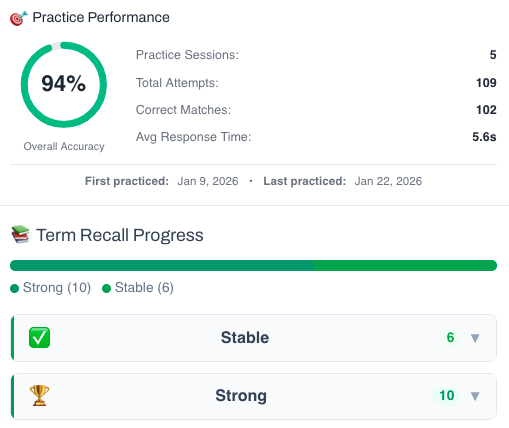
This isn’t a simple quiz — it’s a fully tracked learning system. You build knowledge through recognition, then recall, and your progress feeds directly into the Integrated Practice Bar (Writing tasks, AI Chat, and more).
- Practice sessions, accuracy, and response-time tracking
- Term strength levels (Learning → Stable → Strong)
- Personal progress history for each unit
This feature is available to YSP members.
Explore Membership Benefits