Asking Yes/No Questions: Do You…? Does She…?
Core PathWay
1 Why Do We Need Question Words?
English questions look different from statements. Look at these two sentences:
Statement: You like coffee.
Question: Do you like coffee?
The question has a special word: do. This word comes first. We call this question word order. In English, you cannot just say ‘You like coffee?’ with a different voice. You need to use do or does. This is very important!
We use questions every day. When you meet new people, you ask questions. When you talk about habits and routines, you ask questions. When you want to know about someone’s preferences, you ask questions. Questions help you get to know people. Questions help you have good conversations.
Key Terms
2 How to Make Questions with Do and Does
Now you learn the question pattern. This pattern is very important. You use it many times every day. Look at the pattern. Study the examples. Then you can make your own questions!
The pattern is simple: Do or Does + person + verb (base form). The verb does not change. You always use the simple form of the verb after do or does.
Focus
- Do comes before the person (subject)
- Use do with I, you, we, they
- Use does with he, she, it
- After do or does, use the base verb (no -s, no -es)
- Short answers: Yes, I do / No, I don't / Yes, she does / No, she doesn't
Rules
- Question word order: Do/Does + subject + base verb
- Use the same word (do or does) in your short answer
- Never say 'Do you works?' or 'Does he work?' — always base form after do/does
- Match your answer to the question: Do you…? → Yes, I do / No, I don't
Examples
- Do you drink coffee? — Yes, I do. / No, I don't.
- Does your brother play football? — Yes, he does. / No, he doesn't.
- Do they work together? — Yes, they do. / No, they don't.
Common mistake
Key Terms
3 The New Flatmate Interview
Alex needs a new flatmate. Today, Jordan comes to see the flat. Alex wants to know about Jordan’s routine and habits. Alex asks many questions.
Alex: Hi! Come in. Do you work in the city?
Jordan: Yes, I do. I work in an office nearby.
Alex: Great! Does your job start early?
Jordan: No, it doesn’t. I start at 9 o’clock. I finish at 5 o’clock.
Alex: Perfect. Do you cook often?
Jordan: Yes, I do. I like cooking. I cook dinner every day.
Alex: That’s good! Do you have any pets?
Jordan: No, I don’t. But I like animals.
Alex: Me too. Does your family live nearby?
Jordan: Yes, they do. My parents live in the next town. I go there on weekends.
Alex: Nice. Do you study in the evenings?
Jordan: No, I don’t. I finish work and then I relax. Sometimes I play football with friends.
Alex: Sounds good! Do you need to see the bedroom?
Jordan: Yes, please!
Alex: Do you want to move in soon?
Jordan: Yes, I do. I need a place next week.
Alex: Perfect! I think we can live together well. Do you speak other languages?
Jordan: Yes, I do. I speak Spanish and a little French.
Alex: Excellent! Welcome to your new home!
Key Terms
4 Your Turn: Write a Question Dialogue
Now you practice! Write your own dialogue. One person asks questions. The other person gives short answers.
5 Remember: Question Word Order
Good work! Now you know how to ask yes/no questions in English.
Remember the pattern: Do or Does + person + base verb.
Use do with I, you, we, they. Use does with he, she, it.
Always use the base form of the verb. Never say ‘Do you works?’ Say ‘Do you work?’
Match your short answer to the question. If the question uses do, answer with do. If the question uses does, answer with does.
Common question starters you can use:
– Do you…? (for talking about yourself or the other person)
– Does he…? / Does she…? (for talking about another person)
– Do they…? (for talking about a group of people)
Now practice! Use these questions in real conversations. Ask your friends. Ask your family. Ask people you meet. Every question you ask helps you learn!
Member-Exclusive Practice Bar
Access a wide range of integrated practice for this unit — from Vocabulary and Grammar activities to AI-curated Writing tasks and Thematic Chat practice.
This feature is available to YSP members.
Explore Membership BenefitsMember-Exclusive Vocabulary Review & Acquisition System
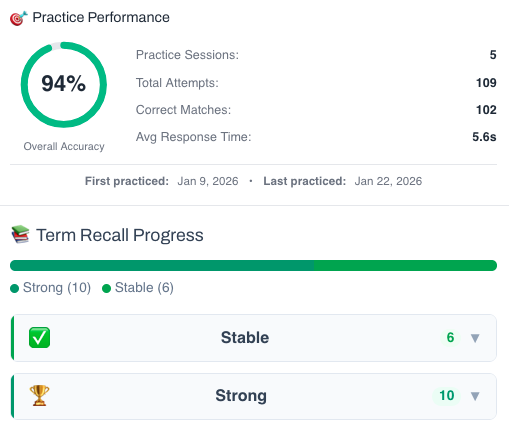
This isn’t a simple quiz — it’s a fully tracked learning system. You build knowledge through recognition, then recall, and your progress feeds directly into the Integrated Practice Bar (Writing tasks, AI Chat, and more).
- Practice sessions, accuracy, and response-time tracking
- Term strength levels (Learning → Stable → Strong)
- Personal progress history for each unit
This feature is available to YSP members.
Explore Membership Benefits🎮 Practice Games
Sentence Scrambler
Present Simple yes/no questions and short answers using do/does – Sentence Scramble
Member-Exclusive Sentence Builder
Reconstruct scrambled sentences to practice word order and develop your grammar intuition.
This feature is available to YSP members.
Explore Membership Benefits