Time Markers and Signal Words for Present Simple
Core PathWay
1 Time Markers: Your Tense Signal System
Ever notice how certain words seem to tell you which tense to use? That’s exactly what they do.
In business writing and professional speech, time markers work like traffic signals for grammar. When you see words like always, typically, every, or usually, they’re signaling: ‘Use Present Simple here.’ These markers appear constantly in schedules, company policies, procedures, and reports because business communication focuses on regular actions and established routines.
Think about your own work department. You probably have a weekly meeting schedule, regular shift patterns, and standard practices that happen the same way each time. When you describe these operations, you need Present Simple — and the time markers help you recognize when. Understanding this signal system makes choosing the right tense much easier, especially when you’re writing formal documents or describing requirements and regulations.
The good news? Once you learn to spot these markers, they become automatic clues that guide your grammar choices.
Key Terms
2 Present Simple with Frequency Markers
Frequency markers are your most reliable clues for Present Simple. Words like always, usually, typically, and generally describe how often something happens — and that ‘how often’ meaning connects directly to habits and routines.
When you describe regular workplace actions, these markers appear naturally. They tell your reader: ‘This happens repeatedly, not just once.’ That’s exactly when Present Simple does its job best.
Focus
- Present Simple describes habits, routines, and general truths
- Frequency adverbs (always, usually, typically, generally) trigger Present Simple
- These adverbs usually go BEFORE the main verb but AFTER ‘be’
- Third person singular adds -s or -es to the verb
Rules
- FORM: Subject + base verb (add -s/-es for he/she/it)
- POSITION: Frequency adverbs go before main verbs: ‘We usually start at 9am’
- POSITION: Frequency adverbs go after ‘be’: ‘The manager is always punctual’
- NEGATIVE: Use do/does + not + base verb: ‘He does not typically work weekends’
- QUESTION: Use Do/Does + subject + base verb: ‘Does the team usually meet on Mondays?’
Examples
- The finance department typically prepares reports on the last Friday of each month.
- Our company always follows strict data protection regulations.
- Team leaders generally conduct performance reviews twice a year.
- Sarah usually arrives at the office before 8am.
- The system does not typically require manual updates.
Common mistake
3 Time Markers in Action: Policy and Schedule
Here’s how time markers appear in real business documents. Notice how they signal Present Simple throughout.
COMPANY POLICY: REMOTE WORK GUIDELINES
Our remote work policy applies to all permanent staff members. Employees typically work from the office three days per week and remotely for two days. In general, team members choose their remote days, but department managers always approve the weekly schedule in advance.
The IT department runs system maintenance every Monday morning between 7am and 8am. During this time, employees cannot access shared drives. On Fridays, all staff members submit their weekly progress reports by 4pm. This standard helps managers track project timelines effectively.
Managers usually hold one-to-one meetings with their direct reports twice a month. These meetings focus on current projects, upcoming deadlines, and professional development goals. Generally, the employee prepares an agenda and shares it 24 hours before the meeting.
WEEKLY SCHEDULE: CUSTOMER SERVICE TEAM
Morning shift: 8am–4pm
Afternoon shift: 12pm–8pm
Every team member works one weekend shift per month. The team leader always publishes the monthly rota two weeks in advance. Staff typically request shift swaps through the online system, and supervisors usually approve requests within 48 hours.
NOTICING PROMPTS:
1. Which time markers can you find in these texts? Make a list.
2. What verb tense follows each time marker? Is it always the same?
3. Look at the position of ‘always’, ‘usually’, ‘typically’, and ‘generally’ in the sentences. Where do they appear in relation to the main verb?
Key Terms
4 Practice: Describe Your Work Routine
Now use what you’ve learned. Write about your work routine or your company’s procedures using time markers.
5 Your Time Marker Checklist
Let’s consolidate what you’ve learned into a simple decision tool.
TIME MARKERS THAT SIGNAL PRESENT SIMPLE:
Frequency adverbs: always, usually, typically, generally, normally, regularly, often, sometimes, rarely, never, seldom
Routine phrases: every [day/week/month/year], on [Mondays/Fridays], in general, as a rule, in most cases
Schedule markers: each time, whenever, once/twice a [week/month/year]
THE DECISION RULE:
If you see every/always/usually/typically/generally + action → use Present Simple
These markers describe regular patterns, not single events happening right now or in the past.
CONTRAST WITH OTHER TENSES:
Compare these time markers:
– Present Simple: always, usually, every Monday, typically → The team meets every Monday.
– Present Continuous: now, right now, at the moment, currently → The team is meeting right now.
– Past Simple: yesterday, last week, ago, in 2020 → The team met yesterday.
– Future: tomorrow, next week, will, going to → The team will meet tomorrow.
Notice how the time marker changes the tense? That’s your signal system working. When you write or speak, let these markers guide your grammar choices. They’re reliable clues that make tense selection much easier — especially in business communication, where routines and regular procedures dominate the conversation.
Member-Exclusive Practice Bar
Access a wide range of integrated practice for this unit — from Vocabulary and Grammar activities to AI-curated Writing tasks and Thematic Chat practice.
This feature is available to YSP members.
Explore Membership BenefitsMember-Exclusive Vocabulary Review & Acquisition System
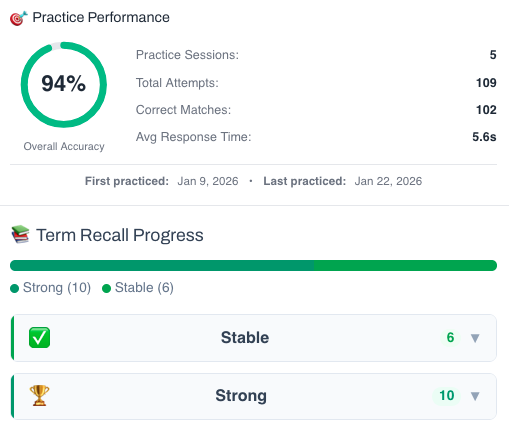
This isn’t a simple quiz — it’s a fully tracked learning system. You build knowledge through recognition, then recall, and your progress feeds directly into the Integrated Practice Bar (Writing tasks, AI Chat, and more).
- Practice sessions, accuracy, and response-time tracking
- Term strength levels (Learning → Stable → Strong)
- Personal progress history for each unit
This feature is available to YSP members.
Explore Membership Benefits🎮 Practice Games
Sentence Scrambler
Time Markers and Signal Words for Present Simple – Sentence Scramble
Member-Exclusive Sentence Builder
Reconstruct scrambled sentences to practice word order and develop your grammar intuition.
This feature is available to YSP members.
Explore Membership Benefits