Using at, in, and on for Times and Dates
Core PathWay
1 Why Three Different Prepositions?
English uses three small words for time: at, in, and on. Many languages use just one word. This can be confusing!
Think about time like this. Some times are points — exact moments like 3pm or midnight. Some times are containers — long periods like January or morning. Some times are surfaces — specific days like Monday or your birthday.
English gives each type its own preposition. At is for points. In is for containers. On is for surfaces. When you learn this pattern, choosing the right preposition becomes easy.
Imagine you are planning your week. You check your diary. You have an appointment on Tuesday. The meeting starts at 9am. You finish work in the evening. Each time expression needs the correct preposition. Let’s learn the rules.
Key Terms
2 The Three Time Prepositions: at, in, on
Now let’s look at each preposition. Each one has its own job. Each one goes with certain time words.
When you make a schedule or talk about your routine, you need all three prepositions. The pattern is simple. Learn which time words go with which preposition. Then you can use them correctly every time.
Focus
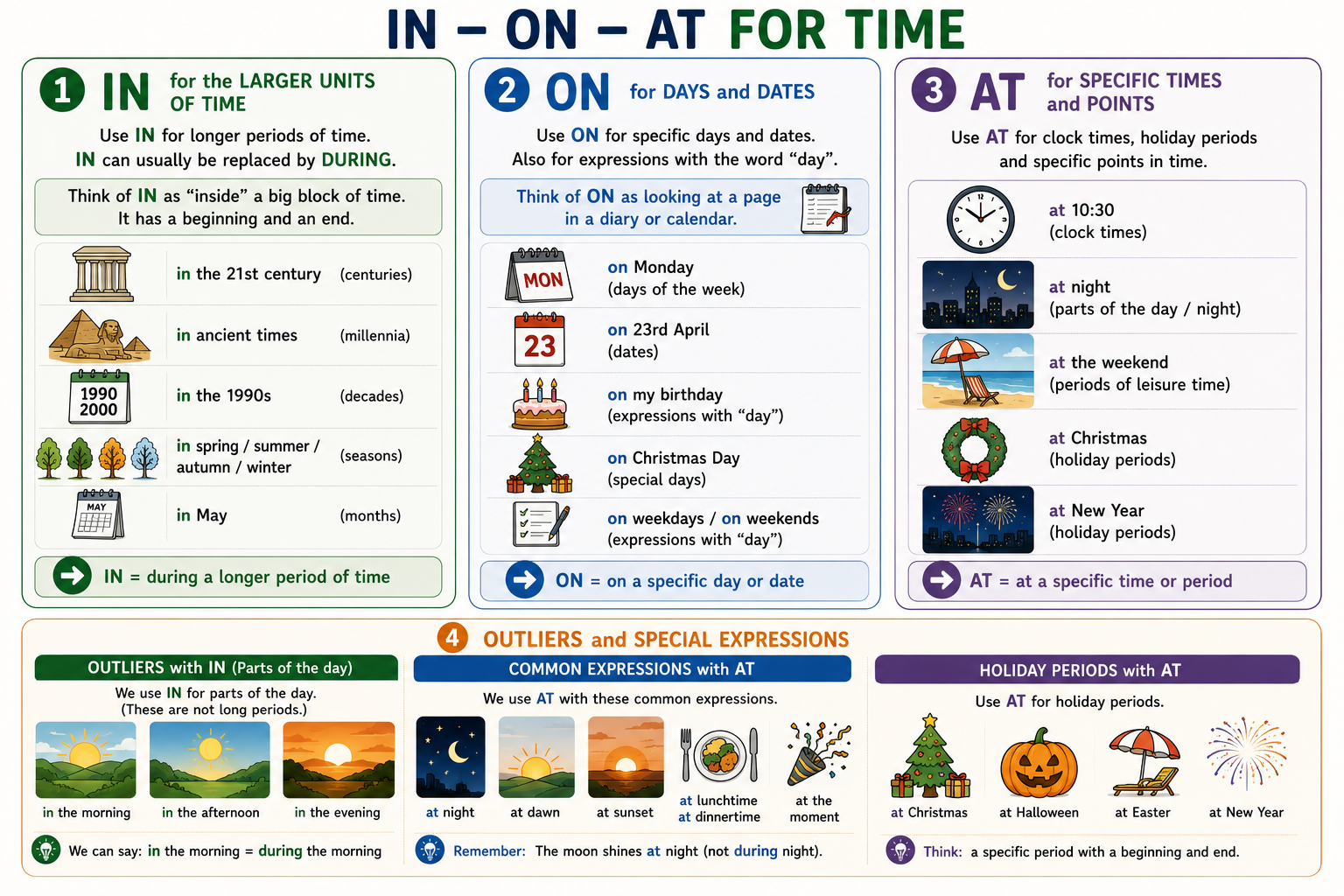
- AT + clock times and specific moments (at 9am, at midday, at the weekend)
- IN + longer periods: months, years, seasons, parts of day (in January, in 2024, in summer, in the morning)
- ON + days and dates (on Monday, on 15th May, on my birthday)
Rules
- Use AT when you can point to an exact time on a clock, or a specific moment like midnight, midday, or the weekend
- Use IN when time is a container you are inside — months, years, seasons, and parts of the day (morning, afternoon, evening)
- Use ON when you think of time as a surface — specific days of the week, dates, and special day events like birthdays and holidays
Examples
- My appointment is at 10am. I always have meetings in the morning. The deadline is on Friday.
- She was born in March. Her birthday is on 23rd March. The party starts at 7pm.
- We go on holiday in summer. We leave on Saturday. The flight is at midday.
Common mistake
Key Terms
3 My Busy Week
This is my typical week. I am very busy!
I start work at 8:30am every day. In the morning, I check my emails and plan my day. On Monday, I have a team meeting at 10am. We discuss our projects and deadlines.
On Tuesday afternoon, I visit clients. I usually finish at 5pm. In the evening, I go to the gym or meet friends. Sometimes I work late — I finish at 7pm or at 8pm.
Wednesdays are my busiest days. I have appointments all day. My first meeting is at 9am. My last appointment finishes at 6pm. I don’t have time for lunch!
On Thursday, I work from home. I like working in the afternoon when the house is quiet. At midday, I make coffee and take a break.
Fridays are better. I finish work at 4pm. At the weekend, I relax. On Saturday morning, I go shopping. On Sunday, I visit my family. My sister’s birthday is in March. We are planning a party on 15th March. It starts at 7pm.
In summer, I go on holiday for two weeks. This year, I am going in July. I leave on 5th July. My flight is at midday. I can’t wait!
At night, I read or watch TV. I go to bed at 11pm. Then I sleep until midnight — no, I’m joking! I sleep until morning. In the morning, my routine starts again.
Key Terms
4 Write Your Weekly Diary
Now write about your typical week. Use the three time prepositions correctly.
5 Quick Reference: Choosing the Right Preposition
Here is a simple way to remember the three prepositions.
AT = clock times + special moments
Use AT with: o’clock times (at 9am, at 3pm), midnight, midday, night, the weekend
IN = long periods + parts of the day
Use IN with: months (in January), years (in 2024), seasons (in summer), morning/afternoon/evening (in the morning)
ON = days + dates
Use ON with: days of the week (on Monday), dates (on 15th May), special days (on my birthday, on New Year’s Day)
When you read a schedule or listen to someone talk about their plans, notice these prepositions. Which time words go together? The more you notice, the more natural it becomes.
Practice using these prepositions when you talk about your day. Start small. Say ‘I start work at 9am’ or ‘I have a meeting on Tuesday’. Soon, choosing the right preposition will feel automatic.
⚖️ Using IN with Time Periods
⚖️ AT for Specific Times vs AT for Multi-Day Periods
Member-Exclusive Practice Bar
Access a wide range of integrated practice for this unit — from Vocabulary and Grammar activities to AI-curated Writing tasks and Thematic Chat practice.
This feature is available to YSP members.
Explore Membership BenefitsMember-Exclusive Vocabulary Review & Acquisition System
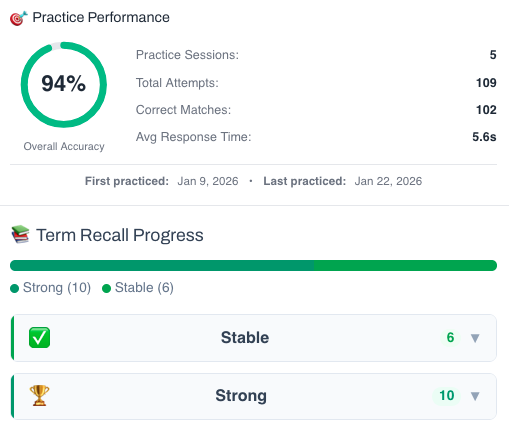
This isn’t a simple quiz — it’s a fully tracked learning system. You build knowledge through recognition, then recall, and your progress feeds directly into the Integrated Practice Bar (Writing tasks, AI Chat, and more).
- Practice sessions, accuracy, and response-time tracking
- Term strength levels (Learning → Stable → Strong)
- Personal progress history for each unit
This feature is available to YSP members.
Explore Membership Benefits🎮 Practice Games
Sentence Scrambler
Using at/in/on for times, dates, days, months, years, and parts of the day – Sentence Scramble
Member-Exclusive Sentence Builder
Reconstruct scrambled sentences to practice word order and develop your grammar intuition.
This feature is available to YSP members.
Explore Membership Benefits