Present Simple for Facts and Permanent Situations
Core PathWay
1 What Never Changes
Some things in life are always true. Water boils at 100 degrees Celsius. The sun rises in the east. These are facts that don’t change.
In business, many things are also permanent. A company operates in certain countries. It manufactures specific products. These facts stay the same day after day. They are part of how the company is built.
We use Present Simple to talk about these permanent situations. We don’t use Present Continuous (the -ing form) because these things are not temporary. They are stable facts. When you say ‘Our company employs 500 people,’ you are describing a permanent situation, not something happening right now for a short time.
This lesson shows you how to talk about facts and permanent states in English. You will see how companies describe what they do, where they headquarter their operations, and how their systems work.
2 Grammar Focus: Present Simple for Permanent States
Present Simple is the tense we use for things that are always true or don’t change. This is different from Present Continuous, which we use for temporary actions happening now.
When you describe how a company works, what a job involves, or what a system does, you need Present Simple. These are permanent facts about the business world.
Focus
- Present Simple describes permanent situations and general truths
- Use it for company operations, job roles, and unchanging systems
- Third person singular (he/she/it) adds -s or -es to the verb
- Negative form uses do not/does not + base verb
- Question form uses Do/Does + subject + base verb
Rules
- Form: Subject + base verb (I manage, you handle, we operate)
- Third person: Subject + verb + s/es (she manages, he handles, it operates)
- Negative: Subject + do/does not + base verb (they do not manufacture, it does not provide)
- Question: Do/Does + subject + base verb (Do they specialize? Does it distribute?)
- Use for: permanent states, company facts, job descriptions, general truths, regular operations
Examples
- TechCorp manufactures electronic components in three countries. (permanent operation)
- Sarah manages the marketing department and oversees a team of twelve people. (permanent job role)
- Water boils at 100°C. This company specializes in software development. (general truths and permanent focus)
Common mistake
3 Company Profile: GlobalTech Industries
GlobalTech Industries operates in the technology sector and specializes in cloud computing solutions. The company headquarters its main operations in Singapore, but it also manages regional offices in fifteen countries across Asia, Europe, and North America. GlobalTech employs approximately 3,500 people worldwide and continues to grow its workforce each year.
The company manufactures server hardware in Malaysia and distributes products through a network of authorized suppliers and partners. The Research and Development department handles all new product innovation and reports to the Chief Technology Officer. This department oversees a budget of $50 million annually.
GlobalTech provides cloud services to a diverse client base that includes banks, hospitals, and educational institutions. The company currently holds an 18% market share in the Southeast Asian cloud computing market. Last year, the company generated revenue of $890 million, which represents steady growth in a competitive industry.
Each regional branch operates with some independence, but all branches follow the same core systems and procedures. The Singapore headquarters manages global strategy and financial planning. Regional managers oversee daily operations in their territories and have responsibility for meeting sales targets. Every manager reports to a regional director, who then reports to the executive board.
The company structure includes three main divisions: Hardware Manufacturing, Cloud Services, and Customer Support. Each division handles specific tasks and provides different services. The Hardware Manufacturing division employs 800 workers, while Cloud Services employs 1,200 technical specialists. The Customer Support department operates 24 hours a day, seven days a week, because the company provides services to clients in different time zones around the world.
Key Terms
4 Practice: Describe a Company
Now use what you have learned. Describe a company you know — your own company, a company you worked for, or a well-known business.
5 Looking Ahead
You have learned how to use Present Simple for permanent situations and facts. This is essential when you describe company operations, job roles, and general truths.
Remember: Present Simple tells us what is always true or permanent. ‘The company employs 500 people’ is a stable fact. ‘Water boils at 100°C’ is a scientific truth. These things don’t change.
In the next lesson, you will learn about Present Continuous. Present Continuous describes temporary situations — things happening right now for a short time. You will see the clear difference between ‘I work in the sales department’ (permanent job) and ‘I am working on a special project this month’ (temporary task).
Understanding when to use Present Simple and when to use Present Continuous is one of the most important skills in English. You are building that skill step by step.
6 Recap
This lesson taught you how to use Present Simple for permanent states and general truths. You learned the form (subject + base verb, with -s for third person), and you saw how this tense describes facts that don’t change.
You explored company operations and job roles using Present Simple. Words like operate, manage, employ, manufacture, provide, and specialize helped you describe what companies do as permanent facts, not temporary actions.
You practiced writing a company profile using Present Simple throughout. This skill is valuable in business English — whether you write reports, presentations, or company descriptions.
The key idea is permanence versus temporariness. Present Simple = permanent. In the next lesson, you will learn Present Continuous = temporary. Together, these two tenses give you the power to describe both stable facts and changing situations accurately.
Member-Exclusive Practice Bar
Access a wide range of integrated practice for this unit — from Vocabulary and Grammar activities to AI-curated Writing tasks and Thematic Chat practice.
This feature is available to YSP members.
Explore Membership BenefitsMember-Exclusive Vocabulary Review & Acquisition System
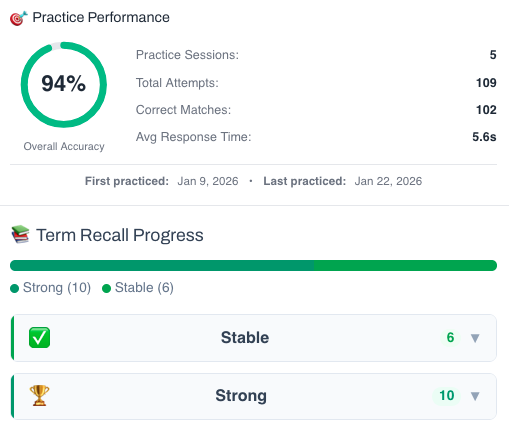
This isn’t a simple quiz — it’s a fully tracked learning system. You build knowledge through recognition, then recall, and your progress feeds directly into the Integrated Practice Bar (Writing tasks, AI Chat, and more).
- Practice sessions, accuracy, and response-time tracking
- Term strength levels (Learning → Stable → Strong)
- Personal progress history for each unit
This feature is available to YSP members.
Explore Membership Benefits🎮 Practice Games
Sentence Scrambler
Present Simple for Facts and Permanent Situations – Sentence Scramble
Member-Exclusive Sentence Builder
Reconstruct scrambled sentences to practice word order and develop your grammar intuition.
This feature is available to YSP members.
Explore Membership Benefits