Present Simple for Scheduled Future Events
Core PathWay
1 When the Future is Already Decided
Here’s something that surprises many learners: English doesn’t always use ‘will’ or ‘going to’ for future events.
When you look at a train timetable, you see sentences like ‘The train leaves at 7:15am’ or ‘The flight departs at 9:30pm.’ These are future events — they haven’t happened yet — but we use Present Simple, not future forms. Why? Because these events are part of a fixed schedule. They’re official. They’re outside your personal control. The railway company has decided when the train leaves, and that decision is final.
This use of Present Simple appears in formal contexts: transport schedules, conference programmes, cinema times, business meeting agendas. When you see a venue programme that says ‘Registration opens at 9am’ or ‘The keynote starts at 10am,’ you’re seeing Present Simple expressing future time. It feels strange at first — you might expect ‘will open’ or ‘is going to start’ — but native speakers naturally choose Present Simple for timetabled events. This lesson shows you exactly when and how to use this structure.
2 The Grammar: Present Simple for Scheduled Future
Present Simple for scheduled future uses exactly the same form as Present Simple for habits and routines. The difference is the meaning and context.
The form is simple: subject + base verb (add -s/-es for third person singular). ‘The conference starts at 9am.’ ‘Registration closes at 5pm.’ ‘My flight leaves tomorrow.’ The verb form is Present Simple, but the time reference is future — we know this from time markers like ‘tomorrow,’ ‘next week,’ ‘at 9am,’ or from the context (a timetable or programme).
We use this structure when events are part of an official timetable or schedule. These are events we can’t personally change: train departures and arrivals, flight times, conference sessions, cinema showings, shop opening hours, course timetables. The key idea is: the event is fixed and outside personal control.
Focus
- Form is identical to Present Simple (base verb + s/es for 3rd person)
- Meaning: timetabled or scheduled events in the future
- Use: transport schedules, conference programmes, official timetables, fixed events
- Future time is shown by time markers (tomorrow, next week, at 9am) or context
Rules
- Use Present Simple (not will/going to) for events on official schedules and timetables
- The event must be fixed and outside personal control (train times, conference sessions, shop hours)
- Time markers or context make it clear the event is in the future
- For personal plans and intentions, use going to or will instead
Examples
- The train departs from platform 7 at 6:45am. (transport timetable)
- Registration opens at 9am and the keynote begins at 10am. (conference programme)
- The next workshop starts at 2pm and finishes at 4pm. (event schedule)
Common mistake
3 A Day at the Conference
Alex’s Conference Travel Plan — March 15th
Alex is travelling to a business conference in Berlin. Here’s the itinerary:
The train leaves London at 7:15am and arrives in Brussels at 10:30am. There’s a one-hour break before the connecting train departs at 11:35am. That train arrives at Berlin Hauptbahnhof at 6:20pm.
The conference venue is the Mercure Hotel. Registration opens at 8:30am on March 16th. The opening keynote starts at 10am sharp — Alex doesn’t want to miss it. Lunch finishes at 2pm, and then there are three afternoon sessions. Alex is going to attend the marketing workshop at 3pm (that’s a personal choice — the workshop begins at 3pm whether Alex attends or not).
On March 17th, the final session ends at 4pm. Alex’s return flight departs from Berlin Brandenburg at 8pm. Boarding usually closes 30 minutes before departure, so Alex needs to be at gate B12 by 7:30pm at the latest.
Notice the pattern: when Alex talks about the fixed schedule — trains, flights, conference programme — the verbs are Present Simple even though everything is in the future. But when Alex talks about personal plans (‘I’m going to attend the workshop’), that’s going to, not Present Simple. The workshop time is fixed (begins at 3pm), but Alex’s decision to attend is personal.
Key Terms
4 Your Turn: Plan Your Day
Now practise using Present Simple for scheduled events and going to for personal plans.
5 Remember the Key Distinction
The core rule is simple: if the event is on a fixed schedule or timetable, use Present Simple. If it’s your personal plan or intention, use going to or will.
Fixed schedule = Present Simple: ‘The meeting starts at 3pm.’ ‘The train leaves at 6:45am.’ ‘Registration opens at 9am.’
Personal plan = going to/will: ‘I’m going to attend the workshop.’ ‘I’ll probably arrive early.’ ‘We’re going to have lunch together.’
This use of Present Simple is formal and neutral. You’ll see it in written schedules, programmes, and timetables. You’ll hear it in announcements and formal speech. Start noticing it in authentic contexts: airport departure boards, conference programmes, cinema listings, course timetables. Once you start looking, you’ll see it everywhere — and you’ll understand why English speakers choose Present Simple for these future events. The events are decided, official, and fixed. Present Simple reflects that certainty and formality perfectly.
6 Recap
You’ve learned that Present Simple can express future time when events are part of official schedules and timetables. This surprises many learners who expect ‘will’ or ‘going to’ for all future events.
The key distinction: fixed schedule = Present Simple (The train departs at 7am. The conference starts at 9am. Registration opens at 8:30am). Personal plan = going to/will (I’m going to attend the workshop. I’ll probably arrive early).
This structure appears in formal contexts: transport timetables (departures, arrivals, platforms, gates, boarding times), business contexts (conferences, registration, keynotes, workshops, sessions, breaks), and event programmes (venues, schedules, itineraries). The form is simple — regular Present Simple — but the meaning is future, shown by time markers or context.
Practise noticing this in authentic materials: airport departure boards, train timetables, conference programmes, cinema listings. The more you notice it, the more natural it will feel to use Present Simple for scheduled future events in your own speaking and writing.
Member-Exclusive Practice Bar
Access a wide range of integrated practice for this unit — from Vocabulary and Grammar activities to AI-curated Writing tasks and Thematic Chat practice.
This feature is available to YSP members.
Explore Membership BenefitsMember-Exclusive Vocabulary Review & Acquisition System
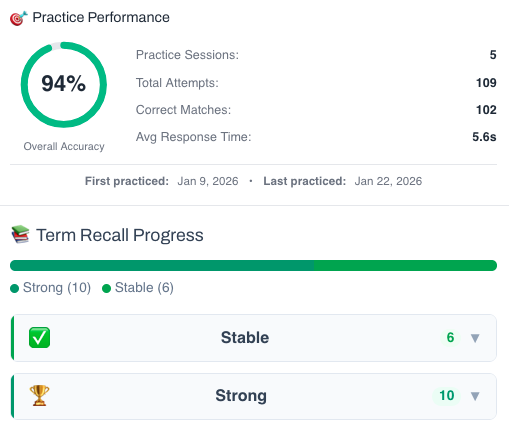
This isn’t a simple quiz — it’s a fully tracked learning system. You build knowledge through recognition, then recall, and your progress feeds directly into the Integrated Practice Bar (Writing tasks, AI Chat, and more).
- Practice sessions, accuracy, and response-time tracking
- Term strength levels (Learning → Stable → Strong)
- Personal progress history for each unit
This feature is available to YSP members.
Explore Membership Benefits🎮 Practice Games
Sentence Scrambler
Present Simple for Scheduled Future Events – Sentence Scramble
Member-Exclusive Sentence Builder
Reconstruct scrambled sentences to practice word order and develop your grammar intuition.
This feature is available to YSP members.
Explore Membership Benefits