Present Simple Third Person: He Works, She Watches, It Goes
Core PathWay
1 Why Do We Add -s?
English has a special rule. When you talk about yourself, you say ‘I work‘. When you talk about another person, you say ‘he works‘ or ‘she works‘. We add -s to the verb.
This happens with he, she, and it. It does not happen with I, you, we, or they. Look at these examples: I live in London. She lives in Paris. I study English. He studies English.
This is very important for talking about other people. You can describe your friend’s daily routine. You can say what your brother does every day. You can talk about what happens in the morning. Let’s learn the rules together.
Key Terms
2 The Three Spelling Rules
There are three ways to add the ending. Most verbs are easy. Some verbs need special spelling. Let’s look at each rule now.
Rule 1 is for most verbs. Rule 2 is for verbs that end in special letters. Rule 3 is for verbs that end in y. When you know these three rules, you can use any verb correctly.
Focus
- Most verbs: add -s (work → works, help → helps, get up → gets up)
- Verbs ending in -ch, -sh, -s, -x, -o: add -es (watch → watches, brush → brushes, go → goes, finish → finishes)
- Verbs ending in consonant + y: change y to -ies (study → studies, try → tries)
- Pronunciation: -s sounds like /s/ (works), /z/ (lives), or /ɪz/ (watches)
Rules
- Add -s to most verbs: live → lives, start → starts, help → helps
- Add -es after -ch, -sh, -s, -x, -o: teach → teaches, brush → brushes, go → goes
- Change consonant + y to -ies: study → studies, try → tries (but: play → plays because 'ay' is a vowel + y)
Examples
- He gets up at 7 o'clock every morning.
- She brushes her teeth after breakfast.
- The class starts at 9 o'clock.
Common mistake
Key Terms
3 Three People, Three Lives
Meet three people. They all have different daily routines.
Marco lives in Rome. He works in a small café near the city centre. Every morning, he gets up at 6 o’clock. He starts work at 7. Marco loves his job. In the evening, he watches football on TV. He supports Roma. At night, he studies English online. He tries to learn five new words every day. Marco wants to speak English well.
Anna lives in London. She teaches music at a school. She plays the piano very well. Anna goes to the gym three times a week. She finishes work at 4 o’clock. After work, she tries new recipes in her kitchen. She loves cooking. Anna makes dinner for her family every evening. On Saturday, she relaxes at home.
Robot-3000 is a robot assistant. It works in an office building. It helps people every day. It answers questions. It carries things. It goes everywhere in the building. Robot-3000 never sleeps. It works 24 hours a day. It finishes one job and starts another job immediately. It never stops. The robot does a very good job. Everyone likes Robot-3000.
Three very different lives. But all the verbs follow the same rules. He works. She teaches. It helps.
Key Terms
4 Write About Someone You Know
Now you can practice. Write about a person you know.
5 Remember the Rules
You now know the three spelling rules. Let’s look at them one more time.
Rule 1: Most verbs add -s. Examples: work → works, live → lives, help → helps, start → starts.
Rule 2: Verbs ending in -ch, -sh, -s, -x, -o add -es. Examples: watch → watches, brush → brushes, finish → finishes, go → goes, teach → teaches.
Rule 3: Verbs ending in consonant + y change to -ies. Examples: study → studies, try → tries.
Here is an easy way to decide. Look at the verb. Does it end in -ch, -sh, -s, -x, or -o? Add -es. Does it end in consonant + y? Change y to -ies. Everything else? Add -s.
One more important thing. This only happens with he, she, and it. With I, you, we, and they, use the base verb. I work. You work. We work. They work. But: He works. She works. It works.
Now you can describe what other people do every day. Good work!
Member-Exclusive Practice Bar
Access a wide range of integrated practice for this unit — from Vocabulary and Grammar activities to AI-curated Writing tasks and Thematic Chat practice.
This feature is available to YSP members.
Explore Membership BenefitsMember-Exclusive Vocabulary Review & Acquisition System
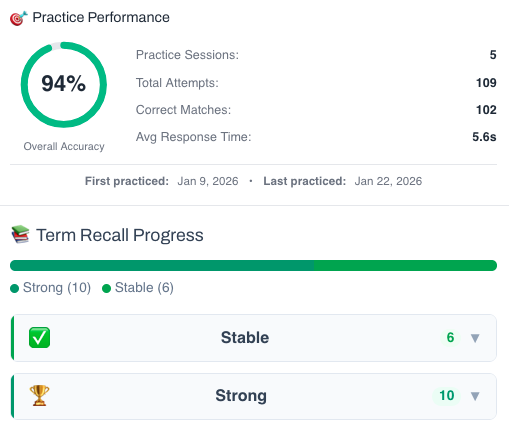
This isn’t a simple quiz — it’s a fully tracked learning system. You build knowledge through recognition, then recall, and your progress feeds directly into the Integrated Practice Bar (Writing tasks, AI Chat, and more).
- Practice sessions, accuracy, and response-time tracking
- Term strength levels (Learning → Stable → Strong)
- Personal progress history for each unit
This feature is available to YSP members.
Explore Membership Benefits🎮 Practice Games
Sentence Scrambler
Present Simple third-person singular: -s/-es/-ies endings and pronunciation – Sentence Scramble
Member-Exclusive Sentence Builder
Reconstruct scrambled sentences to practice word order and develop your grammar intuition.
This feature is available to YSP members.
Explore Membership Benefits