The Recruitment Cycle: From Staffing Need to Job Description
Core PathWay
1 Section 1. Planning the Workforce: Where Hiring Begins
Every hire begins long before a job advert goes live. It begins with workforce planning. This is the ongoing process of forecasting an organisation’s staffing needs and planning how to meet them. Think of it as the big picture — looking ahead and asking: ‘Do we have the right people, in the right roles, at the right time?’
A key part of workforce planning is managing headcount. This word has two uses. First, it means the total number of people employed in a company, department, or role. Second — and this is very useful in HR conversations — it also refers to the number of new hires that have been approved. So when someone says ‘We have budget for two new headcounts this quarter,’ they mean two new positions have been approved.
Workforce planning helps organisations identify a need — or more specifically, a staffing need. This means recognising that a team or department requires an additional or replacement employee. A staffing need might come from growth (the team is too small for the work), or from someone leaving (a gap has appeared).
When a staffing need is clear, the next question is: why does this role exist? This is where a skills gap becomes important. A skills gap is a mismatch between the skills a team currently has and the skills it needs. Identifying a skills gap gives the organisation a clear reason — and a strong argument — for hiring.
2 Section 2. Getting Approval: The Business Case and the Hiring Request
Identifying a staffing need is just the start. Before anyone can hire, the organisation needs to agree — and approve the cost.
The first step is usually building a business case. This is a written argument, usually with figures, justifying why a new hire (or any investment) should be approved. A good business case explains the problem (for example, a skills gap), the solution (a new hire), and the cost. It answers the question: ‘Why should we spend money on this?’
Once the business case is ready, the hiring manager submits a job requisition. This is the formal request a manager sends to HR to get approval to hire for a role. Think of it as the official starting gun for the recruitment process.
The job requisition then needs someone to sign off on it. To sign off on something means to give formal approval. For example: ‘Finance needs to sign off on the new headcount before we can proceed.’ Different organisations have different sign-off chains — sometimes it is the HR director, sometimes a finance team, sometimes both.
Before anyone signs off, the organisation also needs budget approval. This is confirmation that the funds exist and are authorised to cover a new hire’s salary. Without budget approval, the job requisition cannot move forward — no matter how strong the business case is.
Notice how these words work together: you build a business case → you submit a job requisition → you get sign-off → you receive budget approval. That is the approval chain in most organisations.
3 Section 3. Types of Hire and Key People in the Process
Not every hire is the same. Understanding the type of hire helps everyone involved plan the right process.
If an employee has left and the organisation needs someone to fill their role, this is called a replacement hire. The verb we use here is to backfill — to hire someone to replace an employee who has left, so the position does not stay empty. For example: ‘We need to backfill the project coordinator role — she leaves at the end of the month.’
If the role is completely new — it did not exist before — this is called a growth hire or new headcount. A growth hire adds to the team rather than replacing anyone. It usually requires a stronger business case, because the organisation is spending money on something that did not previously exist.
Now, who are the key people? Two titles often cause confusion: line manager and hiring manager.
A line manager is the manager an employee reports to directly on a day-to-day basis. This is about the ongoing working relationship.
A hiring manager is the manager responsible for a specific vacancy — usually the person the new hire will report to. In many cases, the line manager and the hiring manager are the same person. But in larger organisations, they can be different.
Both roles matter in recruitment. The hiring manager typically leads decisions about what the role looks like and who gets the job. The line manager shapes the day-to-day working environment the new hire will join.
4 Section 4. Defining the Role: From Job Analysis to Job Documentation
Once a hire is approved, the organisation needs to define the role clearly. This is where documentation becomes essential.
The process usually starts with job analysis. This is the systematic process of examining a role’s duties, responsibilities, and requirements before it is documented. In other words, before anyone writes anything down, someone needs to work out what the job actually involves. A related phrase is to scope out a role — this means to work out, in outline, what a role will actually involve before it is formally documented. Scoping out is less formal than job analysis, but the idea is similar.
Once the role is clear, the team can draw up the key documents. To draw up a job description means to write or prepare a formal document from scratch.
The main document is the job description (JD). This is a written document setting out a role’s title, duties, responsibilities, and requirements. It usually includes the job title (the official name given to the position, such as ‘Marketing Executive’) and a list of key responsibilities / duties — the main tasks the role involves.
The JD also shows the reporting line — the management structure showing who an employee is accountable to. You might also see the phrase to report to, as in: ‘This role reports to the Head of Operations.’
Alongside the JD, organisations often produce a person specification — a document listing the skills, experience, and qualities a candidate needs to do the job well — and a job specification, which focuses on the education, training, experience, and skills required. These two documents are often used together.
Both documents divide requirements into essential criteria (requirements a candidate absolutely must meet) and desirable criteria (requirements that are a bonus but not mandatory). This distinction is very important for candidates reading a job advert.
Some organisations — especially in structured or government hiring — also use KSAs, which stands for knowledge, skills, and abilities. KSAs are used to evaluate candidates in a structured way.
Finally, getting all of this agreed requires stakeholder buy-in. To get buy-in means to secure agreement and support from the people affected by or involved in a decision. Without buy-in from the right people, even a well-written job description can get stuck.
Member-Exclusive Practice Bar
Access a wide range of integrated practice for this unit — from Vocabulary and Grammar activities to AI-curated Writing tasks and Thematic Chat practice.
This feature is available to YSP members.
Explore Membership BenefitsMember-Exclusive Vocabulary Review & Acquisition System
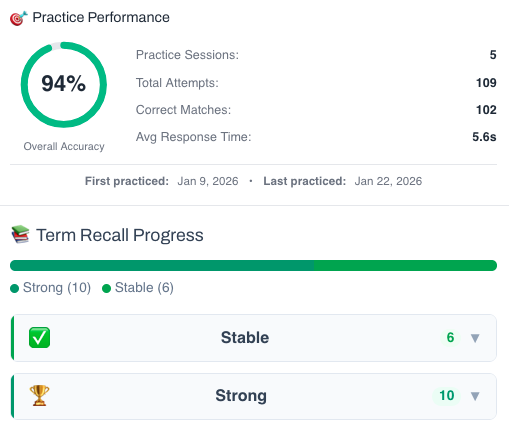
This isn’t a simple quiz — it’s a fully tracked learning system. You build knowledge through recognition, then recall, and your progress feeds directly into the Integrated Practice Bar (Writing tasks, AI Chat, and more).
- Practice sessions, accuracy, and response-time tracking
- Term strength levels (Learning → Stable → Strong)
- Personal progress history for each unit
This feature is available to YSP members.
Explore Membership Benefits