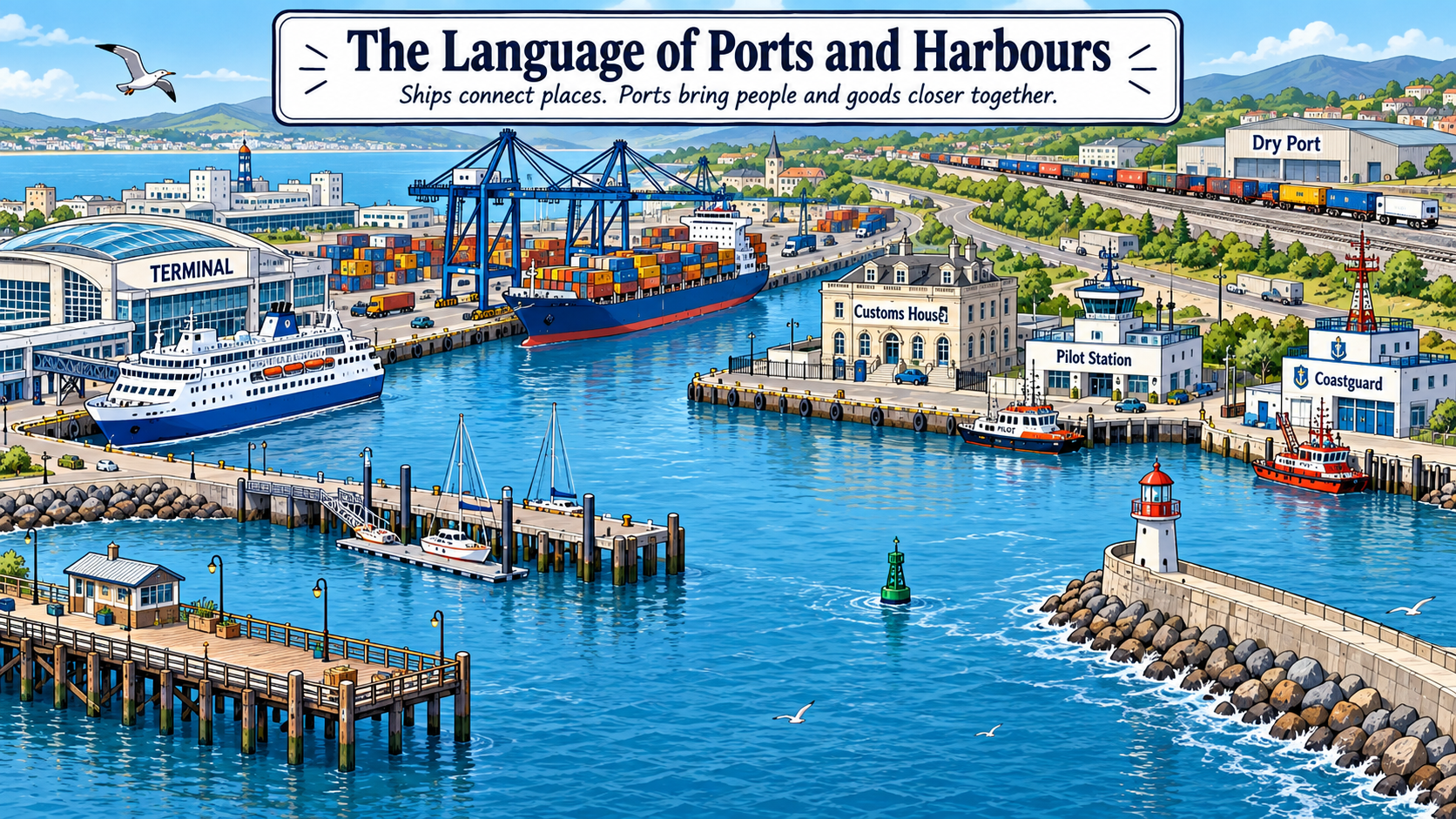
The Language of Shipyards and Dry Docks
Core PathWay
1 Section 1. Welcome to the Shipyard
Ready to build your vocabulary for shipyards and dry docks? Here is where we start. A shipyard is a large industrial area next to water where ships are built or repaired. It is not just one building — it is a whole site with many different areas, structures, and workshops, and each one has a specific name and purpose. Think of a shipyard as a small city that exists only to build and maintain ships. Some shipyards are very old, with buildings that go back hundreds of years. Others are modern industrial sites with huge cranes and computer-controlled equipment. In both cases, the vocabulary is the same. To talk about a shipyard confidently, you need to know what each area is called and what happens there. That is exactly what this pack gives you. We will move through the site from the water’s edge to the workshops at the back, picking up the key terms as we go.
2 Section 2. Where Ships Meet the Water — Docks and Launch Structures
The most important part of any shipyard is the place where a ship goes into the water — or comes out of it. Let’s look at the main structures here. A dry dock is an enclosed basin that can be pumped free of water so that workers can reach the bottom and sides of a ship. When the work is done, the dock is flooded again and the ship floats out. A graving dock is a type of dry dock cut into the ground, usually lined with stone or concrete. The word ‘graving’ comes from an old word meaning to clean a ship’s hull. A floating dry dock is different — it is a large U-shaped structure that floats on the water. It can be sunk to let a ship in, then raised to lift the ship clear of the water. A construction dock is a dry dock used specifically for building new ships, not repairing old ones. A slipway is a sloped surface that leads from the land into the water. A ship can be built on a slipway and then launched by sliding down into the sea. A marine railway works on a similar idea — it uses a wheeled cradle on rails to move a ship between the water and the yard. Finally, a ship lift is a platform that raises or lowers a ship vertically, like a lift in a building.
3 Section 3. Where Ships Are Built and Finished — Berths and Quays
Not all shipyard work happens in a dock. Some of the most important areas are the places where a ship is constructed or completed while it sits alongside a wall or on a prepared surface. A building berth is the place in a shipyard where a new ship is constructed. It can be on a slipway, in a dock, or on a flat area of ground. Workers assemble the ship’s structure here before it is launched. Once a ship has been launched, it is often not completely finished. It needs equipment, systems, and fittings to be added. This final work happens at a fitting-out quay, which is a long wall or platform alongside deep water where the ship can float while workers complete the job. The fitting-out quay is sometimes called a fitting-out berth. Think of the building berth as the place where the shell of the ship is made, and the fitting-out quay as the place where it becomes a working vessel. These two areas handle different stages of the same process, so it helps to keep them clearly separate in your mind.
4 Section 4. Lifting and Moving — The Goliath Crane
Building a ship means moving enormous pieces of steel. A single hull section can weigh hundreds of tonnes, so shipyards need very powerful lifting equipment. The most important of these is the Goliath crane. This is a very large crane that straddles the building area on two tall legs, like a bridge on wheels. It can travel along rails and lift huge steel sections into position. The name ‘Goliath’ comes from the biblical giant, and it fits — these cranes are some of the biggest machines in any industrial site. You will often see a Goliath crane positioned directly over a building berth or a construction dock. It is one of the most recognisable features of a modern shipyard. Notice that ‘Goliath crane’ is written with a capital G because it refers to a specific type of crane with a proper name. When you describe a shipyard, the Goliath crane is usually the first thing people can see from a distance.
5 Section 5. The Workshops — Making the Parts
Behind the water’s edge, a shipyard has many specialist workshops. Each one produces or prepares a specific part of the ship. A fabrication shed is a large workshop where steel sections are cut, shaped, and welded together to form parts of the ship’s hull. A plating shed is similar — this is where flat steel plates are worked into the curved shapes needed for the ship’s body. A paint shed is an enclosed area where large sections of the ship are painted before assembly. Painting inside a shed gives better results because the conditions are controlled. The propeller shop is where propellers are made, balanced, and finished. Propellers must be very precise, so this is skilled work. The boiler shop is a workshop for building and repairing boilers — the large containers that produce steam for power or heating on a ship. The forge is where metal is heated until it is soft and then shaped by hammering. Forged metal is very strong, so forged parts are used where strength is critical. A mould loft is a large, open floor space — often on an upper level — where the exact shapes of the ship’s parts are drawn out at full size. Workers use these drawings as templates. The shipwright’s shed is the general workshop for shipwrights — the skilled workers who build and repair the wooden or steel structures of a ship.
6 Section 6. Older Workshops — History in the Yard
Some shipyard buildings come from an earlier time, when ships were made of wood and powered by wind. Even today, you can find these structures in historic yards. A mast house is a building where masts — the tall vertical poles that carry a ship’s sails — were made and stored. In the age of sailing ships, the mast house was one of the most important buildings in the yard. A rope walk is a very long, narrow building where rope was made. Rope-making needs a long straight space because the fibres are twisted together over a great distance. Some rope walks are several hundred metres long. A sail loft is a large, open space — usually on an upper floor — where sails were cut and sewn. Sails are very large, so a sail loft needed a big, clear floor. A victualling store is a store where food, drink, and other supplies for the ship’s crew were kept. ‘Victualling’ means providing food and provisions. A timber pond is a pool of water where large pieces of timber were stored. Keeping wood in water stopped it from cracking and helped preserve it. These older terms are still used in historic shipyards and in texts about naval history, so it is worth knowing them.
7 Section 7. Now Hear It in Use
You have met the key terms of the shipyard — from the dry dock at the water’s edge to the forge and sail loft at the back of the yard. Now hear them working in a real conversation. Listen to how these two speakers use the vocabulary naturally as they walk through a shipyard together and discuss a repair job.
💬 Dialogue 1: A Tour of the Yard
Marina is a new project coordinator at a busy shipyard. Tomasz is an experienced shipwright who is showing her around the site. They are discussing where a damaged vessel will be repaired and what work needs to be done.
Tomasz: “Right, Marina, let me show you where the Adriana Star is going to be taken in. She came in last night and she needs hull work below the waterline, so we are putting her in the graving dock on the south side.”
Marina: “Is that the one near the fitting-out quay? I walked past it this morning but I wasn’t sure what it was used for.”
Tomasz: “That’s right. The fitting-out quay is just to the east of it. Once we finish the hull repairs in the dry dock, she’ll move across there so the electrical team can complete their work. It’s a good system — keeps the dock free for the next vessel.”
Marina: “I see — so the graving dock and the dry dock are the same thing? I wasn’t sure if they were different facilities.”
Tomasz: “Good question. A graving dock is a type of dry dock — it’s a permanent basin cut into the ground. You pump the water out, the ship sits on blocks, and the workers can get under the hull. We also have a floating dry dock on the north side, which is a different structure, but it does the same basic job.”
Marina: “That makes sense. And what about that large sloped area I saw near the water’s edge on the west side? It looked like some kind of ramp going into the water.”
Tomasz: “That’s the slipway. We use it to launch smaller vessels after construction, or to haul them out of the water for maintenance. It’s one of the oldest methods in the shipyard — simple but effective. Next to it you’ll see the marine railway, which works on a similar principle but uses a tracked cradle to move the vessel up and down.”
Marina: “Right. And further back from the water — those large buildings near the building berth — what are those used for?”
Tomasz: “Good eye. The building berth is where new vessels are constructed — it’s the main construction area of the shipyard. Those buildings alongside it are the fabrication shed and the plating shed. The fabrication shed is where the steel sections are cut and assembled into large blocks. The plating shed is where the steel plates are prepared before they go to the berth.”
Marina: “So the steel is prepared in the plating shed, assembled into blocks in the fabrication shed, and then the blocks go to the building berth to be put together as the ship. Is that the right order?”
Tomasz: “Exactly right — you’ve got it. And once the hull is complete at the building berth, the vessel is launched and moves to the fitting-out quay for the final systems work. Oh, and before I forget — you’ll want to know about the Goliath crane. That’s the massive overhead crane you can see spanning the whole building berth. It lifts the steel blocks into position during construction. Without it, we couldn’t assemble sections that weigh hundreds of tonnes.”
Marina: “I did notice that crane — it’s hard to miss. So it only works over the building berth, or does it move to other parts of the shipyard as well?”
Member-Exclusive Practice Bar
Access a wide range of integrated practice for this unit — from Vocabulary and Grammar activities to AI-curated Writing tasks and Thematic Chat practice.
This feature is available to YSP members.
Explore Membership BenefitsMember-Exclusive Vocabulary Review & Acquisition System
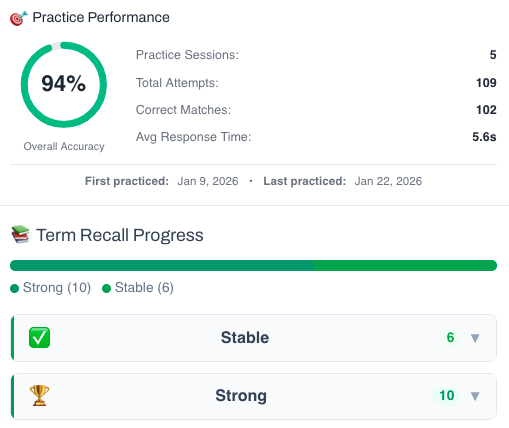
This isn’t a simple quiz — it’s a fully tracked learning system. You build knowledge through recognition, then recall, and your progress feeds directly into the Integrated Practice Bar (Writing tasks, AI Chat, and more).
- Practice sessions, accuracy, and response-time tracking
- Term strength levels (Learning → Stable → Strong)
- Personal progress history for each unit
This feature is available to YSP members.
Explore Membership Benefits