Adjective + Present Participle Compounds: Active, Vivid, Precise
Core PathWay
1 Section 1. Two Words, One Powerful Idea
English has a remarkable habit: it takes two separate words, joins them with a hyphen, and turns them into a single, precise adjective. The result is a compound adjective — compact, descriptive, and extremely common in professional writing, journalism, and advertising.
Consider the difference between these two options: ‘a solution that lasts a long time’ versus ‘a long-lasting solution.’ Same meaning — but the compound version is sharper, more confident, and far more natural in professional English. This is exactly what adjective + present participle compounds do: they compress a descriptive phrase into one efficient modifier.
You have already met compounds built with past participles — forms like well-known or hard-earned, which carry a passive or completed meaning. This page focuses on a different family: compounds built with present participles (the -ing form). These carry an active, ongoing quality. A fast-growing company is not just large — it is actively growing, right now. A good-looking candidate does not just look acceptable — the quality is vivid and immediate. That sense of energy and process is what makes this compound type so effective.
Here are three examples to set the scene:
‘They have developed a long-lasting solution rather than a temporary fix.’
‘She is one of the hardest-working people in the department.’
‘The government introduced far-reaching changes to the tax system.’
Notice how each compound does the work of a whole phrase — efficiently, precisely, and with real descriptive power.
2 Section 2. How These Compounds Work — Form, Meaning, and Contrast
Understanding this compound type is straightforward once you see the pattern. The structure is simple, but the meaning it creates is always active and ongoing — and that is what separates it from the past participle compounds you have already studied. Here is everything you need to know to build and decode these forms confidently.
Focus
- FORM: The structure is ADJECTIVE + PRESENT PARTICIPLE (-ing form). The two parts are joined by a hyphen when the compound comes before a noun (attributive position). Example: a fast-growing company.
- POSITION RULE: Use a hyphen before the noun — 'a hard-working employee'. When the compound comes after a linking verb (predicative position), the hyphen is often dropped — 'She is hard working.' However, many writers keep the hyphen in both positions for clarity, and this is widely accepted.
- MEANING: The compound describes an active, ongoing characteristic of the noun. It answers the question: 'What is this noun actively doing or continuously exhibiting?' A 'slow-moving' queue is a queue that is moving slowly. A 'long-lasting' effect is an effect that lasts a long time.
- DECODING RULE: To understand any new adjective + present participle compound, reverse it into a relative clause. ADJECTIVE + PRESENT PARTICIPLE + NOUN → NOUN + that/which + VERB + ADJECTIVE/ADVERB. Example: 'a fast-growing sector' → 'a sector that is growing fast'. Example: 'a good-looking design' → 'a design that looks good'.
- INTENSIFICATION: The adjective element can be modified to intensify meaning, especially in comparatives and superlatives. Example: 'the hardest-working team', 'an ever-growing problem', 'an increasingly far-reaching policy'.
- WORD ORDER IS FIXED: The adjective always comes first. You cannot reverse the parts. 'Growing-fast' is not a compound — it is simply wrong.
- CONTRAST WITH PAST PARTICIPLE COMPOUNDS: This is the key distinction. Past participle compounds (covered previously) carry a PASSIVE or RESULTING-STATE meaning — something has been done TO the noun. Present participle compounds carry an ACTIVE or ONGOING meaning — the noun is doing something or continuously exhibiting a quality. Compare: 'a highly-regarded researcher' (passive — she IS regarded highly by others) vs. 'a hard-working researcher' (active — she IS working hard, continuously). The participle type signals the direction of the action.
Rules
- RULE 1 — BUILD IT: Take an adjective or adverb + the -ing form of a verb. Join them with a hyphen before a noun. → good + looking = good-looking (a good-looking proposal)
- RULE 2 — DECODE IT: Reverse any compound into a relative clause to check its meaning. → 'a slow-moving process' = 'a process that is moving slowly'.
- RULE 3 — ACTIVE MEANING ONLY: Present participle compounds always describe something the noun is actively doing or an ongoing quality it has. If the meaning is passive (something done TO the noun), use a past participle compound instead.
- RULE 4 — HYPHEN BEFORE THE NOUN: Always hyphenate when the compound modifies a noun directly. The hyphen may be dropped in predicative position, but keeping it is acceptable and often clearer.
- RULE 5 — FIXED ORDER: Adjective/adverb first, present participle second. Never reverse the order.
Examples
- 'The report highlighted the far-reaching consequences of the policy change, affecting industries across the entire region.' [far-reaching = consequences that reach far — active, ongoing scope]
- 'We are looking for a self-starting, forward-thinking candidate who can manage projects independently from day one.' [self-starting = actively starting things themselves; forward-thinking = actively thinking ahead]
- 'The slow-moving negotiations frustrated both sides, but neither was willing to make the first concession.' [slow-moving = the negotiations are moving slowly — an active, ongoing process]
Common mistake
3 Section 3. Your Reference Set — 30 Essential Compounds
Below are 30 of the most useful adjective + present participle compound adjectives, organised by category. Each one is worth knowing actively — you will encounter them in professional writing, journalism, and everyday conversation.
DESCRIBING APPEARANCE OR IMPRESSION
• good-looking — attractive in appearance; pleasant to look at
• fine-looking — having an impressive or distinguished appearance
• sharp-looking — appearing smart, professional, and well-presented
• odd-looking — having a strange or unusual appearance
• rough-looking — appearing untidy, worn, or slightly threatening
DESCRIBING EFFORT, BEHAVIOUR, AND ATTITUDE
• hard-working — consistently putting in great effort; diligent and industrious
• easy-going — relaxed, calm, and not easily upset or stressed
• self-starting — able to begin tasks and work independently without being told
• forward-thinking — planning ahead; open to new ideas and future possibilities
• free-thinking — willing to question accepted ideas and form independent opinions
DESCRIBING SCALE, REACH, AND IMPACT
• far-reaching — having a wide or significant effect, often beyond what was expected
• wide-ranging — covering a large number of topics, areas, or issues
• all-consuming — taking up all of a person’s time, energy, or attention
• ever-growing — continuously increasing in size, number, or importance
• fast-growing — increasing in size or importance at a rapid rate
DESCRIBING DURATION AND PERSISTENCE
• long-lasting — continuing for a long period of time; not temporary
• long-running — having continued for a long time, often used for disputes, shows, or projects
• slow-moving — progressing or changing at a very slow pace
• quick-acting — producing an effect or result very rapidly
• short-lived — lasting only a brief time; ending sooner than expected
DESCRIBING PROCESSES AND CHANGE
• fast-moving — developing, changing, or progressing at a rapid pace
• slow-burning — developing gradually over a long period before becoming significant
• high-performing — achieving results that are significantly above average
• low-yielding — producing less output or profit than expected or desired
• ground-breaking — completely new and innovative; introducing ideas that change a field
DESCRIBING RISK, THREAT, AND CHALLENGE
• far-reaching — (also used here) with the sense of consequences that extend widely
• life-threatening — likely to cause death if not addressed immediately
• nerve-wracking — causing extreme anxiety or tension
• eye-catching — immediately noticeable; attracting attention quickly
• thought-provoking — making a person think deeply about an issue or question
Notice the pattern across all 30: each compound describes something the noun is actively doing or an ongoing quality it continuously has. That active, present-tense energy is the defining feature of this compound family — and what makes these adjectives so vivid and precise in use.
4 Recap: The Key Takeaways
Here is what this page has covered.
Form: Adjective + present participle (-ing) → hyphenated compound adjective. Always hyphenate before a noun. Word order is fixed: adjective first, participle second.
Meaning: These compounds describe an active, ongoing characteristic of the noun. To decode any new compound, reverse it: ‘a fast-growing sector’ = ‘a sector that is growing fast.’
The key contrast: Present participle compounds are ACTIVE — the noun is doing something. Past participle compounds (which you have already studied) are PASSIVE — something has been done to the noun. Hard-working (active: she works hard) versus well-regarded (passive: she is regarded well by others). Getting this distinction right is what separates confident, precise use from guesswork.
The 30 compounds in Section 3 cover the most useful examples across six real-world categories: appearance, behaviour, scale, duration, process, and risk. These are the forms you are most likely to encounter — and need — in professional and academic English.
The next time you read ‘a ground-breaking study’ or ‘a nerve-wracking presentation,’ you will know exactly what is happening: a two-part compound, an active meaning, and a level of precision that a longer phrase simply cannot match.
Member-Exclusive Practice Bar
Access a wide range of integrated practice for this unit — from Vocabulary and Grammar activities to AI-curated Writing tasks and Thematic Chat practice.
This feature is available to YSP members.
Explore Membership BenefitsMember-Exclusive Vocabulary Review & Acquisition System
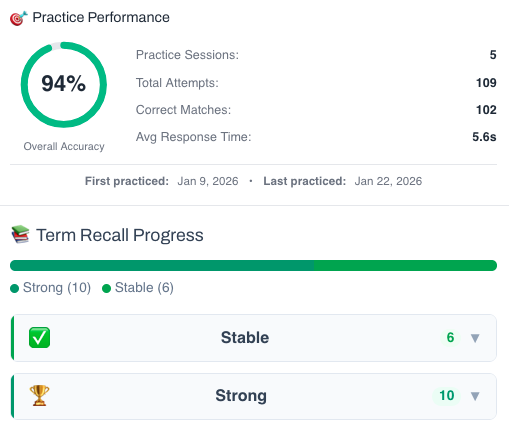
This isn’t a simple quiz — it’s a fully tracked learning system. You build knowledge through recognition, then recall, and your progress feeds directly into the Integrated Practice Bar (Writing tasks, AI Chat, and more).
- Practice sessions, accuracy, and response-time tracking
- Term strength levels (Learning → Stable → Strong)
- Personal progress history for each unit
This feature is available to YSP members.
Explore Membership Benefits🎮 Practice Games
Sentence Scrambler
ADJECTIVE + PRESENT PARTICIPLE COMPOUNDS – Sentence Scramble
Member-Exclusive Sentence Builder
Reconstruct scrambled sentences to practice word order and develop your grammar intuition.
This feature is available to YSP members.
Explore Membership Benefits