Adverb / Adjective + Past Participle Compounds
Core PathWay
1 Section 1. The Compound That Does Everything
If you had to pick one compound type that punches above its weight in written English, this is it. Adverb/adjective + past participle compounds are everywhere — in journalism, academic writing, business reports, and everyday conversation. They are compact, precise, and immediately recognisable once you know the pattern.
The idea is simple: take an adverb or adjective and attach it to a past participle. Hyphenate the two words, and you have a single compound adjective that can describe a noun with remarkable efficiency. Instead of saying ‘a figure who is well known in the tech industry’, you write ‘a well-known figure in the tech industry.’ One hyphenated unit. Same meaning. Much sharper.
The golden rules are straightforward. First, when the compound comes before the noun it describes, you hyphenate it: a deeply-rooted tradition, a highly-regarded scientist. Second, when it comes after a linking verb like be, seem, or become, the hyphen is usually dropped: The tradition is deeply rooted. The scientist is highly regarded. Third, the past participle always carries the core meaning — the adverb or adjective tells you how or to what degree. So in open-minded, the person’s mind has been ‘opened’ in a broad, receptive way. In soft-spoken, the voice has been ‘spoken’ softly. The modifier shapes the participle; the participle anchors the meaning.
Here is what this pattern looks like in action at B2 level: ‘She’s a well-known figure in the tech industry, though she rarely gives interviews.’ ‘His deeply-rooted scepticism made it difficult to convince him of anything.’ ‘The open-minded approach they took to the project was genuinely refreshing.’ Notice how each compound replaces a longer phrase without losing any precision — that is exactly why native speakers and skilled writers reach for this pattern so often.
2 Section 2. Grammar Guide — How to Build and Decode These Compounds
This guide gives you everything you need to form these compounds correctly and to work out the meaning of unfamiliar ones when you meet them. Once you see the system, you will be able to build your own compounds with confidence — and that is a genuinely powerful skill at B2 and above.
The pattern has two moving parts: the modifier (an adverb or adjective) and the base (a past participle). Your job is to understand how they combine, when to hyphenate, and how to read the meaning from the parts. Use the rules and examples below as your toolkit.
Focus
- PART 1 — THE MODIFIER: This is the first element. It can be an adverb (well, highly, deeply, widely, newly, broadly, long, short, hard) or an adjective (open, broad, soft, free, clear, fair, good, ill, kind). The modifier tells you HOW or TO WHAT DEGREE the action of the past participle applies.
- PART 2 — THE BASE (PAST PARTICIPLE): This is the second element. It is always a past participle — a verb form typically ending in -ed, -en, -d, -t, or -n (known, spoken, regarded, rooted, minded, founded, written, read, built, grown, paid, made, established). The participle carries the core descriptive meaning.
- PART 3 — HYPHENATION RULE: Hyphenate the compound when it appears BEFORE the noun it modifies (attributive position): a well-known author, a deeply-rooted belief, a newly-appointed director. Drop the hyphen when it appears AFTER a linking verb (predicative position): The author is well known. The belief is deeply rooted. The director is newly appointed.
- PART 4 — DECODING UNFAMILIAR COMPOUNDS: To work out the meaning of a new compound, read it as a mini-sentence using 'in a ___ way' or 'to a ___ degree'. Example: broadly-accepted = accepted in a broad way (= by many people). Hard-earned = earned in a hard way (= with great effort). This strategy works for almost every compound you will encounter.
- PART 5 — BUILDING YOUR OWN: Choose a past participle that describes a state or quality. Then ask: How? To what degree? By whom? With what? Choose an adverb or adjective that answers one of those questions. Combine and hyphenate. Test it: does it describe the noun clearly? If yes, it works. Examples you can build: widely + read = widely-read; long + established = long-established; hard + working is NOT this pattern (working is a present participle — a different type); free + range = free-range (adjective + noun — also different). Stay with past participles for this pattern.
- PART 6 — ADVERB MODIFIERS VS ADJECTIVE MODIFIERS: Adverb modifiers (well, highly, deeply, widely) describe HOW the action happened: well-prepared, highly-skilled, deeply-felt. Adjective modifiers (open, broad, soft, free, clear) describe a QUALITY of the resulting state: open-minded, broad-shouldered, soft-spoken, clear-sighted. Both work the same way grammatically — the difference is in the flavour of meaning they add.
Rules
- Rule 1 — Form: [adverb OR adjective] + [past participle] → hyphenated compound adjective. The modifier always comes first; the past participle always comes second.
- Rule 2 — Hyphenation: Hyphenate BEFORE a noun (attributive). No hyphen AFTER a linking verb (predicative). This rule applies to almost all compound adjectives in English, not just this type.
- Rule 3 — The past participle is the anchor: The core meaning lives in the past participle. The modifier shapes or intensifies it. If you are unsure of the meaning, identify the past participle first, then ask how the modifier changes it.
- Rule 4 — Adverbs ending in -ly: Most -ly adverbs do NOT hyphenate with past participles, even in attributive position. Write: a widely accepted view (no hyphen), a highly regarded expert (no hyphen). This is a standard exception to the hyphenation rule. Short adverbs without -ly (well, hard, long, short, ill) DO hyphenate: well-known, hard-earned, long-established.
- Rule 5 — Fixed vs productive compounds: Some compounds are fully fixed and listed in dictionaries (well-known, open-minded, hard-earned). Others are productive — you can create them on the fly to describe a specific situation (a hastily-prepared report, a newly-discovered species). Both types are correct; fixed compounds are simply more frequent.
- Rule 6 — Register: This compound type is more common in written English than in casual speech. In conversation, speakers often use longer phrases instead. In writing — especially journalism, academic prose, and professional reports — these compounds are extremely frequent. Knowing them will significantly improve both your reading fluency and your writing precision.
Examples
- She delivered a well-prepared presentation that impressed the entire board. [BEFORE noun → hyphen; adverb 'well' + past participle 'prepared']
- The policy has been widely criticised, but no alternative has been proposed. [AFTER linking verb → no hyphen; -ly adverb 'widely' + past participle 'criticised' → no hyphen even in attributive use]
- His long-established reputation in the field meant that people trusted his judgement immediately. [BEFORE noun → hyphen; adjective/adverb 'long' + past participle 'established']
Common mistake
3 Section 3. Your Core Collection — 30 Essential Compounds
The thirty compounds below are a carefully selected starting set — chosen for frequency, usefulness at B2 level, and relevance to exams and professional writing. Think of them as your core collection. In reality, there are hundreds of these compounds in active use, and the grammar guide in Section 2 gives you the tools to decode any new one you encounter.
The compounds are grouped by theme to make them easier to learn and remember. Study the definitions, notice the patterns, and look for opportunities to use them in your own writing.
PEOPLE — CHARACTER AND PERSONALITY
1. well-known — familiar to many people; famous in a particular field. She is a well-known figure in environmental law.
2. open-minded — willing to consider new ideas and different points of view. An open-minded interviewer makes candidates feel comfortable.
3. strong-willed — determined; not easily persuaded to change direction. A strong-willed leader can be an asset in a crisis.
4. ill-tempered — easily annoyed; tending to be in a bad mood. His ill-tempered response surprised everyone in the room.
5. soft-spoken — speaking quietly and gently; not forceful in manner. Despite being soft-spoken, she commanded the room’s full attention.
6. quick-witted — able to think fast and respond cleverly. A quick-witted candidate handles unexpected questions with ease.
7. highly-regarded — respected and admired by others. She is a highly regarded authority on climate policy. (Note: -ly adverb → no hyphen in attributive use: a highly regarded expert)
8. well-respected — earning genuine admiration through consistent behaviour or achievement. He is a well-respected member of the academic community.
9. broad-minded — tolerant of different opinions, lifestyles, and cultures. A broad-minded approach to leadership encourages innovation.
10. self-assured — calm and confident in one’s own abilities. The self-assured tone of her proposal convinced the committee immediately.
PEOPLE — ABILITIES AND EXPERIENCE
11. well-educated — having received a thorough, high-quality education. A well-educated workforce is central to economic growth.
12. highly-skilled — possessing advanced technical or professional abilities. The region is struggling to attract highly skilled workers. (no hyphen: -ly adverb)
13. well-qualified — having the right training, experience, or credentials for a role. Only well-qualified applicants were invited to the second interview.
14. widely-read — having read extensively across many subjects. A widely read journalist brings depth to every story. (no hyphen: -ly adverb)
15. hard-earned — achieved through significant effort and difficulty. Her hard-earned promotion came after years of dedication.
16. long-established — existing for a long time; with deep roots in a community or field. The firm has a long-established reputation for integrity.
17. newly-appointed — recently given a new role or position. The newly appointed director will address the team on Monday.
18. well-prepared — having done thorough preparation before an event or task. A well-prepared candidate is rarely caught off guard.
IDEAS, BELIEFS, AND ATTITUDES
19. deeply-rooted — strongly established in someone’s thinking or in a culture; difficult to change. His deeply-rooted scepticism made persuasion almost impossible.
20. widely-accepted — agreed upon or believed by most people. It is a widely accepted principle that transparency builds trust. (no hyphen: -ly adverb)
21. well-founded — based on solid evidence or good reasoning. Her concerns about the project timeline were entirely well-founded.
22. deeply-held — believed or felt very strongly and sincerely. Deeply-held convictions are rarely changed by a single argument.
23. long-held — believed or maintained for a long period of time. The report challenged several long-held assumptions about consumer behaviour.
24. ill-conceived — planned or thought out poorly; likely to cause problems. The ill-conceived policy was withdrawn within weeks of its launch.
LANDSCAPES, PLACES, AND BUILT ENVIRONMENTS
25. well-maintained — kept in good condition through regular care and attention. The well-maintained gardens attracted visitors throughout the year.
26. densely-populated — having a large number of people living in a small area. Densely populated urban centres face unique infrastructure challenges. (no hyphen: -ly adverb)
27. newly-built — recently constructed. The newly-built stadium can accommodate over sixty thousand spectators.
28. long-abandoned — left empty or unused for a long period. The long-abandoned factory was finally converted into apartments.
29. well-connected — having good transport links to other places; or, of a person, having useful contacts. The town is well-connected by rail to the capital.
30. purpose-built — designed and constructed for a specific use from the beginning. The team moved into a purpose-built research facility on the edge of the city.
Thirty compounds is a solid foundation — but it is genuinely just the beginning. Every time you read a quality newspaper article or academic text, you will find new ones. Keep a personal list, note the pattern, and your collection will grow naturally.
4 Recap — What You Have Learned
This page has introduced one of the most productive and widely used compound types in English. Here is a quick summary of the key points.
The pattern is simple: adverb or adjective + past participle → hyphenated compound adjective. The modifier tells you how or to what degree; the past participle carries the core meaning.
The hyphenation rules are the detail most learners get wrong. Hyphenate before a noun (a well-known author). Drop the hyphen after a linking verb (the author is well known). And remember: -ly adverbs never take a hyphen, even before a noun (a widely accepted view, a highly skilled engineer).
Decoding any unfamiliar compound is straightforward: find the past participle, then ask how the modifier shapes it. Hard-earned = earned with great difficulty. Newly-appointed = appointed very recently. The system is consistent.
Building your own compounds is the real prize. Choose a past participle that describes a quality. Add an adverb or adjective that answers how or to what degree. Test it against a noun. If it communicates clearly and precisely, it works.
The thirty compounds in Section 3 are your core collection — a starting point, not a limit. English has hundreds of these compounds in active circulation. The more you read, the more you will notice them, and the more naturally you will reach for them in your own writing.
Member-Exclusive Practice Bar
Access a wide range of integrated practice for this unit — from Vocabulary and Grammar activities to AI-curated Writing tasks and Thematic Chat practice.
This feature is available to YSP members.
Explore Membership BenefitsMember-Exclusive Vocabulary Review & Acquisition System
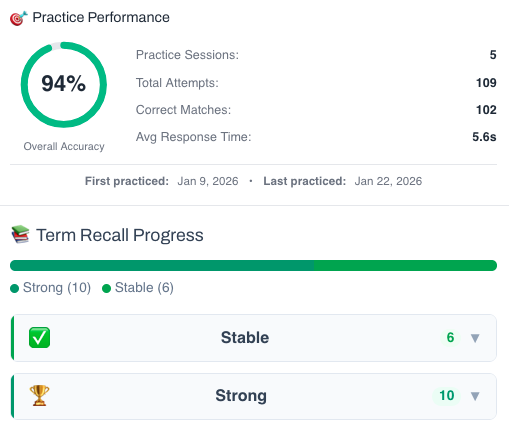
This isn’t a simple quiz — it’s a fully tracked learning system. You build knowledge through recognition, then recall, and your progress feeds directly into the Integrated Practice Bar (Writing tasks, AI Chat, and more).
- Practice sessions, accuracy, and response-time tracking
- Term strength levels (Learning → Stable → Strong)
- Personal progress history for each unit
This feature is available to YSP members.
Explore Membership Benefits🎮 Practice Games
Sentence Scrambler
ADVERB/ADJECTIVE + PAST PARTICIPLE COMPOUNDS – Sentence Scramble
Member-Exclusive Sentence Builder
Reconstruct scrambled sentences to practice word order and develop your grammar intuition.
This feature is available to YSP members.
Explore Membership Benefits