Just, Already, and Yet: Talking About Recent Actions
Core PathWay
1 Morning Rush: When Timing Matters
It’s 7:30 on a Tuesday morning. In the Martinez family kitchen, everyone is moving fast.
‘Has anyone fed the dog yet?’ Maria calls from upstairs. ‘I’ve just done it,’ her son replies. ‘And I’ve already packed my sports bag.’ Maria feels relieved. One less thing to worry about. Meanwhile, her husband Marco is looking worried. ‘I haven’t called the plumber yet. He’s coming at nine, right?’ These three small words – just, already, and yet – are doing important work in this conversation.
When we use just, we’re saying something happened very recently, maybe seconds or minutes ago. It creates a sense of ‘this is fresh news.’ When we use already, we’re often surprised or pleased that something happened sooner than expected. It communicates relief or satisfaction. When we use yet in questions and negatives, we’re talking about things we expected to happen but haven’t happened so far. It creates gentle pressure or urgency.
These three adverbs work with the Present Perfect tense to connect past actions to the present moment. They help us talk about things that matter right now, even though they happened in the recent past. In busy morning situations, job contexts, or any time coordination matters, these words become essential tools. They’re not just grammar – they’re how we manage expectations, share updates, and keep life organized.
Key Terms
2 How Just, Already, and Yet Work
Focus
- JUST goes between ‘have/has’ and the past participle: I’ve just finished
- ALREADY goes between ‘have/has’ and the past participle, or at the end: She’s already left / She’s left already
- YET goes at the end of questions and negatives: Have you eaten yet? / I haven’t eaten yet
Rules
- Use JUST to show very recent completion (seconds, minutes, or hours ago). It answers the question ‘When did this happen?’ with ‘Very recently!’
- Use ALREADY in affirmative sentences to show something happened sooner than expected. It often expresses surprise, relief, or satisfaction.
- Use YET in questions (Have you…yet?) to ask if an expected action has happened. Use YET in negatives (haven’t…yet) to say an expected action hasn’t happened but might happen soon.
Examples
- I’ve just checked my email. There’s a message from the boss. (very recent action, happened moments ago)
- Don’t worry about the dishes. I’ve already done them. (sooner than expected, expressing helpfulness)
- Have you finished the report yet? The meeting starts in ten minutes. (asking about expected completion)
Common mistake
Understanding where to put these adverbs and when to use them makes your English sound natural and fluent. Each adverb has its own personality and position in the sentence.
The rules are clear and consistent. Once you learn the patterns, you can use them confidently in any situation where timing matters. Let’s break down each adverb separately so you can see exactly how they work.
Key Terms
🎧 The Tuesday morning rush – Listen first, then read the story
3 The Rodriguez Family: Tuesday Morning Rush
At 7:15 a.m., the Rodriguez household is in full morning mode. Elena has an important appointment with a client at 9:30, her husband David is catching a 10 o’clock train, and their teenage daughter Sofia has a school exam.
Elena rushes into the kitchen. ‘Has anyone seen my keys?’ she asks. ‘They’re on the table,’ David replies. ‘I’ve just found them under yesterday’s newspaper.’ Elena sighs with relief. ‘Thanks! Have you had breakfast yet?’ David shakes his head. ‘Not yet. I’ve already had a shower and I’ve already packed my bag, but I haven’t eaten yet.’ He opens the fridge. ‘Oh good, you’ve already bought the groceries. I thought we’d run out of milk.’
Upstairs, Sofia is getting ready for her exam. She’s already prepared her notes and she’s just finished getting dressed. ‘Mum!’ she calls down. ‘Have you called the school yet? They need to know I’ll be late tomorrow for the dentist.’ Elena groans. ‘I haven’t called them yet. I’ll do it from the car.’
David is now making coffee. ‘Has the plumber arrived yet?’ he asks. ‘He said between 8 and 8:30.’ Elena checks her watch. ‘Not yet. But I’ve just sent him a message to confirm.’ She looks around the kitchen. ‘Have you done the laundry yet?’ David laughs. ‘I’ve already started it! It’s in the machine now. I put it on ten minutes ago.’
Sofia comes downstairs with her backpack. ‘Have you seen my calculator yet, Dad?’ David points to the counter. ‘It’s there. I’ve just charged it for you.’ Sofia smiles. ‘Thanks! You’ve already done so much this morning.’ She grabs a piece of toast. ‘I haven’t had time for a proper breakfast yet.’
Elena is gathering her papers. ‘Right, I’ve already checked my presentation three times. I’ve just printed the extra copies. I think I’m ready.’ The doorbell rings. ‘That’s the plumber,’ David says. ‘Perfect timing. He hasn’t kept us waiting.’
As Elena heads for the door, she turns back. ‘Have you fed the cat yet?’ David grins. ‘I’ve already done it. And I’ve already taken out the rubbish. You can stop worrying!’ Elena kisses him. ‘You’re amazing. I’ve just realized how organized we are this morning.’
Sofia checks her phone. ‘The bus is coming. I haven’t missed it yet!’ She runs to the door. ‘Bye! Wish me luck!’ Elena waves. ‘Good luck! You’ve already prepared so well. You’ll be fine.’
David pours coffee into a travel cup. ‘I’ve just made this for your journey,’ he tells Elena. She takes it gratefully. ‘Have you packed your lunch yet?’ she asks. He holds up a bag. ‘Already done. I made it while you were upstairs.’ They both laugh. Despite the rush, they’ve managed everything. It’s just another busy Tuesday, but they’ve already learned to work as a team.
Key Terms
4 Common Mistakes for Italian Speakers
If Italian is your first language, you might find these three adverbs tricky because Italian and English use different patterns.
The biggest mistake is using Past Simple instead of Present Perfect. In Italian, you might say ‘Ho appena finito’ and translate it as ‘I just finished.’ But in English, we must say ‘I’ve just finished.’ The action is recent and still relevant now, so we need the Present Perfect. The same applies to already and yet: ‘I’ve already called’ (not ‘I already called’) and ‘Have you finished yet?’ (not ‘Did you finish yet?’).
Word order causes problems too. Italian puts ‘già’ (already) and ‘ancora’ (yet) in different positions than English. In Italian, you can say ‘Già ho mangiato,’ but in English, already must come after ‘have’: ‘I’ve already eaten.’ Similarly, ‘ancora’ often comes before the verb in Italian questions, but yet always goes at the end in English: ‘Have you eaten yet?’ not ‘Have you yet eaten?’
Another confusion involves ‘appena’ (just). In Italian, ‘appena’ can mean ‘as soon as’ or ‘just now.’ In English, just with Present Perfect only means ‘very recently.’ Don’t say ‘I’ve just seen him, I’ll tell you’ when you mean ‘As soon as I see him, I’ll tell you.’ For future meaning, use ‘as soon as,’ not ‘just.’
Finally, remember that yet is only for questions and negatives. Italian speakers sometimes try to use it in affirmative sentences because ‘ancora’ can work that way in Italian. In English, if the sentence is affirmative, use already: ‘I’ve already done it’ (not ‘I’ve yet done it’). Save yet for ‘I haven’t done it yet’ and ‘Have you done it yet?’
Practice these patterns until they feel natural. When you want to talk about recent actions, think: Present Perfect + just/already/yet. Get the word order right, and you’ll sound fluent and natural.
5 Recap: Using Just, Already, and Yet with Confidence
You’ve learned three essential adverbs that make your English sound natural when talking about recent actions. Just, already, and yet work with the Present Perfect tense to connect past actions to the present moment.
Remember the key patterns: just goes between have/has and the past participle to show very recent completion (‘I’ve just finished’). Already also goes between have/has and the past participle, or at the end, to show something happened sooner than expected (‘I’ve already called’ or ‘I’ve called already’). Yet goes at the end of questions and negatives to talk about expected actions (‘Have you finished yet?’ and ‘I haven’t finished yet’).
Each adverb communicates something different. Use just when you want to emphasize that something happened moments ago. Use already when you’re pleased or surprised that something is complete. Use yet when you’re checking on progress or explaining that something hasn’t happened but might happen soon. These aren’t just grammar rules – they’re tools for managing daily life, coordinating with others, and expressing your feelings about timing.
The most important thing to remember: always use Present Perfect (have/has + past participle) with these three adverbs. Don’t use Past Simple. This is the key to sounding natural and accurate in English. Practice these patterns in your daily routines, and they’ll quickly become automatic.
Use the VAS to build solid recognition and recall of the terms below.
✔ Every correct Match = +1 point
✔ Every correct Recall = +2 points
🎓 Reach 5 points with good accuracy and the term is automatically promoted to your Personal Dictionary.
Incorrect answers lower accuracy, meaning more correct Matches or Recalls may be needed to reach promotion.
Member-Exclusive Vocabulary Review & Acquisition System
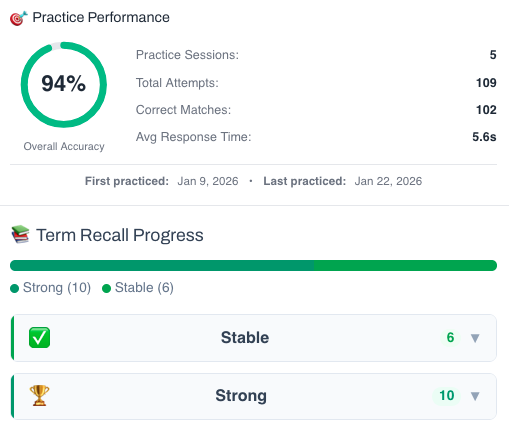
This isn’t a simple quiz — it’s a fully tracked learning system. You build knowledge through recognition, then recall, and your progress feeds directly into the Integrated Practice Bar (Writing tasks, AI Chat, and more).
- Practice sessions, accuracy, and response-time tracking
- Term strength levels (Learning → Stable → Strong)
- Personal progress history for each unit
This feature is available to YSP members.
Explore Membership BenefitsMember-Exclusive Practice Bar
Access a wide range of integrated practice for this unit — from Vocabulary and Grammar activities to AI-curated Writing tasks and Thematic Chat practice.
This feature is available to YSP members.
Explore Membership BenefitsMember-Exclusive Sentence Builder
Reconstruct scrambled sentences to practice word order and develop your grammar intuition.
This feature is available to YSP members.
Explore Membership Benefits