Sharing Life Experiences: Have You Ever…?
Core PathWay
1 Why Do We Use Present Perfect for Experiences?
Imagine you meet someone new at a party. You want to know about their life. You ask: ‘Have you ever been to Japan?’ Not ‘Did you go to Japan?’ Why?
The magic word is ever. It means ‘at any time in your life’. When you use ever, you don’t care about when. You just want to know: did this happen or not?
Think about it like this: your life is a big book. Present Perfect asks ‘Is this experience in your book?’ Past Simple asks ‘When did you write this page?’
Look at the difference:
– ‘Have you ever eaten Thai food?’ (At any time in your life? I don’t care when.)
– ‘Did you eat Thai food yesterday?’ (Specific time: yesterday.)
The same works for never. It means ‘at no time in your life’. When you say ‘I’ve never been to London’, you mean: in all my life, from birth until now, this didn’t happen.
This is why we use Present Perfect for experiences. The time is not important. The experience is important. It’s perfect for getting to know people, talking about your bucket list, and sharing your life story.
💬 Meeting a New Colleague
Two colleagues meet for the first time at a company lunch
2 How to Form Questions and Negatives
Let’s learn the patterns. They’re simple!
Questions with ‘ever’:
Have/Has + you/he/she + ever + past participle?
Examples:
– Have you ever tried sushi?
– Has she ever visited Italy?
– Have they ever seen snow?
Negatives with ‘never’:
I/You/We/They + have never + past participle
He/She/It + has never + past participle
Examples:
– I’ve never been to Africa.
– She’s never tried Indian food.
– They’ve never met a famous person.
Short answers:
Yes, I have. / No, I haven’t.
Yes, she has. / No, she hasn’t.
You can also say:
Yes, I have. I went there last summer. (Now you can use Past Simple because you mention a specific time!)
The pattern is your friend. Learn it, and you can talk about any experience!
💬 Talking About Travel Dreams
Friends discussing their bucket lists at a café
3 A Welcome Party Story
Marco arrives at his new company’s welcome party. He feels a bit nervous, but excited to meet his new colleagues from around the world.
Yuki from Japan walks over with a smile. ‘Hi! I’m Yuki. Have you ever worked in an international company before?’
Marco relaxes. ‘No, I haven’t. This is my first time. It’s really exciting! Have you ever been to Italy?’
‘I’ve never been to Europe,’ Yuki says, ‘but I’ve always wanted to go. I love Italian food though. Have you ever tried Japanese food?’
‘Yes, I have! I tried sushi last year. It was delicious.’ Marco notices he mentioned a specific time, so he used past simple for that part.
Sarah from Canada joins them. ‘Hey! Are you talking about food? Have you ever had poutine? It’s a Canadian dish.’
‘I’ve never heard of it,’ Marco says. ‘What is it?’
‘It’s fries with cheese and sauce. Amazing! Have you ever visited North America, Marco?’
‘No, I’ve never been there, but it’s on my bucket list. Have you ever been to Italy, Sarah?’
‘Yes, I have! I visited Rome two years ago.’ Again, specific time means Past Simple.
Ahmed from Egypt walks over. ‘This sounds like a travel conversation! Have you ever seen the pyramids?’
Everyone laughs. ‘No, we haven’t!’ they say together.
‘Well, you should come visit. Have any of you ever tried Egyptian food?’
Yuki shakes her head. ‘I’ve never tried it, but I’d love to.’
Marco smiles. ‘I’ve never tried it either. Maybe we can all go to an Egyptian restaurant together?’
‘Great idea!’ Sarah says. ‘Have you ever organized a group dinner, Marco?’
‘No, I haven’t, but there’s a first time for everything!’
The conversation continues. Everyone shares their experiences, their bucket lists, and their dreams. They use ‘Have you ever…?’ to learn about each other. They use ‘I’ve never…’ to share what they still want to do. By the end of the party, they’re not just colleagues. They’re friends with plans to try new experiences together.
Marco thinks: ‘Have I ever felt so welcome? No, I haven’t. This is amazing.’
4 Common Mistakes and How to Fix Them
Italian speakers often make specific mistakes with Present Perfect. Let’s look at them and learn how to self-correct.
Mistake 1: Using Past Simple instead of Present Perfect
❌ WRONG: ‘Did you ever visit London?’
Why? In Italian, you might say ‘Sei mai stato a Londra?’ which feels like past simple. But in English, experiences without specific time need Present Perfect.
How to self-correct: Ask yourself: ‘Am I mentioning when?’ If no, use Present Perfect.
Mistake 2: Double negative with ‘never’
❌ WRONG: ‘I haven’t never been to Japan.’
Why? In Italian, double negatives are normal (‘Non sono mai stato’). In English, ‘never’ already contains the negative meaning.
How to self-correct: Choose one: either ‘haven’t ever’ OR ‘have never’. Not both!
Mistake 3: Using ‘never’ in questions
❌ WRONG: ‘Have you never been to Rome?’
Why? Questions use ‘ever’, not ‘never’. ‘Have you never…?’ is possible but means something different (surprise that someone hasn’t done something).
How to self-correct: In normal questions about experiences, always use ‘ever’.
Mistake 4: Forgetting the past participle
❌ WRONG: ‘Have you ever go to Spain?’
Why? Present Perfect needs the past participle form, not the base verb.
How to self-correct: Remember the pattern: Have/Has + ever + PAST PARTICIPLE.
Use the VAS to build solid recognition and recall of the terms below.
✔ Every correct Match = +1 point
✔ Every correct Recall = +2 points
🎓 Reach 5 points with good accuracy and the term is automatically promoted to your Personal Dictionary.
Incorrect answers lower accuracy, meaning more correct Matches or Recalls may be needed to reach promotion.
Member-Exclusive Vocabulary Review & Acquisition System
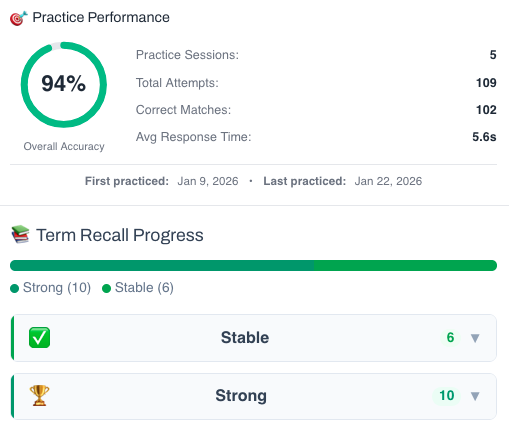
This isn’t a simple quiz — it’s a fully tracked learning system. You build knowledge through recognition, then recall, and your progress feeds directly into the Integrated Practice Bar (Writing tasks, AI Chat, and more).
- Practice sessions, accuracy, and response-time tracking
- Term strength levels (Learning → Stable → Strong)
- Personal progress history for each unit
This feature is available to YSP members.
Explore Membership BenefitsMember-Exclusive Practice Bar
Access a wide range of integrated practice for this unit — from Vocabulary and Grammar activities to AI-curated Writing tasks and Thematic Chat practice.
This feature is available to YSP members.
Explore Membership BenefitsMember-Exclusive Sentence Builder
Reconstruct scrambled sentences to practice word order and develop your grammar intuition.
This feature is available to YSP members.
Explore Membership Benefits