Past Simple vs Present Perfect: Overcoming Italian Passato Prossimo Interference
Core PathWay
1 Why Your Italian Brain Resists English Past Tenses
If you’re an advanced Italian speaker who still hesitates between ‘I went’ and ‘I have gone’, you’re experiencing a sophisticated interference pattern, not a basic error. Italian’s Passato Prossimo elegantly handles any completed action with present relevance or recent occurrence: ‘Ho finito stamattina’ works whether the morning is over or ongoing. English, however, splits this single category into two distinct systems based on a criterion Italian doesn’t prioritize: whether the time period is finished. This creates a fossilized error pattern that persists precisely because your L1 logic is internally consistent—it’s simply organized differently. This page will help you recognize the three main trap contexts where Passato Prossimo misleads you, and provide diagnostic tools to self-monitor before these errors surface in professional settings.
2 Past Simple: The Finished Time Period Tense
The Past Simple in English signals that an action occurred within a time period that is now complete and disconnected from the present moment. This is where Italian speakers encounter their first major trap: Italian uses Passato Prossimo for recent completed actions (‘Ho inviato la relazione ieri’), but English requires Past Simple because yesterday is a finished time period. The critical question isn’t ‘How recent is this action?’ but rather ‘Is the time frame closed?’ When you say ‘I sent the report last week‘, you’re signaling that last week is over and you’re now in a different week. Similarly, ‘I finished the project two hours ago‘ uses Past Simple because ‘ago‘ always measures backwards from now into completed time. Italian speakers often incorrectly use Present Perfect here (‘I have sent the report yesterday’) because Passato Prossimo feels natural for recent actions. The key insight: English cares about temporal boundaries, not recency. If you can answer ‘When exactly?’, you’re almost certainly in Past Simple territory, regardless of how recently the event occurred.
Focus
- Past Simple indicates completed actions in finished time periods
- Specific time markers (yesterday, last week, ago, in 2020) require Past Simple
- The time period must be disconnected from the present moment
- Used for narrative sequences where events are told in chronological order
Rules
- Regular verbs: base form + -ed (worked, finished, presented)
- Irregular verbs: unique past forms (went, sent, wrote, met)
- Negative: did not/didn’t + base form (didn’t attend, didn’t complete)
- Question: Did + subject + base form (Did you submit…? Did they approve…?)
- Always paired with finished time markers: yesterday, last month, ago, in [past year]
Examples
- I attended the conference **last week** and met several potential clients.
- She submitted her resignation **two months ago** but stayed until **yesterday**.
- We launched the new product **in March** and received excellent feedback.
- The meeting started **this morning** at 9am. (said in the afternoon when morning is finished)
- They didn’t respond to my email **yesterday**, so I called them.
- Did you finish the quarterly report before the deadline?
Common mistake
3 Present Perfect: The Unfinished Time Period Tense
The Present Perfect in English creates a bridge between past actions and the present moment, used when the time period is unfinished or when the exact time is unspecified because it’s irrelevant. This is where the second major trap emerges: Italian uses ‘da’ with present tense for ongoing states (‘Vivo qui da cinque anni’), but English requires Present Perfect with ‘since‘ or ‘for‘: ‘I have lived here for five years’. The Present Perfect signals that the time period includes the present moment—you’re still living there now. Similarly, life experience questions use Present Perfect: ‘Have you ever visited Japan?’ doesn’t specify when because the focus is on whether the experience exists in your life history. Italian speakers often incorrectly use Past Simple here (‘Did you ever visit Japan?’), importing Passato Prossimo logic. The adverbs already, yet, just, and recently typically trigger Present Perfect when the time period remains open: ‘I’ve already completed three reports this week‘ (this week isn’t finished). However, if you add a specific time marker, you shift to Past Simple: ‘I completed three reports on Monday‘.
Focus
- Present Perfect connects past actions to the present moment or unfinished time periods
- Used with ‘since’ and ‘for’ to show duration continuing to now
- Expresses life experiences without specifying when they occurred
- Common with adverbs: already, yet, just, recently, ever, never
Rules
- Form: have/has + past participle (have worked, has finished, have been)
- Negative: have/has not (haven’t/hasn’t) + past participle
- Question: Have/Has + subject + past participle (Have you seen…? Has she submitted…?)
- Cannot be used with specific past time markers (not: ‘I have done it yesterday’)
- Required with ‘since’ + point in time and ‘for’ + period of time when action continues to present
Examples
- I have worked in this department **since** January and have learned a great deal.
- She has **already** submitted her proposal, so we’re waiting for approval.
- Have you **ever** managed a cross-functional team?
- They haven’t responded **yet**, but I expect to hear from them soon.
- We have **recently** implemented new security protocols across all systems.
- I have **just** finished the presentation—would you like to review it now?
Common mistake
4 Diagnostic Framework: Choosing Between Past Simple and Present Perfect
The decision between these tenses hinges on a question Italian doesn’t force you to ask: Is the time period finished or unfinished? Let’s build a systematic diagnostic approach that helps you self-monitor for fossilized errors.
Decision Tree 1: Time Period Status
Ask yourself: Can I still add to this time period? If you’re talking about ‘this morning‘ and it’s now 2pm, the morning is finished → Past Simple: ‘I sent three emails this morning.’ If it’s still 11am, the morning is unfinished → Present Perfect: ‘I’ve sent three emails this morning.’ The same logic applies to ‘today‘, ‘this week‘, ‘this year‘—are you still in that period?
Decision Tree 2: Specific Time Marker Test
Ask yourself: Does my sentence include a specific time marker that answers ‘When exactly?’ Words like yesterday, last week, ago, in 2019 always require Past Simple, even if the action feels recent. ‘I finished the report two hours ago‘ (not ‘have finished’). Conversely, if you’re expressing a life experience without specifying when, use Present Perfect: ‘I have attended several international conferences’ (when isn’t relevant).
Decision Tree 3: The ‘Since’ and ‘For’ Trap
Italian uses ‘da’ with present tense; English uses ‘since‘ and ‘for‘ with Present Perfect for ongoing situations. Ask yourself: Is this state or action still true now? ‘She has managed this team for three years’ (she still manages it). But if the situation ended, shift to Past Simple: ‘She managed this team for three years before her promotion last month‘.
Narrative Sequence Recognition
When telling a story or describing a series of completed events, English uses Past Simple throughout the narrative sequence, even though Italian comfortably uses Passato Prossimo: ‘I arrived at the office, checked my emails, and attended the morning briefing’ (not ‘have arrived… have checked… have attended’). The narrative frame is closed—you’re recounting finished events in order.
Common Fossilized Patterns to Monitor:
Error Pattern 1: ‘I have done it yesterday’ → Correct: ‘I did it yesterday‘ (finished time)
Error Pattern 2: ‘I am here since 2020’ → Correct: ‘I have been here since 2020′ (ongoing state)
Error Pattern 3: ‘Did you ever visit Tokyo?’ → Correct: ‘Have you ever visited Tokyo?’ (life experience)
Error Pattern 4: ‘This morning I have sent the report’ (said at 3pm) → Correct: ‘This morning I sent the report’ (morning is finished)
Notably, American English shows more flexibility with ‘just‘ and ‘recently‘, often accepting Past Simple where British English prefers Present Perfect, but the finished/unfinished time period distinction remains crucial in both varieties. When in doubt, ask: ‘Could I add a specific time to this sentence?’ If yes, you’re likely in Past Simple territory.
5 In Context: An Error Diary Entry with Self-Corrections
Professional Development Journal—Week 12
I’m reviewing my persistent grammar patterns after yesterday’s presentation. I caught myself saying ‘I have prepared this presentation last week‘—there’s that fossilized error again! Correction: ‘I prepared this presentation last week‘ because last week is a finished time period. The Passato Prossimo logic (‘Ho preparato la presentazione la settimana scorsa’) still interferes, even though I’ve studied this for years.
Interestingly, I correctly said ‘I have worked on similar projects recently‘ during the Q&A session because recently refers to an unfinished time period extending to now—I didn’t specify exactly when. But then I slipped again: ‘I have attended a conference in Berlin two months ago.’ Correction: ‘I attended a conference in Berlin two months ago‘ because ‘ago‘ always signals finished time and requires Past Simple.
My colleague asked ‘Have you ever managed a remote team?’ and I almost responded ‘Yes, I did’ instead of ‘Yes, I have.’ That’s a life experience question without a specific time marker, so Present Perfect is essential. She was asking about my entire career history, not a particular moment.
One success: I correctly distinguished between ‘I sent five emails this morning‘ (said at 2pm when morning was over) and ‘I’ve already sent three emails this morning‘ (said at 11am when morning was ongoing). The finished versus unfinished time period distinction is finally becoming automatic.
Self-monitoring note: I’ve noticed I still think ‘da’ equals ‘since’ with present tense. Reminder: ‘Lavoro qui da marzo’ becomes ‘I have worked here since March’ in English, not ‘I work here since March.’ The ongoing state requires Present Perfect, not present tense.
Reflection prompts:
Can you identify which sentences originally contained errors? What was the diagnostic question that would have prevented each mistake? Notice how the writer distinguishes between this morning when finished (Past Simple) versus when ongoing (Present Perfect)—this is the core distinction Italian doesn’t require you to make, but English demands it. How many times does the writer correctly use ‘since‘ and ‘for‘ with Present Perfect rather than incorrectly importing Italian ‘da’ with present tense?
Use the VAS to build solid recognition and recall of the terms below.
✔ Every correct Match = +1 point
✔ Every correct Recall = +2 points
🎓 Reach 5 points with good accuracy and the term is automatically promoted to your Personal Dictionary.
Incorrect answers lower accuracy, meaning more correct Matches or Recalls may be needed to reach promotion.
Member-Exclusive Vocabulary Review & Acquisition System
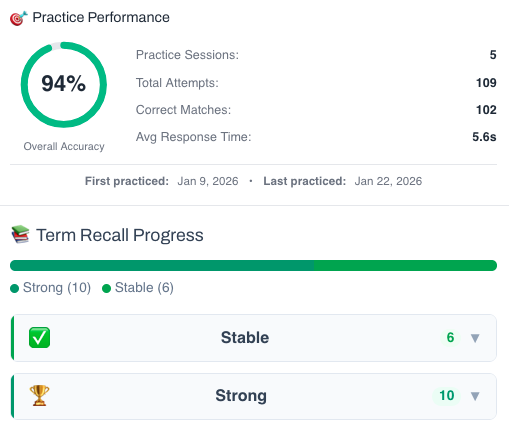
This isn’t a simple quiz — it’s a fully tracked learning system. You build knowledge through recognition, then recall, and your progress feeds directly into the Integrated Practice Bar (Writing tasks, AI Chat, and more).
- Practice sessions, accuracy, and response-time tracking
- Term strength levels (Learning → Stable → Strong)
- Personal progress history for each unit
This feature is available to YSP members.
Explore Membership BenefitsMember-Exclusive Practice Bar
Access a wide range of integrated practice for this unit — from Vocabulary and Grammar activities to AI-curated Writing tasks and Thematic Chat practice.
This feature is available to YSP members.
Explore Membership BenefitsMember-Exclusive Sentence Builder
Reconstruct scrambled sentences to practice word order and develop your grammar intuition.
This feature is available to YSP members.
Explore Membership Benefits