Why ‘I’ve Known Her for Years’ Sounds Right (But ‘I’ve Been Knowing Her’ Doesn’t)
Core PathWay
1 Why Does ‘I’ve Been Knowing Her’ Sound So Wrong?
A language teacher stands at the board and writes two sentences: ‘I’ve known her for years’ and ‘I’ve been knowing her for years.’ She asks the class which one sounds natural. Every native speaker immediately points to the first sentence, but many Italian learners feel confused. Both sentences express duration, both use the Present Perfect, and both describe something that started in the past and continues now. So why does the second one sound completely wrong?
This confusion is completely normal, and it’s not your fault. In Italian, you can say ‘La conosco da anni’ using a simple present tense, or you might use a continuous form in other contexts without this strange restriction. English, however, divides verbs into two fundamental categories that behave very differently with time expressions: state verbs and action verbs. The verb ‘know’ is a state verb, and state verbs refuse to wear continuous forms when you talk about how long something has been true.
The good news is that once you understand this distinction, you’ll immediately recognize hundreds of sentences that follow the same pattern. You’ll stop making errors like ‘I’ve been having this car for five years’ or ‘She’s been believing in ghosts since childhood.’ More importantly, you’ll know exactly when you CAN use continuous forms and when you can’t.
Key Terms
2 The Fundamental Difference: States vs Actions
English makes a sharp distinction that Italian handles differently. State verbs describe conditions, feelings, thoughts, and possessions that exist without any visible activity. When you know someone, when you own a house, when you believe something, you’re not doing anything active. These states simply exist, and they can exist for a long time. Action verbs, on the other hand, describe things you actively do: you read, you work, you study, you play. These activities have energy and movement.
This matters enormously when you talk about duration using ‘for’ or ‘since’. State verbs can only use Present Perfect Simple with these time expressions because the state has been continuous and unchanging. You can’t show a state ‘in progress’ because it’s not a process. Action verbs, however, can use either Simple or Continuous, and your choice changes the meaning in important ways.
Focus
- State verbs describe unchanging conditions: thoughts, feelings, possession, existence
- State verbs use only Present Perfect Simple with for/since expressions
- Action verbs describe activities and can use Simple OR Continuous with different meanings
- Italian doesn’t mark this distinction the same way, causing interference errors
Rules
- State verbs + duration = Present Perfect Simple only (I’ve known her for years / I’ve had this car since 2020)
- Action verbs + completed focus = Present Perfect Simple (I’ve read three books this month)
- Action verbs + ongoing process = Present Perfect Continuous (I’ve been reading all morning)
- Common state verbs include: know, have, believe, understand, own, belong, recognize, remember, seem, contain, love, want, need
Examples
- I’ve known Maria for ten years. (NOT: I’ve been knowing Maria) — state verb, unchanging condition
- We’ve had this relationship since university. (NOT: We’ve been having this relationship) — state verb, possession/existence
- I’ve read five articles today. (completed action) vs I’ve been reading for two hours. (ongoing process) — action verb, both forms possible
Common mistake
Key Terms
3 Action Verbs: Simple for Completion, Continuous for Process
Here’s where it gets interesting. When you use action verbs with duration expressions, you have a choice, and that choice communicates different meanings. If you say ‘I’ve worked here for five years,’ you’re emphasizing the completed period of time as a fact. If you say ‘I’ve been working here for five years,’ you’re emphasizing the ongoing nature of the activity, often suggesting that it continues and might continue further.
Look at these pairs: ‘I’ve read three books this week’ (Simple — counting completed actions) versus ‘I’ve been reading all morning’ (Continuous — emphasizing the process and duration). ‘She’s studied English for six years’ (Simple — stating the total time as a fact) versus ‘She’s been studying English for six hours today’ (Continuous — emphasizing the continuous effort). Both forms are correct, but they paint different pictures.
State verbs never have this choice. You can’t say ‘I’ve been knowing her’ or ‘I’ve been understanding the problem’ because knowing and understanding aren’t processes you can show in progress. They’re simply states that exist. This is the key rule: state verbs describe conditions that can last a long time, but they can’t be ‘in progress’ because they’re not activities.
Key Terms
4 A Real Conversation: Mixing States and Actions Naturally
Let me tell you about my friendship with Elena. I’ve known Elena since we were children — we met in primary school and we’ve been friends for over twenty years now. Our relationship has always been strong because we understand each other completely. I’ve never doubted her loyalty, and she’s always believed in me, even when I didn’t believe in myself.
Recently, we’ve been spending more time together because she’s been working on a difficult project and needs support. I’ve helped her three times this month — I’ve listened to her ideas, I’ve given her advice, and I’ve been encouraging her when she feels stressed. She’s been reading research articles for weeks now, and the project seems almost finished. I’ve watched her grow more confident as the work has progressed.
Notice how the state verbs (known, understand, believed, seems) all use Simple forms with duration, while the action verbs switch between Simple and Continuous depending on whether I’m counting completed actions (helped three times, given advice) or emphasizing ongoing processes (been spending time, been working, been reading, been encouraging). This mixing feels completely natural to native speakers because we automatically recognize which verbs describe states and which describe actions. Now you can do the same.
Key Terms
5 Recap: States Stay Simple, Actions Choose
You’ve learned why ‘I’ve known her for years’ sounds natural but ‘I’ve been knowing her’ sounds wrong. The answer lies in the fundamental distinction between state verbs and action verbs. State verbs describe unchanging conditions — thoughts, feelings, possession, existence — and these verbs can only use Present Perfect Simple with duration expressions like ‘for’ and ‘since’. They describe states that last, not processes that develop.
Action verbs, however, give you a choice. You can use Present Perfect Simple to emphasize completed actions or to state a period of time as a fact (‘I’ve worked here for five years’). Or you can use Present Perfect Continuous to emphasize the ongoing nature of the activity (‘I’ve been working all morning’). Both are correct, but they communicate different focuses.
The key to mastering this is recognizing which category a verb belongs to. Common state verbs include know, have, believe, understand, own, belong, recognize, remember, seem, and contain. These verbs refuse continuous forms with duration. Once you internalize this pattern, you’ll automatically produce natural-sounding English when talking about how long something has been true or how long you’ve been doing something. The confusion you felt at the start of this lesson should now be replaced with clear understanding and confidence.
Use the VAS to build solid recognition and recall of the terms below.
✔ Every correct Match = +1 point
✔ Every correct Recall = +2 points
🎓 Reach 5 points with good accuracy and the term is automatically promoted to your Personal Dictionary.
Incorrect answers lower accuracy, meaning more correct Matches or Recalls may be needed to reach promotion.
Member-Exclusive Vocabulary Review & Acquisition System
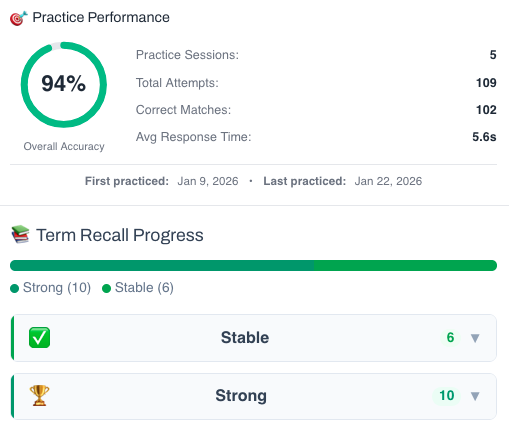
This isn’t a simple quiz — it’s a fully tracked learning system. You build knowledge through recognition, then recall, and your progress feeds directly into the Integrated Practice Bar (Writing tasks, AI Chat, and more).
- Practice sessions, accuracy, and response-time tracking
- Term strength levels (Learning → Stable → Strong)
- Personal progress history for each unit
This feature is available to YSP members.
Explore Membership BenefitsMember-Exclusive Practice Bar
Access a wide range of integrated practice for this unit — from Vocabulary and Grammar activities to AI-curated Writing tasks and Thematic Chat practice.
This feature is available to YSP members.
Explore Membership BenefitsMember-Exclusive Sentence Builder
Reconstruct scrambled sentences to practice word order and develop your grammar intuition.
This feature is available to YSP members.
Explore Membership Benefits