Breaking News: How Journalists Use Present Perfect and Past Simple
Core PathWay
1 Why News Starts with ‘Has Happened’, Not ‘Happened’
Turn on any English news channel and listen carefully to the breaking news headlines. You’ll hear a distinctive pattern: ‘A fire has broken out in central London.’ ‘The government has announced new measures.’ ‘An earthquake has struck the region.’ Notice something? Journalists consistently use the Present Perfect tense to introduce fresh stories, then immediately switch to Past Simple when they provide the details.
This isn’t random. The Present Perfect serves a crucial communicative function in news discourse: it signals that an event is recent, relevant, and still unfolding in its consequences. When a newsreader says ‘Emergency services have evacuated residents from the area,’ the choice of ‘have evacuated’ tells you this is happening now or has just finished—the situation is live and matters right now. It grabs your attention by emphasising the connection between past action and present moment.
But here’s where it gets interesting. Once the headline has hooked you with its sense of immediacy, the journalist switches to Past Simple to tell you what actually happened, step by step. ‘The fire broke out at approximately 3am. Witnesses reported seeing flames on the third floor. Firefighters arrived within minutes and began evacuating the building.’ This shift from Present Perfect to Past Simple is a fundamental pattern in English news discourse—and once you recognise it, you’ll hear it everywhere.
Understanding this pattern doesn’t just help you follow the news more easily. It’s also essential for professional communication. When you need to announce important information in meetings, emails, or presentations, using this tense pattern makes your English sound natural and authoritative. You’re not just reporting facts—you’re managing how your listener perceives the relevance and urgency of what you’re saying.
Key Terms
2 The Grammar Behind the Headlines
The headline-to-detail tense shift follows a predictable grammatical structure that you can learn and apply. The Present Perfect (has/have + past participle) opens the story because it creates a bridge between past event and present relevance. The Past Simple then takes over because it’s the natural tense for narrative sequence—telling what happened first, second, third.
This isn’t about one tense being ‘better’ than the other. It’s about using each tense for its discourse function. Present Perfect says ‘this matters now’; Past Simple says ‘here’s the chronological story’. Mastering this pattern will transform how you share news and recent events in English, making your communication sound professional and native-like.
Focus
- Present Perfect introduces breaking news and recent events to signal present relevance
- Past Simple provides sequential narrative details and specific past time references
- The tense shift happens immediately after the headline—usually in the second sentence
- Time expressions guide tense choice: ‘recently/just’ with Present Perfect; ‘yesterday/at 3pm’ with Past Simple
Rules
- Use Present Perfect for the opening headline or first mention: ‘A major incident has occurred’
- Switch to Past Simple when you start narrating the sequence of events: ‘The incident occurred at 2pm. Police arrived shortly afterwards.’
- Maintain Past Simple throughout the chronological narrative unless you return to present consequences
- You can return to Present Perfect later to emphasise current status: ‘Authorities have now confirmed that all residents are safe’
Examples
- Headline: ‘The Prime Minister has announced his resignation.’ Detail: ‘He made the announcement during a press conference this morning. He said that recent events had made his position untenable.’
- Headline: ‘A powerful earthquake has struck the northern region.’ Detail: ‘The earthquake struck at 4:32am local time. It measured 6.8 on the Richter scale. Emergency services immediately began rescue operations.’
- Headline: ‘Police have arrested three suspects in connection with the robbery.’ Detail: ‘Officers arrested the suspects at a property in East London yesterday evening. They recovered stolen goods worth approximately £50,000.’
Common mistake
Key Terms
3 News Broadcast Transcript: Four Stories, One Pattern
Here’s a realistic transcript from an evening news broadcast. Notice how each story follows the identical tense pattern: Present Perfect headline, immediate switch to Past Simple narrative. This is authentic English news discourse.
Story 1 – Traffic Accident
‘A serious incident has closed the M25 motorway in both directions this evening. The accident occurred at approximately 5:15pm near junction 12. Three vehicles were involved in the collision. Emergency services arrived at the scene within ten minutes. Paramedics treated several people for minor injuries, but fortunately there were no serious casualties. Police are currently investigating the cause. A witness told reporters that heavy rain may have contributed to the crash. Authorities have advised drivers to avoid the area and use alternative routes. The motorway is expected to remain closed until at least 9pm tonight.’
Story 2 – Political Announcement
‘The government has announced plans to invest £2 billion in renewable energy infrastructure. The Prime Minister made the announcement during a speech in Manchester this afternoon. She said the investment would create thousands of new jobs across the northern regions. The funding will support wind and solar energy projects over the next five years. Environmental groups have welcomed the decision, though some critics argue the amount is insufficient. The government confirmed that construction on the first projects will begin next spring. Ministers reported that the initiative is part of a broader strategy to achieve carbon neutrality by 2050.’
Story 3 – Sports Result
‘Manchester United has secured a dramatic victory in tonight’s Champions League match. The team won 3-2 against Bayern Munich in a thrilling encounter at Old Trafford. United took the lead in the 12th minute through a Marcus Rashford goal. Bayern equalised just before half-time. The German side then went ahead early in the second half. However, United fought back with two goals in the final ten minutes. Manager Erik ten Hag praised his players’ determination in his post-match statement. The result means United has now qualified for the knockout stages of the competition.’
Story 4 – Weather Event
‘Severe flooding has affected several towns in the southwest of England. Heavy rainfall overnight caused rivers to burst their banks in Devon and Cornwall. Emergency services have evacuated more than 200 residents from their homes in the worst-affected areas. The flooding began around midnight when the River Exe reached record levels. Local councils opened emergency shelters for displaced families. The Environment Agency issued flood warnings for at least 15 areas across the region. Weather forecasters predict that conditions will improve by tomorrow afternoon, though authorities warn that flood water may take several days to recede fully.’
Key Terms
4 Common Mistakes and How They Change the Message
Italian speakers often struggle with this tense pattern because Italian uses the passato prossimo (equivalent to Present Perfect) more broadly than English does. This leads to two characteristic errors that change the discourse effect significantly.
Mistake 1: Using Past Simple throughout
Many learners say: ‘A fire broke out in the city centre. Emergency services evacuated residents from the building.’
This isn’t grammatically wrong, but it changes the communicative effect. By using Past Simple from the start, you’re treating the news as a completed past event rather than something with present relevance. It sounds like you’re recounting history, not breaking news. Native speakers will perceive this as less urgent and immediate. In professional contexts, this can make important announcements sound stale or less significant than you intend.
Mistake 2: Using Present Perfect throughout
Other learners overcorrect and say: ‘A fire has broken out in the city centre. Emergency services have evacuated residents at 3am this morning.’
This creates a more serious problem. Present Perfect doesn’t combine naturally with specific past time expressions like ‘at 3am’ or ‘yesterday’. The sentence sounds wrong to native speakers. Moreover, using Present Perfect for sequential narrative details makes the story harder to follow—the listener can’t build a clear chronological picture of events.
The Discourse Impact
When you use the correct pattern—Present Perfect headline followed by Past Simple details—you’re doing more than following grammar rules. You’re managing your listener’s attention and perception. The Present Perfect headline says ‘Stop! This is important and current!’ The Past Simple narrative then satisfies your listener’s natural question: ‘Okay, so what actually happened?’ This is why the pattern feels so natural to native speakers and why news organisations use it consistently across all English-speaking countries.
Practical Application
Next time you need to share news in English—whether you’re updating colleagues on a project development, telling friends about a recent event, or presenting information in a meeting—try this pattern. Start with Present Perfect to hook attention (‘We’ve secured the contract with the new client’), then switch to Past Simple for the story (‘We submitted our proposal last Monday. The client reviewed it over the weekend and called us yesterday morning to confirm their decision’). You’ll notice your English sounds more professional and native-like immediately.
Key Terms
5 Recap: The News Tense Pattern
You’ve learned that English news discourse follows a predictable and purposeful tense pattern. Journalists use Present Perfect to introduce breaking news because it creates a bridge between past event and present moment—it tells listeners ‘this matters now’. They then switch immediately to Past Simple to provide chronological narrative details, because Past Simple is the natural tense for sequential storytelling.
This pattern appears in every English news broadcast, from BBC World News to CNN, from local radio to international television. Once you recognise it, you’ll hear it constantly. More importantly, you can now apply it in your own professional and social communication. When you need to share important news or recent developments, start with Present Perfect to signal relevance and urgency, then switch to Past Simple to tell the story step by step.
Avoiding the two common mistakes—using only Past Simple (which loses immediacy) or only Present Perfect (which sounds unnatural with specific time references)—will make your English sound significantly more native-like. This isn’t just about grammar correctness; it’s about discourse management and communicative effectiveness. You’re now equipped to recognise and use one of the most fundamental patterns in professional English communication.
Use the VAS to build solid recognition and recall of the terms below.
✔ Every correct Match = +1 point
✔ Every correct Recall = +2 points
🎓 Reach 5 points with good accuracy and the term is automatically promoted to your Personal Dictionary.
Incorrect answers lower accuracy, meaning more correct Matches or Recalls may be needed to reach promotion.
Member-Exclusive Vocabulary Review & Acquisition System
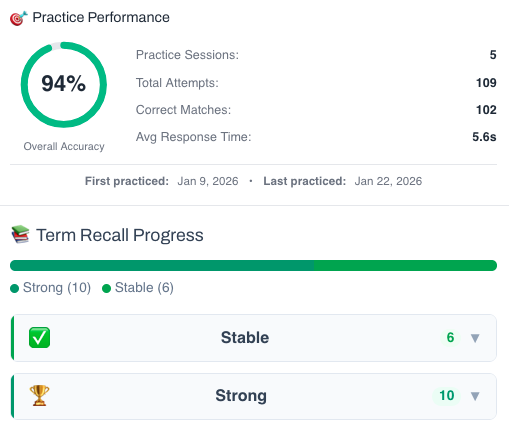
This isn’t a simple quiz — it’s a fully tracked learning system. You build knowledge through recognition, then recall, and your progress feeds directly into the Integrated Practice Bar (Writing tasks, AI Chat, and more).
- Practice sessions, accuracy, and response-time tracking
- Term strength levels (Learning → Stable → Strong)
- Personal progress history for each unit
This feature is available to YSP members.
Explore Membership BenefitsMember-Exclusive Practice Bar
Access a wide range of integrated practice for this unit — from Vocabulary and Grammar activities to AI-curated Writing tasks and Thematic Chat practice.
This feature is available to YSP members.
Explore Membership BenefitsMember-Exclusive Sentence Builder
Reconstruct scrambled sentences to practice word order and develop your grammar intuition.
This feature is available to YSP members.
Explore Membership Benefits