The Best I’ve Ever Seen: Present Perfect with Superlatives and Ordinals
Core PathWay
1 Why ‘The Best I’ve Ever Seen’ Sounds Right
When you walk out of a cinema after watching something truly remarkable, you might say to your friend, ‘That was the best film I’ve ever seen.’ Notice what you didn’t say: ‘That was the best film I saw.’ The second version sounds incomplete, even wrong. Why?
The answer lies in how superlatives work in English. When you use words like ‘best,’ ‘worst,’ ‘most interesting,’ or ‘least compelling,’ you’re not just talking about one moment in the past. You’re making a judgment that spans your entire life experience up to now. The phrase ‘the best’ automatically opens a frame that includes everything you’ve experienced from birth until this present moment. That’s why Present Perfect is required—it’s the only tense that connects past experiences to the present moment of speaking.
Think of it this way: when a critic writes ‘This is the most profound performance I’ve ever witnessed,’ they’re comparing this performance against every other performance in their entire career. The Present Perfect (‘have witnessed’) signals that their accumulated experience—their whole professional life—forms the context for this judgment. If they wrote ‘the most profound performance I witnessed,’ it would suggest a closed timeframe in the past, disconnected from now.
This grammatical principle applies equally to ordinal numbers (first, second, third) and phrases like ‘the only time.’ These expressions, like superlatives, create a life-experience scope that demands Present Perfect. Mastering this pattern will make your evaluative language sound natural and authoritative, particularly when discussing arts, culture, and personal judgments.
Key Terms
2 The Grammar Pattern: Superlatives and Ordinals with Present Perfect
Understanding the structural pattern will help you use this construction confidently. The key principle is simple: whenever you use a superlative adjective or an ordinal number to frame an experience, Present Perfect follows. This isn’t optional—it’s grammatically required because these phrases inherently reference your accumulated life experience up to the present moment.
The same logic applies to ‘the only’ constructions. When you say ‘This is the only film that has moved me,’ you’re making a statement about your entire viewing history up to now. The life-experience frame is active, so Present Perfect is necessary.
Focus
- Superlative adjectives (best, worst, most interesting, least impressive) + Present Perfect
- Ordinal numbers (first, second, third, last) + time/that + Present Perfect
- ‘The only’ + noun + that/who + Present Perfect
- These structures create a life-experience frame from past to present
Rules
- Pattern 1: This is the + SUPERLATIVE + noun + (that) + subject + have/has + past participle. Example: ‘This is the most outstanding screenplay I’ve ever read.’
- Pattern 2: This is the + ORDINAL + time/noun + (that) + subject + have/has + past participle. Example: ‘It’s the third time this director has won an award.’
- Pattern 3: This is the only + noun + that/who + subject + have/has + past participle. Example: ‘She’s the only actress who has truly captured this character.’
- The superlative or ordinal creates a comparison across your entire life span up to now, which requires Present Perfect to connect past experiences to the present moment of judgment.
Examples
- This is the most memorable film I’ve ever seen. (NOT: the most memorable film I ever saw)
- It’s the second time the cinematography has impressed me this year. (NOT: the second time the cinematography impressed me)
- He’s the only director who has made me cry. (NOT: the only director who made me cry)
Common mistake
Key Terms
3 A Film Critic’s Reflections: Three Weeks of Reviews
After twenty-five years of writing film reviews, I thought I’d seen everything cinema could offer. Yet this month has challenged that assumption in ways I never anticipated.
Week one brought ‘Echoes of Silence,’ a masterpiece from an emerging director whose name I’d never encountered before. As I sat in the screening room, I realized I was witnessing something extraordinary. This is the most compelling character study I’ve ever evaluated—and I don’t use that phrase lightly. The performance by the lead actress transcends anything I’ve witnessed in recent years. She’s the only performer who has truly made me forget I was watching acting. The cinematography creates a visual language that’s both intimate and epic, a combination I’ve rarely seen executed with such precision.
The screenplay deserves particular attention. It’s the third time this writer has been nominated for an award, and frankly, it’s the first time I’ve felt the recognition is genuinely deserved. The dialogue doesn’t just serve the plot—it reveals character with surgical precision. This is the most memorable script I’ve read this decade, and I’ve read thousands.
Week two was less inspiring. ‘Midnight Returns’ is the fourth sequel in a franchise that should have ended years ago. It’s the worst example of commercial filmmaking I’ve seen this year—a cynical exercise in extracting money from audiences without offering anything of substance. The director has won multiple awards in the past, which makes this failure even more disappointing. It’s the only time I’ve left a screening feeling genuinely angry about the waste of talent and resources.
But week three restored my faith. ‘The Last Garden’ is an outstanding piece of work from a director whose previous films I’ve admired. This is the fifth film she’s made about family relationships, and it’s by far the most profound. The way she explores grief and reconciliation is unlike anything I’ve encountered in contemporary cinema. It’s the second time this year I’ve given a five-star review, and both times I’ve felt completely confident in that judgment.
What strikes me most, reflecting on these three weeks, is how rare genuine excellence remains. I’ve witnessed thousands of films, written countless reviews, attended more festivals than I can count. Yet truly remarkable cinema—the kind that shifts your perspective or touches something deep—remains astonishingly rare. This is perhaps the most important lesson I’ve learned in my career: the best films aren’t just well-made; they’re necessary. They show us something we’ve never seen before, or show us familiar things in ways that make us see them freshly.
That’s why I continue doing this work. Every screening holds the possibility that I might encounter the most extraordinary film I’ve ever seen. It hasn’t happened yet—but it might happen tomorrow.
Key Terms
4 Common Errors: Why Past Simple Changes the Meaning
Italian speakers frequently make a specific error with this construction, and it’s worth understanding why. In Italian, you would say *’È il film più bello che ho visto’* using the passato prossimo (equivalent to Present Perfect). However, many Italian learners, influenced by the fact that Italian also uses passato remoto (Past Simple) in some contexts, incorrectly transfer this to English and say ‘It’s the best film I saw.’
The problem is that in English, using Past Simple after a superlative fundamentally changes the meaning. Compare these sentences:
Correct: ‘This is the most outstanding film I’ve ever seen.’ (This means: Of all films in my entire life up to now, this is the best.)
Incorrect: ‘This is the most outstanding film I saw.’ (This sounds incomplete and suggests a closed timeframe in the past—perhaps ‘the most outstanding film I saw last year’ or ‘during that festival.’)
The same principle applies to ordinals:
Correct: ‘It’s the third time this director has won an award.’ (This counts all occasions from the past up to now.)
Incorrect: ‘It’s the third time this director won an award.’ (This suggests a completed series of events disconnected from the present.)
With ‘the only’ constructions, the error is particularly noticeable:
Correct: ‘She’s the only actress who has truly moved me.’ (Throughout my entire experience of watching films up to now.)
Incorrect: ‘She’s the only actress who truly moved me.’ (This sounds like you’re referring to a specific past period that’s now finished—perhaps you no longer watch films, or you’re dead!)
The key insight is this: superlatives, ordinals, and ‘the only’ inherently activate a life-experience frame that extends from the past to the present moment. Past Simple closes that frame and disconnects it from now. Present Perfect keeps the frame open and maintains the connection to the present.
When you’re evaluating films, books, performances, or any cultural work, remember that your judgment exists in the present moment, even though it draws on past experiences. That present-moment connection is what demands Present Perfect. It’s not just about grammar rules—it’s about accurately expressing the temporal relationship between your accumulated experience and your current judgment.
Key Terms
5 Recap: Making Judgments That Span Your Life
You’ve now learned why certain English constructions require Present Perfect rather than Past Simple. The fundamental principle is straightforward: when you use superlative adjectives (best, worst, most compelling), ordinal numbers (first, second, third), or ‘the only’ to frame an experience or make a judgment, you’re automatically referencing your entire life experience up to the present moment. This life-experience frame demands Present Perfect.
The pattern appears constantly in reviews and cultural commentary: ‘This is the most remarkable performance I’ve ever witnessed,’ ‘It’s the third time this director has won,’ ‘This is the only film that has truly moved me.’ Each construction connects accumulated past experience to a present-moment judgment.
The common error—using Past Simple in these contexts—changes the meaning by closing the timeframe and disconnecting it from now. When you say ‘the best film I saw,’ you sound like you’re referring to a completed period in the past. When you say ‘the best film I’ve ever seen,’ you’re making a judgment that stands in the present moment and encompasses your whole life.
As you continue practicing, pay attention to how critics, reviewers, and commentators use this pattern. You’ll notice it appears not just in film criticism but in any context where people evaluate experiences: ‘the best restaurant I’ve ever tried,’ ‘the worst mistake I’ve ever made,’ ‘the first time I’ve truly understood this concept.’ Mastering this construction will make your evaluative language sound natural, authoritative, and grammatically precise.
Use the VAS to build solid recognition and recall of the terms below.
✔ Every correct Match = +1 point
✔ Every correct Recall = +2 points
🎓 Reach 5 points with good accuracy and the term is automatically promoted to your Personal Dictionary.
Incorrect answers lower accuracy, meaning more correct Matches or Recalls may be needed to reach promotion.
Member-Exclusive Vocabulary Review & Acquisition System
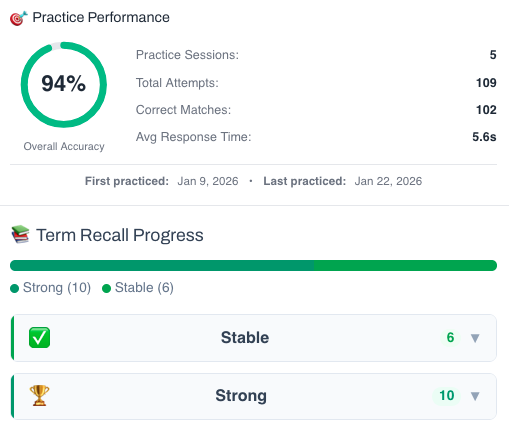
This isn’t a simple quiz — it’s a fully tracked learning system. You build knowledge through recognition, then recall, and your progress feeds directly into the Integrated Practice Bar (Writing tasks, AI Chat, and more).
- Practice sessions, accuracy, and response-time tracking
- Term strength levels (Learning → Stable → Strong)
- Personal progress history for each unit
This feature is available to YSP members.
Explore Membership BenefitsMember-Exclusive Practice Bar
Access a wide range of integrated practice for this unit — from Vocabulary and Grammar activities to AI-curated Writing tasks and Thematic Chat practice.
This feature is available to YSP members.
Explore Membership BenefitsMember-Exclusive Sentence Builder
Reconstruct scrambled sentences to practice word order and develop your grammar intuition.
This feature is available to YSP members.
Explore Membership Benefits