Present Perfect vs Past Simple: The Time Specification Test
Core PathWay
1 Why Do Italian Speakers Confuse Present Perfect and Past Simple?
Italian speakers often struggle with these two structures because Italian Passato Prossimo works very differently from English. In Italian, you use Passato Prossimo for both recent and distant past events, but English makes a critical distinction. The key question is not how long ago something happened, but whether you specify when it happened. When a detective asks ‘When exactly did you see the suspect?’, the answer requires Past Simple. However, when investigators discover new evidence and focus on what matters now, they use Present Perfect. This page will teach you to solve this grammar puzzle like a detective solving a crime scene mystery.
2 Past Simple: Completed Actions at Specified Times
We use Past Simple when we know and state exactly when something happened in the past. This structure answers the question ‘When exactly?’. If you can answer with ‘yesterday’, ‘last week’, ‘at 3pm’, ‘two days ago’, or any specific time, you must use Past Simple. For example: ‘The witness saw someone break into the building at midnight.’ The time is clear and finished. Italian speakers often make mistakes here because Italian Passato Prossimo sounds similar to Present Perfect but works like Past Simple when time is specified. In Italian you say ‘Ho visto il sospetto ieri’ using Passato Prossimo, but in English you must say ‘I saw the suspect yesterday’ using Past Simple. The detective always uses Past Simple when writing a statement with specific times: ‘The security guard called police at 9:15pm. Officers arrived at 9:30pm. They found the safe empty.’ All these actions have clear, finished times.
Focus
- Use Past Simple when you state a specific time (yesterday, last month, at 5pm, in 2020, three days ago)
- The action is completely finished and disconnected from now
- Common time markers: ago, yesterday, last week/month/year, when I was young, in [year]
- Italian Passato Prossimo with time markers = English Past Simple
Rules
- Affirmative: Subject + verb-ed (regular) or irregular past form (saw, broke, stole)
- Negative: Subject + did not (didn’t) + base verb
- Question: Did + subject + base verb?
- Time markers appear at the end or beginning of the sentence
- The action has no connection to the present moment
Examples
- The witness gave her statement to police yesterday.
- Someone stole the evidence from the crime scene three hours ago.
- The detective investigated five similar cases last year.
- Security cameras recorded the suspect at 11:45pm.
- Police discovered important clues when they searched the building.
- The missing documents were in the safe two days ago.
Common mistake
3 Present Perfect: Present Relevance Without Time Specification
We use Present Perfect when we focus on what matters now, not when something happened. This structure answers ‘What’s the situation now?’ rather than ‘When exactly?’. We use it with ‘already’, ‘just’, ‘yet’, ‘ever’, ‘never’, ‘recently‘, or no time word at all. For example: ‘Someone has broken into the office — look, the window is still open.’ The important point is the present result (the open window), not the exact time of the break-in. Italian speakers struggle because this feels like Passato Prossimo, but the logic is different. When a detective says ‘We have found new evidence‘, she means ‘We now have evidence that we didn’t have before’ — the discovery time doesn’t matter. Present Perfect connects past actions to the present moment. Notice these crime scene observations: ‘The safe has been opened’ (it’s open now), ‘The suspect has disappeared’ (he’s missing now), ‘Three witnesses have given statements’ (we now have three statements). The past action creates a present situation that matters to the investigation.
Focus
- Use Present Perfect when the exact time is unknown, unimportant, or not stated
- The past action has a present result or relevance that matters now
- Common markers: already, just, yet, ever, never, recently, so far, up to now
- Never use Present Perfect with specific past time markers (ago, yesterday, last week)
Rules
- Affirmative: Subject + has/have + past participle (seen, broken, stolen, found)
- Negative: Subject + has/have + not (hasn’t/haven’t) + past participle
- Question: Has/Have + subject + past participle?
- Use ‘has’ with he/she/it/singular nouns, ‘have’ with I/you/we/they/plural nouns
- The time marker (if any) goes between ‘have’ and the past participle or at the end
Examples
- Police have recently discovered new clues at the crime scene.
- The witness has just given her statement to the detective.
- Someone has stolen the security camera footage.
- Have you ever investigated a case like this before?
- The suspect has never provided an alibi for that night.
- Three valuable paintings have gone missing from the gallery.
Common mistake
4 In Context: A Detective’s Case Report
Case Update: Gallery Theft Investigation
I am writing to update you on the gallery theft case. Someone has broken into the National Gallery, and three valuable paintings have gone missing. We have been investigating since the crime scene was discovered on Monday morning.
Here’s what we know so far. The security camera system stopped working at 11:47pm on Sunday night. A technician examined the equipment yesterday and confirmed that someone deliberately disabled it. The night guard gave his statement two days ago. He said he checked all the doors at 11:30pm and everything was secure. However, he didn’t notice anything unusual during his rounds.
We have interviewed several witnesses who were near the gallery on Sunday evening. One woman saw a van parked outside the building at around midnight. She recently identified the vehicle type from photographs — it was a white Ford Transit. Unfortunately, she didn’t see the registration number.
The investigation has produced some important clues. Forensic experts found fingerprints on the back door yesterday morning. They have sent the prints to the lab for analysis, but we haven’t received the results yet. We have also discovered that the suspect visited the gallery three times last month. Security camera footage from those visits shows him studying the alarm system carefully.
The suspect has disappeared, and we haven’t located him yet. He left his apartment five days ago and hasn’t returned. Neighbours saw him loading boxes into a car last Thursday. We have checked his known addresses, but he isn’t at any of them. Police have already contacted airports and ports.
We still need to establish his alibi for Sunday night. So far, nobody has confirmed his whereabouts between 11pm and 2am. The case remains open, and we are following several leads.
Noticing Prompts:
– Can you find examples where Past Simple is used with specific time markers like ‘yesterday’, ‘two days ago’, or ‘last Thursday’? Why was Past Simple chosen?
– Notice where Present Perfect appears without time specification (‘has broken into’, ‘have gone missing’, ‘have interviewed’). What present situation or result does each one emphasise?
– The report says ‘hasn’t returned’ (Present Perfect) but ‘left his apartment five days ago’ (Past Simple). Why are different structures used for the same person’s actions?
5 The Time Specification Test: Choosing the Right Structure
The decision between Past Simple and Present Perfect depends on one critical question: Are you specifying when the action happened?
If yes, use Past Simple.
If no, use Present Perfect.
This is the time specification test, and it works like a detective examining evidence at a crime scene.
Let’s see how this works in practice. Imagine a witness talking to police. She says: ‘I saw a man near the building.’ This sentence is incomplete because it doesn’t answer ‘when?’. Now add time: ‘I saw a man near the building at 10pm yesterday.’ The time is specified (yesterday at 10pm), so we use Past Simple. However, if she says ‘I have seen that man before’, she’s not saying when — she’s establishing that she recognises him. No time specification means Present Perfect.
Here’s the trap for Italian speakers: Italian Passato Prossimo doesn’t follow this rule. In Italian, you can say ‘Ho parlato con il testimone ieri’ (I spoke with the witness yesterday) using Passato Prossimo even though the time is specified. English requires Past Simple here: ‘I spoke with the witness yesterday.’ The word ‘yesterday’ is your signal — it specifies time, so Past Simple is mandatory.
Key signal words help you decide.
These words ALWAYS require Past Simple: ago (two hours ago), yesterday, last week/month/year, when (when I was young), in [specific year] (in 2019), at [specific time] (at 3pm).
These words typically use Present Perfect: already, just, yet, ever, never, recently, so far, up to now. Notice that ‘recently’ is interesting — it means ‘not long ago’ but doesn’t specify exactly when, so it uses Present Perfect.
Let’s examine paired examples from an investigation:
Past Simple (time specified): ‘The suspect left the building at 11:30pm.’ → We know exactly when.
Present Perfect (time not specified): ‘The suspect has left the building.’ → We don’t know when, but he’s gone now.
Past Simple (time specified): ‘Someone stole the documents three days ago.’ → Clear time marker ‘ago’.
Present Perfect (time not specified): ‘Someone has stolen the documents.’ → We’ve just discovered this; the time doesn’t matter.
Past Simple (time specified): ‘Police found new clues during yesterday’s search.’ → ‘Yesterday’ specifies when.
Present Perfect (time not specified): ‘Police have found new clues.’ → The discovery is recent and relevant now.
Remember: Italian Passato Prossimo can translate to either English structure depending on whether time is specified. This is why Italian speakers must always apply the time specification test rather than translating directly from Italian grammar patterns.
Use the VAS to build solid recognition and recall of the terms below.
✔ Every correct Match = +1 point
✔ Every correct Recall = +2 points
🎓 Reach 5 points with good accuracy and the term is automatically promoted to your Personal Dictionary.
Incorrect answers lower accuracy, meaning more correct Matches or Recalls may be needed to reach promotion.
Member-Exclusive Vocabulary Review & Acquisition System
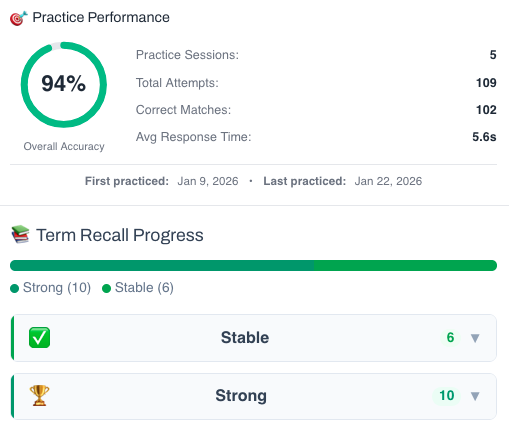
This isn’t a simple quiz — it’s a fully tracked learning system. You build knowledge through recognition, then recall, and your progress feeds directly into the Integrated Practice Bar (Writing tasks, AI Chat, and more).
- Practice sessions, accuracy, and response-time tracking
- Term strength levels (Learning → Stable → Strong)
- Personal progress history for each unit
This feature is available to YSP members.
Explore Membership BenefitsMember-Exclusive Practice Bar
Access a wide range of integrated practice for this unit — from Vocabulary and Grammar activities to AI-curated Writing tasks and Thematic Chat practice.
This feature is available to YSP members.
Explore Membership BenefitsMember-Exclusive Sentence Builder
Reconstruct scrambled sentences to practice word order and develop your grammar intuition.
This feature is available to YSP members.
Explore Membership Benefits