Present Perfect Simple vs Continuous: Completion vs Duration in the Workplace
Core PathWay
1 Why This Choice Matters: Two Colleagues, Two Perspectives
Imagine two colleagues comparing their morning work. One says, ‘I’ve written five emails’—the focus is on the completed, countable result. The other says, ‘I’ve been writing emails all morning’—emphasizing the ongoing activity and duration. Both sentences are correct, but they communicate different aspects of the work experience. For Italian speakers, this distinction can feel unnecessary because the passato prossimo covers both meanings: ‘Ho scritto email’ works in both contexts. However, English requires you to choose: do you want to highlight what you’ve accomplished, or how long you’ve been engaged in the process? This page will teach you exactly when and why to make this choice, helping you communicate with precision about workplace productivity and progress.
2 Present Perfect Simple: Completed Actions and Visible Results
The Present Perfect Simple focuses on completed actions where the result is more important than the duration. We use it when we can count the achievements, when a task is finished, or when we want to emphasize what has been accomplished. In workplace contexts, this form is perfect for reporting completed projects, submitted reports, or met deadlines. For example: ‘She has finished the quarterly report’ tells us the report is done—the emphasis is on completion, not how long it took. Similarly, ‘We have achieved our sales targets’ focuses on the successful result. Italian speakers often feel comfortable with this form because it closely mirrors the passato prossimo. However, be careful: when the activity is still ongoing or when you want to emphasize time spent rather than countable results, the Simple form will sound incomplete or even incorrect. The key question is: Can I see or count the result? If yes, use Present Perfect Simple.
Focus
- Used for completed actions with visible, countable results
- Emphasizes achievement and accomplishment rather than duration
- Often accompanied by quantifiers (three reports, five tasks, two projects)
- Signals that a task or project is finished and ready
Rules
- Form: Subject + has/have + past participle
- Affirmative: I/You/We/They have completed; He/She/It has completed
- Negative: has/have + not + past participle (haven’t finished, hasn’t achieved)
- Question: Has/Have + subject + past participle (Have you finished the report?)
- Common with: already, just, yet, recently, so far, this week/month/year
Examples
- I have written three reports this week.
- She has completed all her tasks before the deadline.
- We have achieved significant progress on the project.
- The team has finished the presentation for tomorrow’s meeting.
- He has accomplished more than we expected this month.
- They have submitted the final report to management.
Common mistake
3 Present Perfect Continuous: Duration, Process, and Ongoing Activities
The Present Perfect Continuous emphasizes the duration of an activity or the process itself rather than the completed result. We use it for ongoing activities that started in the past and continue now, or for repeated actions over a period of time. In workplace discussions, this form is essential when you want to highlight effort, time investment, or the continuity of work. For example: ‘I’ve been working on this project all week’ emphasizes the time and effort spent, not necessarily that the project is finished. Similarly, ‘She’s been attending meetings since 9 a.m.’ focuses on the continuous activity. Italian speakers often avoid this form because Italian doesn’t have an exact equivalent—you might say ‘Sto lavorando’ (present continuous) or ‘Ho lavorato’ (passato prossimo), but neither captures the English sense of an activity that started in the past and continues with emphasis on duration. This avoidance leads to unnatural English: saying ‘I work here for five years’ instead of ‘I’ve been working here for five years.’ The key question is: Do I want to emphasize how long or the ongoing nature? If yes, use Present Perfect Continuous.
Focus
- Used for ongoing or repeated activities emphasizing duration
- Focuses on the process and time spent rather than completion
- Often used with time expressions (all day, for hours, since morning)
- Signals that an activity is still in progress or has just finished with visible effects
Rules
- Form: Subject + has/have + been + verb-ing
- Affirmative: I/You/We/They have been working; He/She/It has been working
- Negative: has/have + not + been + verb-ing (haven’t been working)
- Question: Has/Have + subject + been + verb-ing (Have you been working on this?)
- Common with: for, since, all day/week/month, lately, recently, how long
Examples
- I’ve been writing emails all morning and I’m exhausted.
- She’s been working on the report since yesterday.
- We’ve been making progress on the project for three weeks.
- The team has been attending training sessions this month.
- He’s been trying to meet the deadline but needs more time.
- They’ve been collaborating on this task for several days.
Common mistake
4 Choosing the Right Structure: Completion or Duration?
The choice between Present Perfect Simple and Continuous fundamentally depends on what you want to emphasize: the result or the process. Ask yourself: Am I highlighting what I’ve accomplished (Simple), or how long I’ve been engaged in the activity (Continuous)? Consider these paired examples that show how aspect choice changes meaning:
‘I’ve read the report’ vs ‘I’ve been reading the report’: The Simple version means you finished reading and now know the content—the focus is on completion and the knowledge gained. The Continuous version means you’re either still reading or you’ve just finished, but the emphasis is on the time and effort spent reading, not necessarily on having absorbed all the information. Italian speakers might use both interchangeably because ‘Ho letto il report’ covers both, but in English, the distinction is crucial.
‘She’s written the proposal’ vs ‘She’s been writing the proposal’: The Simple form tells us the proposal is done and ready to submit—a completed task with a visible result. The Continuous form indicates she’s still working on it, or has just finished but we’re emphasizing the duration and effort involved in the writing process.
‘We’ve worked on three projects’ vs ‘We’ve been working on this project’: The Simple version counts completed projects—quantifiable achievements. The Continuous version emphasizes ongoing effort on a single project, highlighting progress rather than completion.
Signal words provide helpful clues. Time expressions with ‘for’ and ‘since’ typically require Continuous when the activity is ongoing: ‘I’ve been working here for five years’ (still employed). However, if you’re counting completed actions, use Simple even with ‘for’: ‘I’ve completed ten reports for this client’ (countable results). Words like ‘already,’ ‘just,’ and ‘yet’ almost always signal Simple because they emphasize completion: ‘I’ve just finished the task.’ Expressions like ‘all day,’ ‘all morning,’ and ‘lately’ often suggest Continuous because they emphasize duration: ‘I’ve been attending meetings all day.’
For Italian speakers, the critical trap is the passato prossimo overlap. When you think ‘Ho lavorato qui per cinque anni,’ your instinct is Present Perfect Simple because of the grammatical similarity. But ask: Is the action still ongoing? If yes, English requires Continuous: ‘I’ve been working here for five years.’ Similarly, ‘Ho scritto email tutta la mattina’ feels like Simple (‘I’ve written emails’), but if you want to emphasize the duration (‘all morning’), English needs Continuous: ‘I’ve been writing emails all morning.’ The decision framework is simple: Result and completion → Simple. Duration and process → Continuous. When in doubt, ask: Can I count it, or am I measuring time?
5 In Context: A Project Manager’s Progress Review
Email from Project Manager to Team
Subject: Weekly Progress Update
Hi Team,
I wanted to share some thoughts on our progress this week. Overall, I’m pleased with what we’ve accomplished. Sarah, you’ve completed the client presentation—excellent work, and right before the deadline too. The design looks professional and the data is clear. Marco, I know you’ve been working on the budget analysis since Monday. Have you been making good progress? I understand it’s complex, but we need the final figures by Friday.
I’ve been reviewing the project timeline this morning, and I’ve noticed some delays in the testing phase. The development team has finished the core features, which is fantastic, but QA has been testing the system for three weeks now and we still don’t have a final report. I’ve been trying to understand what’s causing the hold-up. Have they been encountering major bugs, or is it just taking longer than expected?
On a positive note, our productivity has improved significantly. We’ve achieved most of our monthly targets, and the client has been expressing satisfaction with our ongoing communication. I’ve been attending weekly calls with them, and they appreciate the transparency.
Let’s schedule a team meeting tomorrow to discuss any challenges. I’ve been thinking about our resource allocation, and I believe we need to adjust our approach for the next phase.
Best regards,
Alessandra
Noticing Prompts:
1. Find three examples of Present Perfect Simple. Why did Alessandra choose this form? What does she want to emphasize—the completed result or the duration of the activity?
2. Locate the Present Perfect Continuous examples. In each case, is the activity still ongoing, or is Alessandra emphasizing how long something has been happening?
3. Look at ‘you’ve been working on the budget analysis’ versus ‘you’ve completed the presentation.’ Why does the same person (Alessandra) use different forms when discussing different tasks? What does this tell you about the status of each task?
Use the VAS to build solid recognition and recall of the terms below.
✔ Every correct Match = +1 point
✔ Every correct Recall = +2 points
🎓 Reach 5 points with good accuracy and the term is automatically promoted to your Personal Dictionary.
Incorrect answers lower accuracy, meaning more correct Matches or Recalls may be needed to reach promotion.
Member-Exclusive Vocabulary Review & Acquisition System
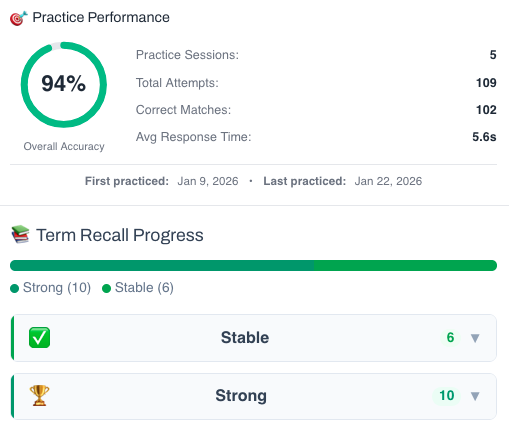
This isn’t a simple quiz — it’s a fully tracked learning system. You build knowledge through recognition, then recall, and your progress feeds directly into the Integrated Practice Bar (Writing tasks, AI Chat, and more).
- Practice sessions, accuracy, and response-time tracking
- Term strength levels (Learning → Stable → Strong)
- Personal progress history for each unit
This feature is available to YSP members.
Explore Membership BenefitsMember-Exclusive Practice Bar
Access a wide range of integrated practice for this unit — from Vocabulary and Grammar activities to AI-curated Writing tasks and Thematic Chat practice.
This feature is available to YSP members.
Explore Membership BenefitsMember-Exclusive Sentence Builder
Reconstruct scrambled sentences to practice word order and develop your grammar intuition.
This feature is available to YSP members.
Explore Membership Benefits