Present Perfect vs Past Simple: Understanding Unfinished Time Periods
Core PathWay
1 The Challenge of ‘Today’: Why One Word Takes Two Tenses
Why does English sometimes feel inconsistent? Italian speakers often struggle with a particular grammar puzzle: the same time expression requiring different tenses depending on when you speak.
Imagine you’re in a meeting at 2pm, discussing your team’s progress. You say, ‘We’ve completed three tasks today.’ Later, at midnight, you write in your report: ‘We completed three tasks today.’ Same day. Same tasks. Different tense. Why?
The answer lies in a concept that doesn’t exist in quite the same way in Italian: the distinction between finished and unfinished time periods. When you speak at 2pm, ‘today’ is still happening—it’s an ongoing period that includes the present moment. By midnight, ‘today’ has ended; it’s a finished period in the past. English grammar reflects this temporal reality through tense choice, whereas Italian uses the *passato prossimo* more flexibly.
This isn’t just a theoretical grammar point. In professional contexts, using the wrong tense can create confusion about timing. If you say ‘I sent the email today’ during a morning meeting, your colleagues might wonder when exactly you sent it—was it earlier this morning, or did you mean yesterday? The Present Perfect (‘I’ve sent the email today’) makes the timing crystal clear: it happened within the period that’s still continuing right now.
Key Terms
2 The Rule: Unfinished vs Finished Time Periods
Understanding when to use Present Perfect versus Past Simple depends entirely on one question: Does this time period include the present moment? If you can draw a timeline and place ‘NOW’ inside the time period, you need Present Perfect. If ‘NOW’ falls outside the period—meaning the period has finished—you need Past Simple.
This rule applies consistently to expressions like today, this week, this month, and this year. The challenge is that the same expression can require different tenses at different moments. ‘This week’ takes Present Perfect on Monday, Tuesday, Wednesday, Thursday, Friday, and Saturday—but switches to Past Simple once you’re speaking from the perspective of next week. The time expression hasn’t changed; your temporal position relative to it has.
Focus
- Time expressions like today, this week, this month, this year are unfinished periods when they include the present moment
- Use Present Perfect for actions within unfinished time periods
- Use Past Simple once the time period has finished
- The same time expression can require different tenses depending on when you speak
Rules
- UNFINISHED PERIOD (includes now) → Present Perfect: ‘We’ve achieved three milestones this month.’ (spoken on March 15th)
- FINISHED PERIOD (excludes now) → Past Simple: ‘We achieved three milestones this month.’ (spoken on April 2nd, looking back at March)
- The test: Ask yourself ‘Am I still in this time period right now?’ If yes → Present Perfect. If no → Past Simple.
- Visual timeline: Draw a line representing the time period. Mark where NOW is. If NOW is inside the line, use Present Perfect. If NOW is outside (after) the line, use Past Simple.
Examples
- At 3pm: ‘I’ve had two meetings today.’ | At midnight (next day): ‘I had two meetings yesterday.’
- On Thursday: ‘We’ve completed five tasks this week.’ | On Monday (next week): ‘We completed five tasks last week.’
- In June: ‘The project has reached two milestones this year.’ | In January (next year): ‘The project reached two milestones last year.’
Common mistake
Key Terms
3 A Day in the Life: Following the Tense Shift
Let’s follow Sarah, a project manager, through a single workday to see how her language changes as time periods finish.
9:00 AM – Morning Stand-up Meeting
Sarah arrives at the office and joins her team for their daily stand-up. ‘Good morning, everyone. Let’s review our progress. We’ve completed two tasks already today—the budget update and the client report. That’s excellent work. This week, we’ve hit three important milestones, and we’re on schedule to achieve our target for the month. Has anyone encountered any problems so far today?’
Notice Sarah’s tense choices. It’s 9am, so ‘today’ is very much ongoing. The morning has barely started, yet she uses Present Perfect consistently: ‘we’ve completed’, ‘we’ve hit’, ‘has anyone encountered’. The time periods—today, this week—are unfinished. She’s standing inside them, looking at what’s happened up to this moment.
5:00 PM – End-of-Day Review
Sarah calls a quick meeting before everyone leaves. ‘Before we finish, let’s look at what we’ve achieved today. We’ve completed five tasks in total—two this morning and three this afternoon. I’ve updated the project schedule, and the team has made fantastic progress. This week has been really productive; we’ve met every deadline. Well done, everyone. See you tomorrow.’
It’s now 5pm, but ‘today’ still hasn’t finished. Sarah is still within the time period, so she continues using Present Perfect: ‘we’ve achieved’, ‘we’ve completed’, ‘I’ve updated’, ‘we’ve met’. The day is nearly over, but crucially, it’s not over yet. She’s describing actions within a period that includes the present moment.
11:55 PM – Writing the Daily Report
Late that night, Sarah sits at her computer writing her daily report for senior management. She types: ‘The team completed five tasks today. We met all our deadlines and made excellent progress. This week, we achieved three major milestones. The project remains on schedule, and I updated all documentation before close of business.’
Now look at the tense shift. It’s nearly midnight—’today’ is about to end. From Sarah’s temporal position, she’s essentially looking back at a finished period. She switches to Past Simple: ‘completed’, ‘met’, ‘made’, ‘achieved’, ‘updated’. The actions are the same ones she described at 5pm, but her perspective has changed. She’s no longer inside ‘today’; she’s at its boundary, treating it as complete.
This shift isn’t arbitrary or optional. It reflects a fundamental principle of English grammar: finished periods require Past Simple. If Sarah were writing this report the next morning, she’d be even more clearly outside ‘yesterday’, and Past Simple would be the only natural choice. The Present Perfect would sound wrong because she’d no longer be in the time period when the actions occurred.
Key Terms
4 Self-Correction Strategies: Overcoming Italian Interference
Italian speakers face a specific challenge with this grammar point because the *passato prossimo* serves multiple functions that English divides between Present Perfect and Past Simple. In Italian, you can say ‘Ho completato il rapporto oggi’ whether you’re speaking at 10am or at midnight. English doesn’t allow this flexibility.
The One-Question Self-Correction Strategy
Before you choose a tense, ask yourself one simple question: ‘Am I still in this time period right now?’ If you can answer ‘yes’, use Present Perfect. If you answer ‘no’, use Past Simple. This question works for all the common time expressions: today, this week, this month, this year.
Let’s practice with real examples. It’s Wednesday afternoon, and you’re in a meeting. You want to say: ‘We _____ (complete) three tasks this week.’ Ask the question: ‘Am I still in this week right now?’ Yes, you are—it’s Wednesday. Therefore: ‘We’ve completed three tasks this week.’
Now imagine it’s Monday morning, and you’re reviewing last week’s work. You want to say: ‘We _____ (complete) three tasks last week.’ Ask the question: ‘Am I still in last week right now?’ No, you’re not—last week is finished. Therefore: ‘We completed three tasks last week.’
Common Error Patterns and Fixes
Error 1: *’I sent the email today’ (spoken at 11am)*
Why it’s wrong: ‘Today’ is unfinished; you’re still in it.
Correction: ‘I’ve sent the email today.’
Think: The day includes NOW, so use Present Perfect.
Error 2: *’This year, we have achieved all our targets’ (spoken in January of the following year)*
Why it’s wrong: You’re no longer in ‘this year’—you’re in the next year.
Correction: ‘Last year, we achieved all our targets.’
Think: The year is finished; you’re outside it now.
Error 3: *’We have met the deadline yesterday’*
Why it’s wrong: ‘Yesterday’ is always a finished period.
Correction: ‘We met the deadline yesterday.’
Think: ‘Yesterday’ can never include NOW, so always use Past Simple.
Building the Habit
The key to overcoming this interference error is developing a mental habit. Every time you use today, this week, this month, or this year, pause for a microsecond and ask: ‘Am I in it or outside it?’ With practice, this check becomes automatic. Your brain will start selecting the correct tense without conscious effort, and the Present Perfect will feel natural for ongoing time periods rather than like an arbitrary grammar rule.
Remember: English grammar isn’t trying to be difficult. It’s simply reflecting a temporal reality—the difference between standing inside a time period and looking back at it from outside. Once you internalize this concept, the tense choice becomes logical rather than mysterious.
5 Recap: Mastering Tense Choice with Unfinished Time Periods
You’ve now explored one of the most challenging aspects of English tense usage for Italian speakers: the distinction between Present Perfect and Past Simple with time expressions like today, this week, this month, and this year.
The core principle is straightforward: unfinished time periods (those that include the present moment) require Present Perfect, while finished time periods require Past Simple. The same time expression can demand different tenses depending on your temporal position. At 2pm, ‘today’ is unfinished, so you say ‘I’ve completed the task‘. At midnight, ‘today’ is finished, so you say ‘I completed the task’.
The one-question self-correction strategy gives you a practical tool: ‘Am I still in this time period right now?’ If yes, use Present Perfect. If no, use Past Simple. This simple check helps you overcome the interference from Italian, where *passato prossimo* covers both functions.
By following Sarah through her workday, you’ve seen how tense choice shifts naturally as time periods finish. The language isn’t being inconsistent—it’s reflecting temporal reality. As you practice this distinction in your own speaking and writing, the choice will become increasingly automatic, and you’ll develop an intuitive sense for when a time period includes NOW and when it doesn’t.
Use the VAS to build solid recognition and recall of the terms below.
✔ Every correct Match = +1 point
✔ Every correct Recall = +2 points
🎓 Reach 5 points with good accuracy and the term is automatically promoted to your Personal Dictionary.
Incorrect answers lower accuracy, meaning more correct Matches or Recalls may be needed to reach promotion.
Member-Exclusive Vocabulary Review & Acquisition System
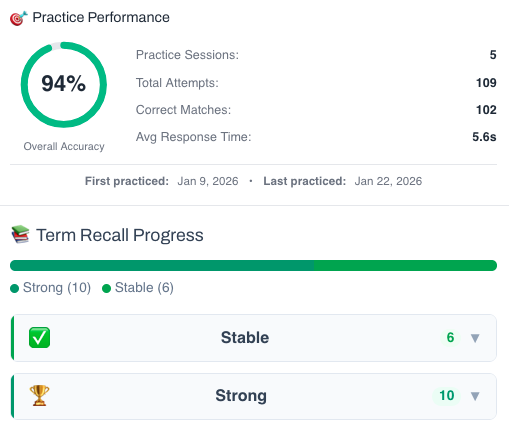
This isn’t a simple quiz — it’s a fully tracked learning system. You build knowledge through recognition, then recall, and your progress feeds directly into the Integrated Practice Bar (Writing tasks, AI Chat, and more).
- Practice sessions, accuracy, and response-time tracking
- Term strength levels (Learning → Stable → Strong)
- Personal progress history for each unit
This feature is available to YSP members.
Explore Membership BenefitsMember-Exclusive Practice Bar
Access a wide range of integrated practice for this unit — from Vocabulary and Grammar activities to AI-curated Writing tasks and Thematic Chat practice.
This feature is available to YSP members.
Explore Membership BenefitsMember-Exclusive Sentence Builder
Reconstruct scrambled sentences to practice word order and develop your grammar intuition.
This feature is available to YSP members.
Explore Membership Benefits