Counting Experiences: Present Perfect for Repeated Actions
Core PathWay
1 Why Present Perfect? The Logic Behind Counting Experiences
Imagine someone asks you: ‘How many times have you been to London?’ You might answer: ‘Three times.’ But here’s the fascinating thing – that answer doesn’t tell us WHEN you went. Was it last year? Five years ago? A mix of different years? We simply don’t know, and more importantly, we don’t need to know.
This is precisely why English uses the Present Perfect tense for counting experiences rather than the Past Simple. When we say ‘I’ve visited Singapore four times,’ we’re focusing on the number – the accumulated experience – not on the specific dates. The experiences exist in an unspecified or unfinished time frame that connects to now.
Think of it this way: if you say ‘I visited Singapore in 2019,’ you’ve given us a specific, finished time period (2019), so you must use Past Simple. But if you say ‘I’ve visited Singapore four times,’ you’re talking about your life experience up until now – a time frame that’s still ongoing. Your life isn’t finished, so the time period isn’t finished either.
This distinction becomes especially important in professional contexts. When a frequent flyer discusses their travel history, they naturally use Present Perfect: ‘I’ve been to this airport dozens of times’ or ‘I’ve experienced jet lag on many occasions.’ They’re sharing accumulated experience, not narrating specific past events.
Understanding this logic will transform how you discuss experiences, travel history, and repeated actions in English. It’s not about memorizing rules – it’s about recognizing whether you’re counting experiences across ongoing time or narrating specific past events.
💬 Discussing Travel Habits at a Networking Event
Two professionals meet at an international business conference and discover they both travel frequently for work
2 Grammar Overview: Present Perfect with Frequency Expressions
Structure Formation:
The Present Perfect for repeated experiences follows this pattern:
Subject + have/has + past participle + frequency expression
Examples:
– I have visited Tokyo three times.
– She has missed her connection several times.
– They have upgraded to business class many times.
Common Frequency Expressions:
– Specific numbers: once, twice, three times, four times, etc.
– Approximate quantities: several times, many times, a few times, numerous times
– Emphasis: countless times, dozens of times, plenty of times
– Minimal frequency: only once, just twice, hardly ever
Question Formation: ‘How many times have you…?’
To ask about frequency of experiences, use this structure:
How many times + have/has + subject + past participle + …?
Examples:
– How many times have you been to this departure lounge?
– How many times has she applied for a visa?
– How many times have they changed their route?
Answering the Questions:
Short answers:
– ‘Three times.’
– ‘Several times.’
– ‘Many times.’
– ‘Only once.’
Full answers:
– ‘I’ve been there four times.’
– ‘She’s applied twice.’
– ‘We’ve changed our route several times.’
Present Perfect vs Past Simple with Repeated Actions:
– The time period is unspecified: ‘I’ve flown to Dubai many times.’
– The time period is unfinished: ‘I’ve had three delays this year.’ (the year isn’t finished)
– You’re counting life experiences: ‘She’s visited 30 countries.’
– You specify a finished time period: ‘I flew to Dubai three times last year.’
– You’re narrating specific past events: ‘I had a delay yesterday.’
– The time frame is clearly completed: ‘She visited 30 countries during her career.’ (career is finished)
Negative Forms:
– I haven’t been to Singapore.
– She hasn’t experienced jet lag many times.
– They haven’t missed a flight in years.
Time Expressions That Work with Present Perfect for Frequency:
– ever (in questions): ‘Have you ever been to Frankfurt?’
– never: ‘I’ve never missed a boarding call.’
– this week/month/year: ‘I’ve traveled twice this month.’ (ongoing period)
– in my life: ‘I’ve changed airlines several times in my life.’
– so far: ‘We’ve had no delays so far.’ (up until now)
💬 Airport Security Conversation About Frequent Travel
A security officer makes friendly conversation with a passenger who travels very frequently
3 Airport Lounge Conversation: Comparing Travel Experiences
Marco settled into a comfortable chair in the departure lounge at London Heathrow, his laptop open but his attention drifting. He’d been traveling for work for nearly eight years now, and airport lounges had become his second office. A woman sitting nearby closed her tablet and smiled.
‘Excuse me,’ she said, ‘but I couldn’t help noticing your airline loyalty program tag. Gold status – impressive. You must be a frequent flyer.’
Marco laughed. ‘You could say that. I’ve been to Singapore four times this year alone for client meetings. How about you?’
‘I’m Sarah. I work as a consultant for airlines, actually, so I’ve visited this airport countless times – probably more than fifty times in the past two years. How many times have you been through Heathrow?’
‘Honestly? I’ve lost count,’ Marco admitted. ‘At least once a month for the past few years. I’ve had layovers here, connections to the US, direct flights home to Milan. This lounge has become very familiar.’
Sarah nodded knowingly. ‘I know that feeling. Have you ever missed a connection here? I’ve had that happen several times when flights from Europe were delayed.’
‘Only twice, fortunately,’ Marco replied. ‘But I’ve experienced serious delays many times – probably fifteen or twenty times overall. The worst was a six-hour delay to Dubai. Have you been to Dubai?’
‘I’ve been there three times for conferences,’ Sarah said. ‘Beautiful airport. Actually, I’ve been upgraded to business class there a few times using my points. Have you ever been upgraded?’
Marco’s eyes lit up. ‘Yes! I’ve had upgrades maybe five or six times in total. The airline usually offers them when I’m on long-haul business trips and they have availability. It makes such a difference, especially for jet lag.’
‘Speaking of jet lag,’ Sarah continued, ‘how many times have you suffered from really bad jet lag? I’ve had it countless times, but I’ve learned to manage it better now.’
‘I’ve had terrible jet lag probably ten times,’ Marco calculated. ‘Especially on the Singapore route – that’s a challenging time difference. I’ve tried different strategies, but nothing works perfectly.’
Sarah leaned forward. ‘Have you ever applied for a fast-track visa program? I’ve done it twice – once for China and once for India. It’s saved me so much time.’
‘I haven’t, actually,’ Marco said. ‘Though I’ve thought about it several times. I’ve had visa issues only once, but it was stressful enough to make me more careful.’
‘How many different destinations have you flown to for work?’ Sarah asked.
‘I’ve counted about twenty-five cities,’ Marco replied. ‘Some I’ve visited just once, but others – like Singapore, Frankfurt, and London – I’ve been to many, many times. What about you?’
‘I’ve been to about forty cities,’ Sarah said, ‘but most of them multiple times. I’ve probably done the London-Frankfurt route more than a hundred times – it’s one of the busiest in Europe.’
Their boarding announcement interrupted the conversation. Marco stood up and extended his hand.
‘It’s been great comparing experiences,’ he said. ‘Safe travels!’
‘You too,’ Sarah replied. ‘And who knows – we’ve probably been on the same flights several times without realizing it!’
As Marco walked toward his gate, he smiled. In the world of frequent business travel, these chance conversations had happened many times before, and they probably would many times again.
4 Common Errors for Italian Speakers: Correction Strategies
Italian speakers often struggle with Present Perfect for repeated experiences because Italian uses the *passato prossimo* differently from English Present Perfect. Here are the most common errors and how to fix them:
Error 1: Using Past Simple Instead of Present Perfect for Unspecified Frequency
❌ *I visited Singapore four times.*
Why this happens: In Italian, you might say ‘Sono stato a Singapore quattro volte’ or ‘Andai a Singapore quattro volte,’ and both can work depending on context. English is stricter – without a specific time reference, you must use Present Perfect.
Correction strategy: Ask yourself: ‘Am I giving a specific time?’ If the answer is no, use Present Perfect. The phrase ‘four times’ doesn’t tell us WHEN, so it requires ‘I’ve visited.’
Error 2: Mixing Present Perfect with Specific Past Time References
❌ *I’ve been to London three times last year.*
Why this happens: Italian speakers sometimes think the frequency expression (three times) means they should use Present Perfect, even when there’s a specific time marker (last year).
Correction strategy: Look for finished time expressions: yesterday, last week, last year, in 2019, etc. These ALWAYS require Past Simple, regardless of frequency expressions.
Error 3: Wrong Question Formation
❌ *How many times did you visit Singapore?* (when asking about general life experience)
Why this happens: Italian question formation with ‘Quante volte’ can use passato prossimo or passato remoto, making the choice feel flexible.
Correction strategy: For questions about life experiences or unspecified repeated actions, always start with ‘How many times have/has…?’ Only use ‘did’ if you’re asking about a specific finished period: ‘How many times did you visit Singapore last year?’
Error 4: Forgetting the Past Participle
❌ *I have visit Tokyo many times.*
Why this happens: In rapid speech, Italian speakers sometimes drop the past participle ending, influenced by Italian patterns.
Correction strategy: Remember the formula: have/has + PAST PARTICIPLE. Regular verbs add -ed (visited, traveled, changed), but watch for irregular forms (been, flown, had).
Error 5: Using Present Perfect for Finished Life Periods
❌ *During my university years, I’ve traveled to France three times.*
Why this happens: The frequency expression ‘three times’ triggers Present Perfect in the speaker’s mind.
Correction strategy: If the time period is finished and clearly stated (during my university years, in my previous job, when I was young), use Past Simple even with frequency expressions.
Error 6: Overusing Present Perfect with Recent Specific Events
❌ *I’ve had a delay yesterday.*
Why this happens: Italian *passato prossimo* (‘ho avuto un ritardo ieri’) sounds natural, so speakers transfer this to English.
Correction strategy: ‘Yesterday’ is a specific finished time, so it requires Past Simple. Present Perfect works with ‘recently’ or ‘lately’ because these are unspecific: ‘I’ve had delays recently.’
Practice Exercise for Self-Correction:
When you’re about to use a frequency expression, ask:
1. Is there a specific time marker (yesterday, last year, in 2019)? → Use Past Simple
2. Is the time period finished (during my childhood, when I worked there)? → Use Past Simple
3. Is it about general life experience or ongoing time? → Use Present Perfect
Use the VAS to build solid recognition and recall of the terms below.
✔ Every correct Match = +1 point
✔ Every correct Recall = +2 points
🎓 Reach 5 points with good accuracy and the term is automatically promoted to your Personal Dictionary.
Incorrect answers lower accuracy, meaning more correct Matches or Recalls may be needed to reach promotion.
Member-Exclusive Vocabulary Review & Acquisition System
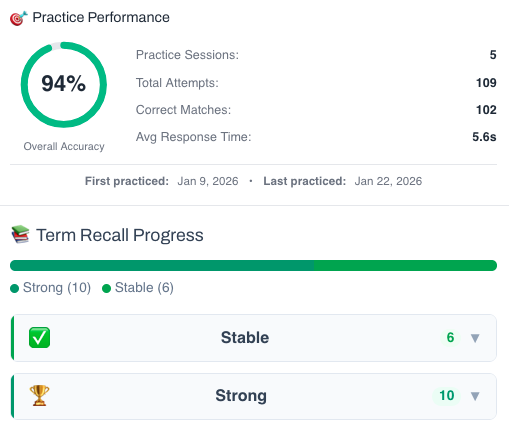
This isn’t a simple quiz — it’s a fully tracked learning system. You build knowledge through recognition, then recall, and your progress feeds directly into the Integrated Practice Bar (Writing tasks, AI Chat, and more).
- Practice sessions, accuracy, and response-time tracking
- Term strength levels (Learning → Stable → Strong)
- Personal progress history for each unit
This feature is available to YSP members.
Explore Membership BenefitsMember-Exclusive Practice Bar
Access a wide range of integrated practice for this unit — from Vocabulary and Grammar activities to AI-curated Writing tasks and Thematic Chat practice.
This feature is available to YSP members.
Explore Membership BenefitsMember-Exclusive Sentence Builder
Reconstruct scrambled sentences to practice word order and develop your grammar intuition.
This feature is available to YSP members.
Explore Membership Benefits