When Present Perfect Signals Sophistication: Register, Formality, and Regional Identity
Core PathWay
1 Four Ways to Say the Same Thing
Grammar isn’t merely about correctness—it’s fundamentally about appropriateness.
Consider these four expressions of essentially identical information. A formal communication from a recruitment department: *”We have received your application and will respond within five working days.”* A casual conversation between friends via text: *”Did you get my message? Let me know!”* A British colleague greeting you at the office: *”I’ve just arrived—shall we grab a coffee before the meeting?”* An American colleague saying precisely the same thing: *”I just arrived—want to grab coffee before the meeting?”
Notice that all four communicate successfully, yet the grammatical choices differ markedly. The Present Perfect (*have received*, *have just arrived*) appears in the formal business correspondence and the British English example, whereas the Past Simple (*did you get*, *just arrived*) dominates the informal text and American English contexts. These aren’t errors or preferences based on whim—they’re sophisticated markers of formality level, regional variation, and register awareness.
When you draft a message to a client or respond to professional correspondence, your tense choice contributes to their perception of your professionalism and credibility. Understanding this dimension of grammar transforms you from someone who merely avoids mistakes into someone who strategically adapts language to context—a hallmark of C1 competence.
Key Terms
2 Present Perfect Versus Past Simple: A Register Comparison
The Present Perfect often functions as more than a tense expressing time relationships—it serves as a formality marker that signals professional context, written versus spoken medium preferences, and regional identity.
In business correspondence and formal professional settings, Present Perfect conveys a sense of institutional voice and measured distance. When a company writes *”We have reviewed your proposal”* rather than *”We reviewed your proposal,”* the Present Perfect subtly emphasizes the current relevance and ongoing relationship, while simultaneously maintaining professional formality. This distinction becomes particularly salient when you’re drafting applications, responding to clients, or communicating upward in organizational hierarchies. Conversely, in casual spoken contexts, especially in American English, the Past Simple dominates even when Present Perfect would be grammatically acceptable—*”Did you finish the report?”* feels more natural in informal American speech than *”Have you finished the report?”* despite both being correct.
Focus
- Present Perfect signals formality in written professional communication
- British English strongly prefers Present Perfect with ‘just’, ‘already’, ‘yet’ even in speech
- American English accepts Past Simple in contexts where British English requires Present Perfect
- Register and medium (written vs spoken) influence tense choice as much as time reference
Rules
- In formal business correspondence, prefer Present Perfect to emphasize current relevance and maintain professional distance: ‘We have received your inquiry’ rather than ‘We received your inquiry’
- British English consistently uses Present Perfect with time adverbs indicating recent completion: ‘I’ve just finished’ / ‘She’s already left’ / ‘Have you seen it yet?’
- American English permits Past Simple in the same contexts: ‘I just finished’ / ‘She already left’ / ‘Did you see it yet?’ — particularly in spoken communication
- When adapting communication for international audiences, consider that Present Perfect signals British English identity and formal register, while Past Simple may signal American English preference or casual register
Examples
- Formal British email to client: ‘We have completed the analysis and have identified several opportunities for cost reduction.’ / Informal American colleague: ‘We finished the analysis and found some ways to cut costs.’
- British colleague in meeting: ‘I’ve just spoken to the finance director and she’s already approved the budget.’ / American colleague: ‘I just spoke to the finance director and she already approved the budget.’
- Formal application letter: ‘I have gained extensive experience in project management and have successfully led cross-functional teams.’ / Casual conversation: ‘I got lots of experience in project management and led several teams.’
Common mistake
Key Terms
3 One Professional, Three Registers: Marco’s Communication Day
Marco Benedetti, an Italian marketing director working in London, begins his Tuesday morning drafting an email to prospective clients in Manchester. He types carefully: *”Thank you for your inquiry regarding our digital transformation services. We have reviewed your requirements and have prepared a preliminary proposal. Our team has identified three key areas where we can deliver immediate value, and we have scheduled a presentation for next Thursday.”* Marco reads it back, satisfied with the formal tone. The Present Perfect constructions signal professionalism and align with British business conventions—essential when establishing credibility with new clients.
At 10:30, Marco joins a video call with colleagues from the New York office. The conversation shifts immediately into a more relaxed register. His American counterpart, Jennifer, asks: *”Did you get my message about the campaign metrics? I sent it yesterday.”* Marco responds naturally: *”Yes, I saw it this morning. Did you have a chance to look at the budget revisions I sent last week?”* He notices himself using Past Simple constructions that mirror Jennifer’s style—*did you get*, *I sent*, *did you have*—rather than the Present Perfect forms he’d written in his client email an hour earlier. This isn’t inconsistency; it’s register awareness. In casual conversation with American colleagues, insisting on *”Have you had a chance to look…”* would sound unnecessarily formal, even slightly distant.
That afternoon, Marco attends a strategy meeting with British partners from the Birmingham office. The managing director opens: *”I’ve just received the quarterly figures, and I must say, they’ve exceeded our projections considerably. Marco, your team’s campaign has generated remarkable results.”* Marco replies: *”Thank you. We’ve worked closely with the analytics team, and they’ve provided invaluable insights throughout the project.”* He’s returned to Present Perfect constructions—*I’ve just received*, *they’ve exceeded*, *we’ve worked*, *they’ve provided*—matching the British preference and the meeting’s formality level.
By day’s end, Marco has navigated three distinct communication contexts, adjusting his tense choices each time. His application of regional variation awareness and sensitivity to written versus spoken norms hasn’t compromised his message—it has enhanced his effectiveness. He’s demonstrated that sophisticated professional context communication requires more than grammatical accuracy; it demands strategic appropriateness. When drafting his evening summary email to the CEO—another formal business correspondence—Marco naturally writes: *”Today’s meeting has confirmed our strategic direction, and the New York team has committed to full collaboration on the autumn campaign.”* The Present Perfect signals formality, current relevance, and British English alignment—precisely the perception he intends to create.
Key Terms
4 Practical Guidance: Adapting Your Tense Choice
Developing sophisticated tense choice requires systematic attention to three variables: your audience’s regional variety, the communication medium, and the formality level required.
When writing formal business correspondence to British audiences or international clients, default to Present Perfect for recent actions with current relevance: *”We have received your order”* / *”I have attached the revised contract”* / *”The team has completed the initial assessment.”* This signals professionalism and aligns with British English conventions that dominate international business standards. However, when the time frame is clearly finished and disconnected from the present, Past Simple remains appropriate even in formal contexts: *”We launched the product in March 2022″* / *”The previous contract expired last year.”*
When communicating with American colleagues or clients, recognize that Past Simple is acceptable—indeed, often preferred—even for recent events: *”Did you receive my email?”* / *”I sent the report this morning”* / *”We finished the project ahead of schedule.”* Insisting on Present Perfect in casual American contexts (*”Have you received my email?”*) risks sounding overly formal or even pedantic. Nevertheless, in highly formal American business writing—particularly legal, academic, or executive-level professional contexts—Present Perfect retains its formality function.
Common mistakes to avoid: Don’t assume that Present Perfect is universally more correct or sophisticated. A British CEO writing *”I just arrived”* in a text to a colleague sounds inappropriately American or careless; the same CEO would naturally write *”I’ve just arrived.”* Conversely, an American professional writing *”I have just finished the analysis”* in an internal team email sounds unnecessarily stiff; *”I just finished the analysis”* achieves the same meaning with appropriate register awareness. The error isn’t grammatical—it’s pragmatic.
Strategic adaptability: When uncertain about your audience’s preferences, consider the medium and formality. Formal written communication to mixed international audiences generally benefits from Present Perfect, which signals professionalism across varieties. Informal spoken communication, particularly with American interlocutors, permits Past Simple even for recent events. Your goal isn’t to master a single “correct” form but to develop the register awareness that allows you to shift appropriately—demonstrating not just linguistic accuracy but sociolinguistic sophistication that enhances your credibility across diverse professional contexts.
5 Key Takeaways: Grammar as Strategic Choice
This lesson has demonstrated that Present Perfect versus Past Simple isn’t merely a grammatical distinction—it’s a strategic choice that signals formality level, regional identity, and register awareness. You’ve seen how the same information can be expressed with different tense choices depending on whether you’re drafting business correspondence, chatting with colleagues, or addressing clients.
The narrative of Marco’s communication day illustrated how sophisticated professionals adapt their language throughout a single workday, shifting between Present Perfect in formal written contexts and British English speech, and Past Simple in casual conversation and American English contexts. This flexibility doesn’t represent inconsistency—it demonstrates advanced appropriateness awareness.
Your practical guidance emphasized three key variables: audience regional variation (British vs American preferences), communication medium (written versus spoken norms), and formality level requirements. When you respond to applications, draft proposals, or communicate in any professional context, your tense choice contributes significantly to others’ perception of your professionalism and credibility. Mastering this dimension of grammar transforms you from someone who merely avoids errors into someone who strategically deploys language to achieve communicative goals—the hallmark of C1 competence.
Use the VAS to build solid recognition and recall of the terms below.
✔ Every correct Match = +1 point
✔ Every correct Recall = +2 points
🎓 Reach 5 points with good accuracy and the term is automatically promoted to your Personal Dictionary.
Incorrect answers lower accuracy, meaning more correct Matches or Recalls may be needed to reach promotion.
Member-Exclusive Vocabulary Review & Acquisition System
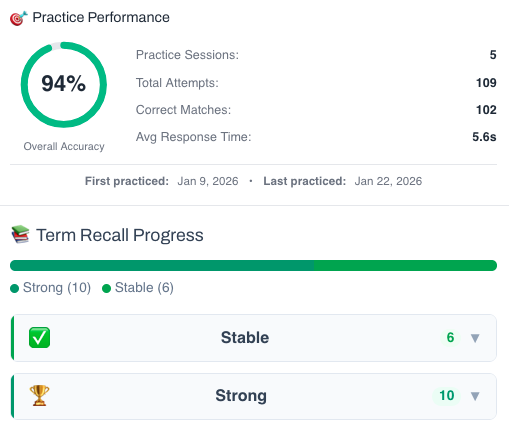
This isn’t a simple quiz — it’s a fully tracked learning system. You build knowledge through recognition, then recall, and your progress feeds directly into the Integrated Practice Bar (Writing tasks, AI Chat, and more).
- Practice sessions, accuracy, and response-time tracking
- Term strength levels (Learning → Stable → Strong)
- Personal progress history for each unit
This feature is available to YSP members.
Explore Membership BenefitsMember-Exclusive Practice Bar
Access a wide range of integrated practice for this unit — from Vocabulary and Grammar activities to AI-curated Writing tasks and Thematic Chat practice.
This feature is available to YSP members.
Explore Membership BenefitsMember-Exclusive Sentence Builder
Reconstruct scrambled sentences to practice word order and develop your grammar intuition.
This feature is available to YSP members.
Explore Membership Benefits