FOR vs DURING: Duration, Events, and Purpose in Travel English
Core PathWay
1 Why Learners Confuse FOR and DURING
Many Italian speakers say ‘I was there during three days’ or ‘We talked for the meeting’. Why? In Italian, ‘durante’ can work in many situations. But English is different. English uses FOR when you measure time: how long did it last? English uses DURING when you say which event or period: when did it happen? This page will teach you how to choose the right word. You will learn about travel situations like flights, stays, and trips. You will also learn how FOR shows purpose: going shopping for souvenirs or buying a gift for someone. These small words make a big difference in English.
2 FOR: Measuring Duration and Expressing Purpose
We use FOR to answer the question ‘how long?’ FOR measures the length of time something lasts. You put a number or quantity after FOR: for three days, for two hours, for a week. This is about duration, not about when. We use FOR with vacation time, flight times, stays at hotels, and breaks from work. FOR always needs a quantity: for five minutes, for a long time, for ages. Italian speakers often use DURANTE here, but English needs FOR. We also use FOR to show purpose: why are you doing something? I went shopping for souvenirs. I bought a gift for my sister. We stopped for breakfast. We went out for dinner. This FOR means ‘to get’ or ‘in order to have’. It connects an action to its goal. You can use FOR + noun (for souvenirs) or FOR + person (for my sister).
Focus
- FOR measures how long something lasts (duration)
- FOR needs a number or quantity of time after it
- FOR shows purpose: why you do something or who receives something
- FOR connects actions to goals (shopping for gifts, stopped for rest)
Rules
- FOR + number/quantity + time word (for three days, for two weeks, for an hour)
- FOR + noun to show purpose (for breakfast, for shopping, for souvenirs)
- FOR + person to show who receives something (for my sister, for you, for the children)
- Use FOR when you can ask ‘how long?’ about the time
- Use FOR when you can ask ‘why?’ or ‘for what purpose?’ about the action
Examples
- We stayed in Rome for five days.
- The flight was delayed for two hours.
- I need a break for ten minutes.
- She went shopping for souvenirs.
- I bought this gift for my mother.
- We stopped for dinner at a nice restaurant.
Common mistake
3 DURING: Identifying When Within a Specific Event
We use DURING to answer the question ‘when?’ DURING identifies which event or period something happened in. You put a specific event or period name after DURING: during the meeting, during my stay, during the conference, during the trip. This is about when, not how long. DURING always needs THE, MY, THIS, or another word before the event name. You cannot say ‘during three hours’ because ‘three hours’ is a duration, not an event name. Italian speakers often make this mistake because Italian ‘durante’ works differently. DURING shows that something happened inside the time of another event. I met her during my vacation. The phone rang during dinner. We had a problem during the flight. The event after DURING is like a container: something happened inside that time container.
Focus
- DURING identifies when something happened (which event or period)
- DURING needs a specific event or period name, not a duration number
- DURING is always followed by the/my/this/that + event name
- DURING shows something happened inside the time of another event
Rules
- DURING + the/my/this + event name (during the meeting, during my stay, during this trip)
- DURING + period name (during summer, during breakfast, during the journey)
- Do NOT use DURING + number (NOT: during three days)
- Use DURING when you can ask ‘when did it happen?’ and answer with an event
- The event after DURING must be a noun, not a duration
Examples
- I met her during my vacation in Spain.
- We visited three museums during our stay.
- The baby cried during the flight.
- She called me during the conference.
- It rained during our trip to the mountains.
- We talked about work during dinner.
Common mistake
4 Choosing the Right Structure: When and Why
How do you choose between FOR and DURING? Ask yourself one question: am I measuring time, or am I naming an event?
If you are measuring time (how long?), use FOR.
If you are naming an event or period (when? which one?), use DURING.
Look at these pairs: ‘I stayed for three days’ measures the length. ‘I met her during my stay’ names when it happened. ‘The meeting lasted for two hours’ measures duration. ‘We discussed the plan during the meeting‘ names the event. ‘We had a break for fifteen minutes’ measures time. ‘I checked my phone during the break‘ names when.
Here is a simple test: can you put a number after the word? If yes, use FOR. ‘For five days’ works. ‘During five days’ does not work in English. Can you put THE or MY before the word? If yes, it might need DURING. ‘During the conference‘ works. ‘For the conference’ only works for purpose, not time.
Watch out for these Italian traps. In Italian you can say ‘durante tre giorni’ but English needs ‘for three days’. In Italian you might say ‘per la riunione’ meaning ‘during the meeting’ but English FOR here means purpose only: ‘for the meeting’ means you prepared something for it, not that something happened during it.
Another key difference: FOR with purpose. When you go shopping for souvenirs, FOR shows your goal. When you buy a gift for your sister, FOR shows who receives it. When you stop for breakfast or go out for dinner, FOR shows why you stopped or went out.
This is completely different from time. Think of FOR as having two jobs: measuring time duration, and showing purpose or recipient. DURING has only one job: naming which event or period.
Signal words help you choose. Numbers and quantities (three days, two weeks, a long time, ages) need FOR. Event names with THE, MY, THIS (the trip, my vacation, this journey) often need DURING. Purpose phrases (shopping, a present, a meal name) need FOR. Here are more contrasts: ‘We rested for an hour’ (duration) vs ‘We rested during the flight‘ (when). ‘The visit lasted for a week’ (duration) vs ‘It snowed during our visit‘ (when). ‘I worked for three hours’ (duration) vs ‘I worked during the conference‘ (when). Remember: Italian speakers often want to use DURANTE everywhere because it feels natural. But English splits this into two words with different jobs. Master this split and your English will sound much more natural.
5 In Context: A Travel Email
Hi Maria,
I’m writing from Barcelona! We arrived here for a week of vacation. The flight was long – it lasted for three hours – but everything went well. During the flight, I watched a movie and had some rest.
We’re staying at a nice hotel for five nights. Yesterday, during our first day here, we went shopping for souvenirs in the old town. I bought a beautiful bag for my sister and some postcards for my friends. We stopped for breakfast at a lovely café during our walk.
This morning we had a meeting with a local guide. The meeting lasted for an hour. During the meeting, she told us about the best places to visit. Tomorrow we’re taking a trip to the beach for the whole day. We’ll have a break for lunch during the trip.
Tonight we’re going out for dinner at a restaurant by the sea. I’ll send you photos!
Love,
Sara
Notice these points: Can you find where Sara uses FOR to measure time? Look at ‘for a week’, ‘for three hours’, ‘for five nights’. Why does she use DURING in ‘during the flight’ and ‘during our first day’? She’s naming which event, not measuring how long. Where does Sara use FOR for purpose? Check ‘shopping for souvenirs’, ‘for my sister’, ‘stopped for breakfast’, ‘going out for dinner’. These show why or for whom, not duration.
Member-Exclusive Practice Bar
Access a wide range of integrated practice for this unit — from Vocabulary and Grammar activities to AI-curated Writing tasks and Thematic Chat practice.
This feature is available to YSP members.
Explore Membership BenefitsMember-Exclusive Vocabulary Review & Acquisition System
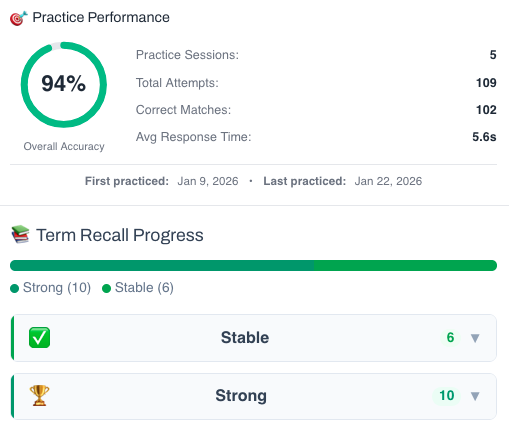
This isn’t a simple quiz — it’s a fully tracked learning system. You build knowledge through recognition, then recall, and your progress feeds directly into the Integrated Practice Bar (Writing tasks, AI Chat, and more).
- Practice sessions, accuracy, and response-time tracking
- Term strength levels (Learning → Stable → Strong)
- Personal progress history for each unit
This feature is available to YSP members.
Explore Membership Benefits🎮 Practice Games
Sentence Scrambler
Distinguishing FOR and DURING in time expressions, plus FOR expressing purpose – Sentence Scramble
Member-Exclusive Sentence Builder
Reconstruct scrambled sentences to practice word order and develop your grammar intuition.
This feature is available to YSP members.
Explore Membership Benefits