Using OF to Express Possession, Material, and Quantity
Core PathWay
1 Why Does English Use OF So Often?
The word OF is very useful in English. It connects two nouns to show a relationship. We use OF to show three different things: who owns what, what things are made from, and amounts.
Look at these examples from a craft fair: ‘the owner of the stall‘ (who owns it), ‘made of leather‘ (what material), and ‘a lot of visitors‘ (how many). You use OF many times every day when you describe objects and talk about quantities.
In this lesson, we visit a craft fair. At the fair, people sell handmade things. You will see jewellery, scarves, bowls, and other beautiful items. The fair is a perfect place to practise all three uses of OF. Let’s start!
Key Terms
2 The Three Uses of OF
OF works in three main ways. First, it shows possession with things and places. Second, it describes what something is made from. Third, it helps us talk about quantities. Let’s look at each one.
Focus
- Use OF to show possession with things and places: ‘the door of the car’, ‘the end of the street’
- Use OF to describe material and composition: ‘made of wood’, ‘a cup of tea’
- Use OF with quantity expressions: ‘a lot of people’, ‘a piece of cake’, ‘a bottle of water’
Rules
- For possession: Use OF with things and places (the price of the necklace, the name of the shop). Do NOT use OF with people’s names — use ‘s instead (Maria’s bag, NOT the bag of Maria)
- For material: Use ‘made of’ when you can still see the original material (made of silver, made of wool). The material does not change its form
- For quantity: Always use OF after these words: a lot of, a piece of, a cup of, a bottle of, a group of, the end of
Examples
- Possession: ‘The price of the necklace is £45.’ / ‘She is the owner of three stalls.’
- Material: ‘The bracelet is made of silver.’ / ‘These bowls are made of wood.’
- Quantity: ‘There are a lot of visitors today.’ / ‘A group of artists work here.’
Common mistake
Key Terms
3 A Day at the Craft Fair
Sam walked through the craft fair on Saturday morning. There were a lot of visitors already. The sun was warm and Sam felt happy.
At the first stall, Sam stopped to look at some beautiful jewellery. The owner of the stall smiled. ‘Hello! All my jewellery is handmade,’ she said. Sam picked up a necklace made of silver. It was lovely. Next to it were some bracelets made of leather. The price of the necklace was £35, and the price of each bracelet was £15.
‘I’ll take this bracelet,’ Sam said. ‘It’s a gift for my sister.’
Sam walked to the next stall. This stall sold wooden items. There were beautiful bowls made of wood, and small boxes made of wood too. The owner of this stall was an older man. ‘I’m a carpenter,’ he explained. ‘I make all these things in my workshop.’
Sam bought a bowl. It was perfect for fruit.
At the end of the fair, Sam felt tired. There was a small café. Sam ordered a cup of coffee and a piece of chocolate cake. At the table next to Sam, a group of artists talked about their work. One woman sold scarves made of wool. ‘The price of wool is very high now,’ she said. ‘But people love handmade scarves.’
Sam drank the coffee slowly. It was a good day. Sam looked at the leather bracelet and the wooden bowl in the bag. ‘These are special gifts,’ Sam thought. ‘I love the work of these artists.’
Before leaving, Sam asked the owner of the jewellery stall for her card. ‘What’s the name of your business?’ Sam asked.
‘It’s called Silver Moon,’ the woman said. ‘Come back next month. I’ll have new designs.’
Sam walked home with a bottle of water and a big smile. The craft fair was wonderful.
Key Terms
4 Your Turn: Describe a Market or Shop
Now practise using OF in your own writing. Think about a market or shop you visited.
5 Remember These Rules
Let’s remember the three main uses of OF.
Use OF for possession with things and places: the door of the car, the end of the street, the owner of the shop. Important: do NOT use OF with people’s names. Say ‘Maria’s bag’, not ‘the bag of Maria’.
Use ‘made of’ for materials: Use this when you can still see the original material. A bowl made of wood. A necklace made of silver. A scarf made of wool.
Use OF with quantity words: Always use OF after these words: a lot of, a piece of, a cup of, a bottle of, a group of.
Watch for these signal words: made of, a lot of, the end of, the owner of, the price of. When you see these, OF always follows.
Now you can describe objects, materials, and quantities correctly. Notice OF phrases when you read or listen to English. This will help you use them naturally!
Member-Exclusive Practice Bar
Access a wide range of integrated practice for this unit — from Vocabulary and Grammar activities to AI-curated Writing tasks and Thematic Chat practice.
This feature is available to YSP members.
Explore Membership BenefitsMember-Exclusive Vocabulary Review & Acquisition System
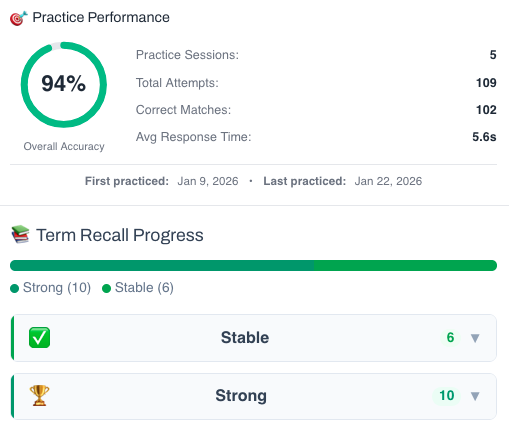
This isn’t a simple quiz — it’s a fully tracked learning system. You build knowledge through recognition, then recall, and your progress feeds directly into the Integrated Practice Bar (Writing tasks, AI Chat, and more).
- Practice sessions, accuracy, and response-time tracking
- Term strength levels (Learning → Stable → Strong)
- Personal progress history for each unit
This feature is available to YSP members.
Explore Membership Benefits🎮 Practice Games
Sentence Scrambler
Using OF to express possession, material composition, and quantity – Sentence Scramble
Member-Exclusive Sentence Builder
Reconstruct scrambled sentences to practice word order and develop your grammar intuition.
This feature is available to YSP members.
Explore Membership Benefits