Using at, in, and on to Describe Location and Position
Core PathWay
1 Why Three Different Prepositions?
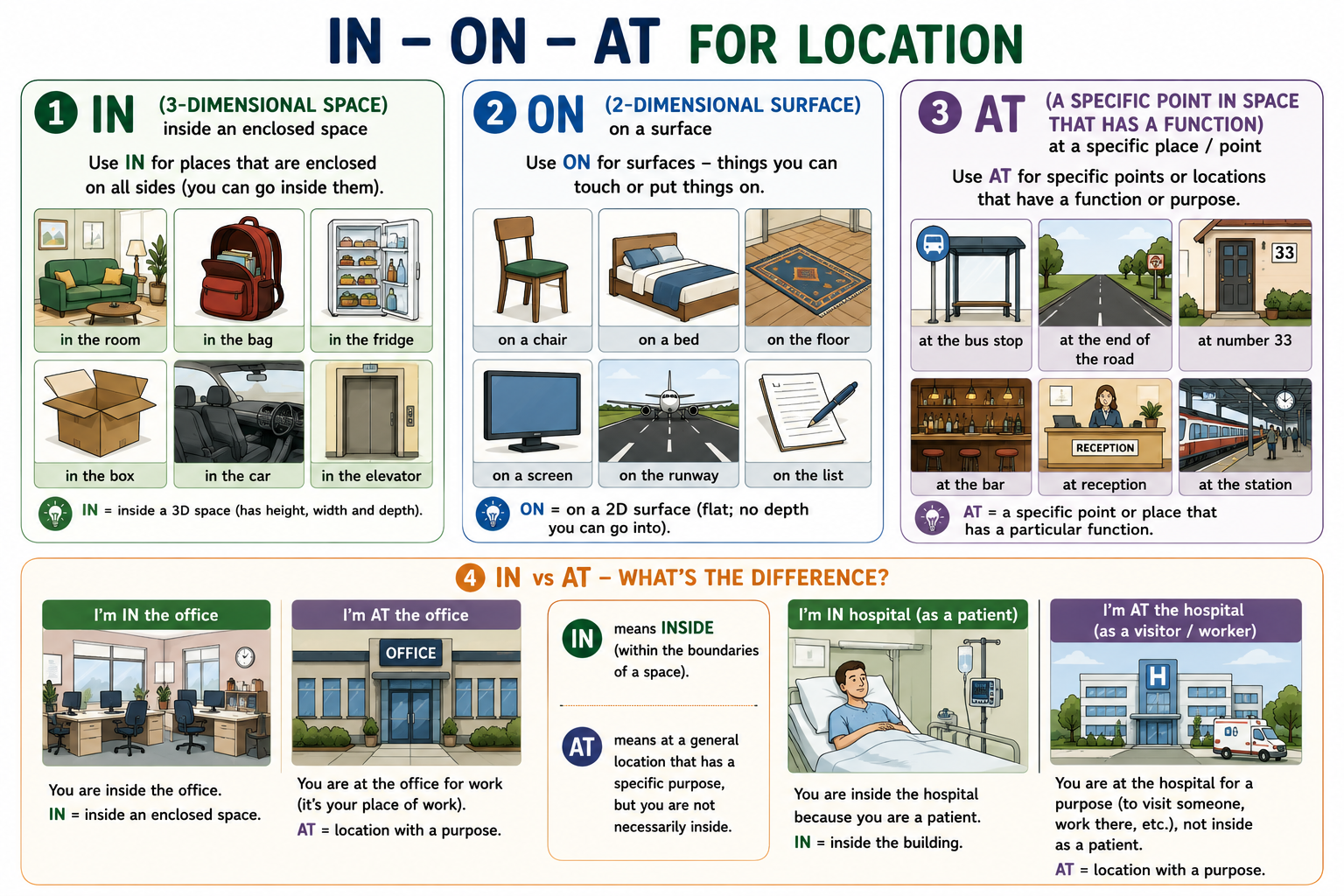
English uses three different prepositions to describe where things are: at, in, and on. Why three? Because English speakers think about location in three different ways. We use at when we think of a place as a point or a specific location. We use in when we think of a place as an enclosed space — something with walls or boundaries around it. We use on when we think of something touching a surface.
This is different from many languages. Some languages use only one or two words for all these situations. In English, the preposition changes depending on how we see the location. Is it a point? Is it inside something? Is it touching a surface?
Imagine you are moving into a new apartment. The landlord shows you around. You need to understand where everything is. The mailbox is on the wall at the entrance. Your keys are on the coffee table in the living room. The mirror is on the door. See how the preposition changes? Let’s learn the rules so you can describe locations clearly and correctly.
Key Terms
2 The Three Rules: at, in, on
Now let’s look at the three rules. Each preposition has a clear job. When you understand the pattern, choosing the right preposition becomes easy. Think about what kind of location you are describing: a point, a space, or a surface. The preposition follows naturally.
We use these prepositions all the time when we talk about homes, buildings, and neighbourhoods. You need them to give directions, describe rooms, and explain where furniture is. The examples below use apartment vocabulary so you can see how the rules work in real situations.
Focus
- Use at for addresses and specific locations (at 42 Park Street, at the station, at home, at work)
- Use in for rooms and enclosed spaces (in the kitchen, in London, in the drawer, in the building)
- Use on for surfaces and floors (on the table, on the wall, on the first floor, on the street)
Rules
- at + specific point or location: We use at when we think of a place as a point on a map or a specific location. Examples: at the door, at the bus stop, at the corner, at home.
- in + enclosed space or area: We use in when something is inside a space with boundaries — a room, a city, a container. Examples: in the bedroom, in the hallway, in the drawer, in the neighbourhood.
- on + surface or contact: We use on when something is touching a surface. Examples: on the table, on the wall, on the floor, on the balcony (the balcony is seen as a surface you stand on).
Examples
- The keys are on the table in the kitchen at number 42. (All three prepositions in one sentence — on the surface, in the room, at the address)
- The remote control is on the coffee table in the living room. (on the surface, in the room)
- There is a mirror on the door in the hallway. (on the surface, in the space)
Common mistake
Key Terms
3 Welcome to Your New Apartment
Alex is meeting the landlord, Jordan, for the first time. Jordan is showing Alex around the apartment. They are standing at the entrance of the building.
‘Welcome!’ says Jordan. ‘Your apartment is on the third floor. The mailbox is on the wall here, next to the door. You can see your apartment number on it — 3B.’
They go upstairs. Jordan opens the door. ‘When you walk in the living room, you’ll see the sofa in the corner. The remote control for the TV is on the coffee table. There’s also a lamp on the small table next to the sofa.’
Alex looks around. ‘It’s very nice. Where is the bathroom?’
‘The bathroom is at the end of the hallway,’ Jordan says. ‘There’s a mirror on the door. Very useful when you’re getting ready in the morning.’
They walk in the bedroom. ‘The bed is in the middle of the room,’ Jordan explains. ‘The lamp is on the bedside table. You can put your clothes in the drawer under the bed, or on the shelf in the cupboard.’
Alex smiles. ‘This is perfect. And is that a balcony?’
‘Yes!’ says Jordan. ‘At night, you can sit on the balcony and relax. The building is in a very quiet neighbourhood. The bus stop is at the corner, on Park Street. You can get to the city centre in fifteen minutes.’
Alex feels happy. ‘Thank you. I think I’m going to love living here.’
Jordan hands Alex the keys. ‘The keys to the main door are on this ring. Welcome home!’
Key Terms
4 Describe Your Home
Now it’s your turn. Use what you have learned to describe a room or your home.
5 Remember the Rule
You now know the three prepositions of place. Here is a simple way to remember them: think of at as a point, in as a box, and on as a surface.
When you need to describe a location, ask yourself: Am I talking about a specific point? Use at. Am I talking about something inside an enclosed space? Use in. Am I talking about something touching a surface? Use on.
Here are the most common patterns to notice and remember:
at + addresses and specific locations: at 42 Park Street, at the station, at home, at work, at the corner, at the entrance
in + enclosed spaces and areas: in the room, in the city, in the drawer, in the building, in the neighbourhood, in the hallway
on + surfaces and floors: on the table, on the wall, on the first floor, on the street, on the balcony, on the shelf
When you listen to English speakers giving directions or describing places, pay attention to these patterns. You will hear them again and again. The more you notice them, the more natural they will feel. Soon you will choose the right preposition without thinking!
⚖️ IN vs AT for Locations
⚖️ IN vs ON with Transport
Member-Exclusive Practice Bar
Access a wide range of integrated practice for this unit — from Vocabulary and Grammar activities to AI-curated Writing tasks and Thematic Chat practice.
This feature is available to YSP members.
Explore Membership BenefitsMember-Exclusive Vocabulary Review & Acquisition System
This isn’t a simple quiz — it’s a fully tracked learning system. You build knowledge through recognition, then recall, and your progress feeds directly into the Integrated Practice Bar (Writing tasks, AI Chat, and more).
- Practice sessions, accuracy, and response-time tracking
- Term strength levels (Learning → Stable → Strong)
- Personal progress history for each unit
This feature is available to YSP members.
Explore Membership Benefits🎮 Practice Games
Sentence Scrambler
Using at/in/on to describe location and position with buildings, areas, surfaces, and points – Sentence Scramble
Member-Exclusive Sentence Builder
Reconstruct scrambled sentences to practice word order and develop your grammar intuition.
This feature is available to YSP members.
Explore Membership Benefits