Fixed Prepositional Expressions: Adjective + Preposition and Noun + Preposition
Core PathWay
1 Why Some Words Are Best Friends
Some words in English are like best friends. They always go together. We call these fixed prepositional expressions.
When you say ‘I am good at sports’, you must use ‘at’. You cannot say ‘good in sports’ or ‘good for sports’. The word ‘good’ always takes ‘at’ when we talk about abilities. This is not a rule you can guess. You need to learn it.
Many learners try to translate from their first language. This causes mistakes. In English, each adjective and each noun has its own preposition partner. Today you will learn the most common ones. You will see two friends, Luca and Sara, talking about their strengths, their interests, and their worries. Listen to how they use these expressions naturally.
Key Terms
2 The Two Pattern Types
English has two main types of fixed prepositional expressions. The first type is adjective + preposition. The second type is noun + preposition.
These patterns do not follow logic. You cannot guess them. You must memorize them like you memorize a phone number. But don’t worry! Once you know the common ones, you will start to notice them everywhere.
Focus
- These are fixed collocations, not logical choices
- The adjective or noun determines which preposition comes next
- You must memorize these partnerships
Rules
- Adjective + preposition: The adjective chooses its preposition partner. Examples: good at, interested in, worried about, afraid of, angry with/about.
- Noun + preposition: The noun chooses its preposition partner. Examples: reason for, answer to, difference between, problem with, solution to.
- You cannot translate these from your first language. English uses different prepositions.
Examples
- I am good at sports but not good at grammar. (adjective + preposition)
- She is interested in music and history. (adjective + preposition)
- What is the reason for the delay? (noun + preposition)
Common mistake
Key Terms
3 Luca and Sara’s Conversation
Luca and Sara walked out of class together. Luca looked worried about something.
‘What’s wrong?’ Sara asked.
‘I’m really worried about my upcoming English exam,’ Luca said. ‘I’m not good at grammar. Can you help me?’
Sara smiled. ‘Well, I am good at grammar, that’s true. But I’m not interested in teaching. I find it boring.’
Luca looked disappointed. ‘Please! I’m afraid of failing. I need to pass this exam.’
‘What are you good at?’ Sara asked. ‘Everyone has different strengths.’
‘I’m good at sports,’ Luca said. ‘And I’m interested in music and history. But grammar? That’s a big problem for me.’
Sara thought for a moment. ‘OK, here’s the difference between us. You learn by doing. I learn by reading. Maybe that’s the reason for your problem with grammar. You need a different approach.’
‘So what’s the solution to my problem?’ Luca asked.
Sara had an idea. ‘There’s a language app with games. You can practice grammar while playing. That might be the answer to your concern.’
Luca’s face brightened. ‘That’s a great idea! Thank you!’
But then he remembered something. ‘Wait – I’m also angry about the cancelled class trip. We were going to practice English in real situations.’
‘I know,’ Sara said. ‘I’m angry about that too. But we can’t change it. Let’s focus on the exam. Download the app tonight. I think it will help.’
Luca nodded. ‘You’re right. Thanks for the advice. Even if you’re not interested in teaching, you just gave me the answer to my biggest concern!’
Key Terms
4 Your Turn to Practice
Now practice what you have learned. Write about yourself using these fixed prepositional expressions.
5 Remember: Learn the Partnerships
Fixed prepositional expressions are partnerships. You cannot guess them. You must memorize them.
Here is a simple strategy: when you learn a new adjective or noun, always learn its preposition partner at the same time. Don’t just learn ‘interested’. Learn ‘interested in‘. Don’t just learn ‘reason’. Learn ‘reason for‘.
Here are the common signal words from today:
Adjectives with fixed prepositions: good at, interested in, worried about, afraid of, angry with/about
Nouns with fixed prepositions: reason for, answer to, difference between, problem with, solution to
When you watch English videos or listen to podcasts, notice these patterns. You will hear them again and again. This is how you make them automatic.
6 What You’ve Learned
Today you learned about fixed prepositional expressions. These are word partnerships that English speakers always use together.
You saw two types: adjective + preposition (like good at, interested in, worried about) and noun + preposition (like reason for, answer to, solution to).
You cannot translate these from your first language. You must memorize them. The best way is to learn the adjective or noun together with its preposition partner from the start.
You read a story about Luca and Sara. You saw how these expressions work in real conversation. You practiced writing about your own strengths and interests using these patterns.
Keep noticing these partnerships when you read or listen to English. Soon they will feel natural!
Member-Exclusive Practice Bar
Access a wide range of integrated practice for this unit — from Vocabulary and Grammar activities to AI-curated Writing tasks and Thematic Chat practice.
This feature is available to YSP members.
Explore Membership BenefitsMember-Exclusive Vocabulary Review & Acquisition System
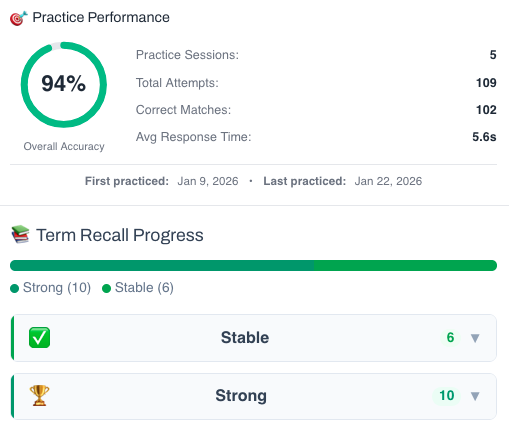
This isn’t a simple quiz — it’s a fully tracked learning system. You build knowledge through recognition, then recall, and your progress feeds directly into the Integrated Practice Bar (Writing tasks, AI Chat, and more).
- Practice sessions, accuracy, and response-time tracking
- Term strength levels (Learning → Stable → Strong)
- Personal progress history for each unit
This feature is available to YSP members.
Explore Membership Benefits🎮 Practice Games
Sentence Scrambler
Fixed Prepositional Expressions and Collocations – Sentence Scramble
Member-Exclusive Sentence Builder
Reconstruct scrambled sentences to practice word order and develop your grammar intuition.
This feature is available to YSP members.
Explore Membership Benefits