Hospital Doctors: The Language of the Ward
Core PathWay
1 Section 1. What Doctors Do: The Core of Patient Care
Hospital doctors have their own language. Let’s make sure you can use it.
When a patient arrives at the hospital, a doctor’s first job is to examine patients. This means the doctor looks at the patient carefully — checking the body, asking questions, and listening to symptoms.
After examining a patient, the doctor tries to diagnose serious conditions. To diagnose means to identify what illness or problem the patient has. For example, a doctor might diagnose pneumonia or a broken bone.
Once the doctor knows what is wrong, the next step is to treat illnesses. To treat an illness means to give the patient the help they need to get better. This could be medicine, rest, or an operation.
When new patients arrive at the hospital for the first time, doctors need to assess new admissions. To assess means to look at a patient’s situation carefully and decide how serious it is. An admission is a patient who has just entered the hospital.
These four actions — examine, diagnose, treat, and assess — are at the heart of what every hospital doctor does.
2 Section 2. Finding Answers: Tests, Scans, and Plans
Doctors often need more information before they can make a decision. This is where tests and technology come in.
A doctor can order diagnostic tests. This means the doctor asks for specific medical tests — for example, a blood test or an X-ray. The word ‘diagnostic’ means ‘used to find out what is wrong’.
After the tests are done, the doctor needs to interpret scans. To interpret means to read and understand the results. A scan is an image of the inside of the body, for example an MRI or a CT scan.
When the doctor has all the information, they can prescribe medication. To prescribe means to officially write or record which medicine a patient should take. Only a qualified doctor can do this.
Finally, the doctor will develop treatment plans. A treatment plan is a clear set of steps that explains how the patient will be helped over time. It might include medication, rest, exercises, or follow-up appointments.
Notice the collocations here: you ‘order’ tests, ‘interpret’ scans, ‘prescribe’ medication, and ‘develop’ plans. Each verb has its own natural partner — and using the right one sounds much more natural.
3 Section 3. Watching and Acting: Ongoing Patient Care
A doctor’s job does not stop after the first diagnosis. Patients need care every day.
Doctors monitor patients’ progress. To monitor means to watch something carefully over time. Progress means how much a patient is getting better — or not. So monitoring progress means checking regularly if the patient is improving.
Sometimes a doctor needs to perform medical procedures. A procedure is a specific medical action — for example, stitching a wound or inserting a tube. To perform means to carry out a skilled action.
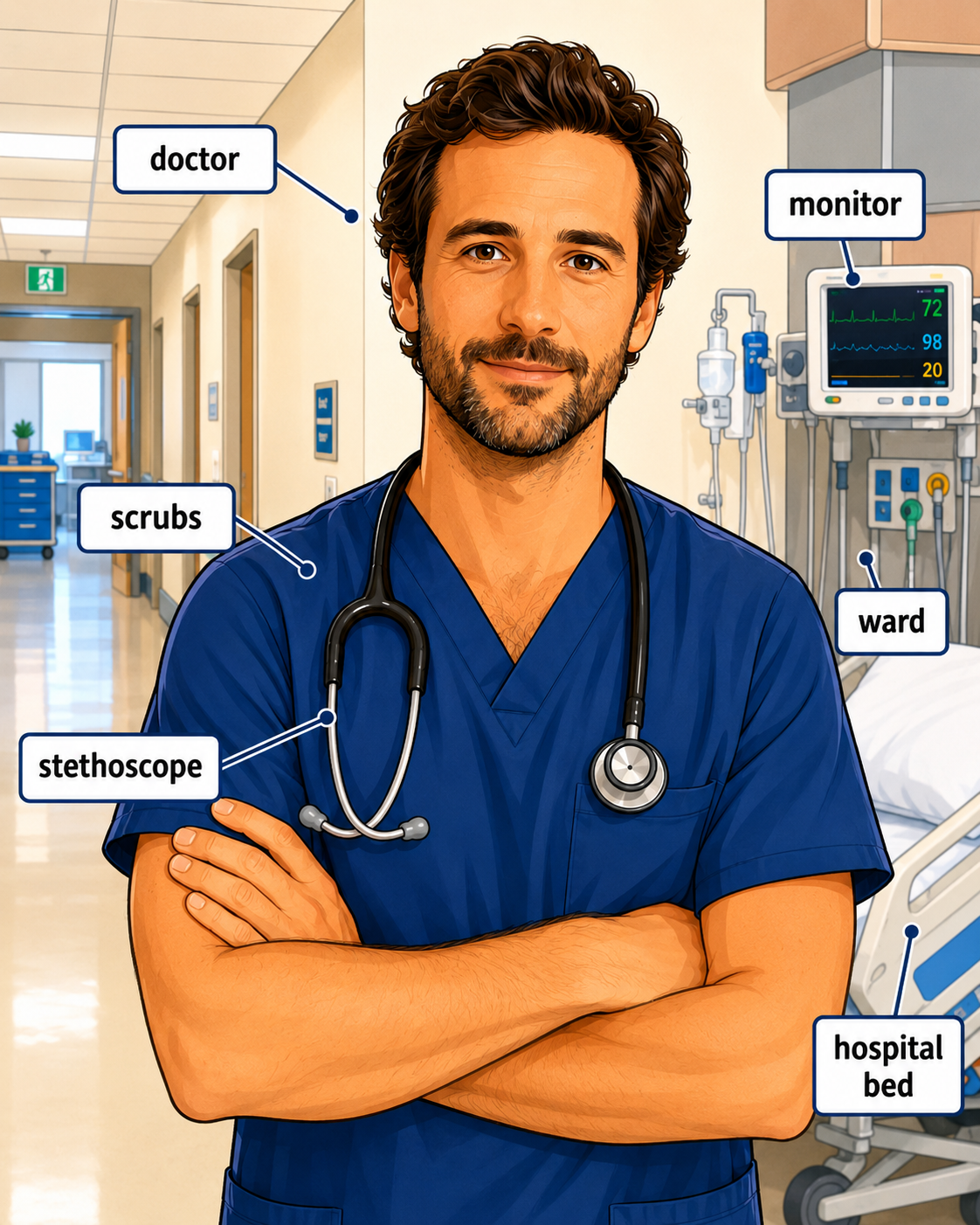
Every day in a hospital, doctors carry out ward rounds. A ward is a room or area in a hospital where patients stay. A ward round is when the doctor walks around the ward and visits each patient to check how they are doing.
When something goes wrong very quickly, doctors must respond to emergencies. An emergency is a sudden, dangerous situation that needs immediate action. Responding to emergencies is one of the most important skills a hospital doctor has.
In these situations, the doctor’s first goal is to stabilise patients. To stabilise means to make a patient’s condition safe and under control — so they are no longer in immediate danger.
4 Section 4. Working Together: Teams and Communication
Hospital medicine is a team sport. Doctors rarely work alone.
When a case is complex, a doctor will consult specialists. A specialist is a doctor who is an expert in one area — for example, a heart specialist or a brain specialist. To consult means to ask for expert advice.
Doctors also discuss cases with colleagues. A colleague is someone you work with. Discussing cases means talking about a patient’s situation with other doctors to get different ideas or check a decision.
It is also very important to explain treatment to patients. This means telling the patient clearly what will happen, why it will happen, and what they should expect. Good doctors use simple language when they do this.
Before any major treatment, the doctor must obtain informed consent. Consent means permission. Informed consent means the patient agrees to the treatment after the doctor has explained everything clearly. This is a legal and ethical requirement.
Finally, doctors work with nurses every day. Nurses carry out many of the doctor’s instructions and spend more time with patients. Good communication between doctors and nurses is essential for safe patient care.
5 Section 5. Paperwork and Meetings: The Administrative Side
Doctors do a lot more than treat patients. There is also important paperwork and planning.
After seeing a patient, doctors must update medical records. A medical record is an official document that contains all the information about a patient’s health and treatment. To update means to add new information.
When a patient is ready to leave the hospital, the doctor will write discharge summaries. A discharge summary is a document that explains what happened during the patient’s stay and what they should do next. Discharge means leaving the hospital.
Doctors also supervise junior doctors. Junior doctors are less experienced doctors who are still learning. To supervise means to watch over someone’s work and help them when needed.
Regularly, doctors attend clinical meetings. A clinical meeting is a formal meeting where doctors and other medical staff discuss patients, new treatments, or problems in the hospital. To attend means to go to a meeting or event.
All of this paperwork and these meetings take time. They are a very real part of a doctor’s working day — not just the exciting parts you see on TV.
6 Section 6. The Reality of the Job: Shifts, Scrubs, and Equipment
Working as a hospital doctor is demanding. The hours are long and the environment is very specific.
Many doctors work long shifts. A shift is a set period of time when someone works. A long shift might be 10, 12, or even 14 hours. This is common in hospitals because patients need care at all times.
Some doctors also work night shifts. A night shift means working through the night — for example, from 10pm to 8am. Night shifts are tiring but essential for 24-hour patient care.
In the hospital, doctors wear scrubs. Scrubs are the simple, comfortable uniform that doctors and nurses wear — usually in blue, green, or grey. They are easy to clean and practical for a medical environment.
Doctors also use medical equipment every day. Medical equipment includes tools like stethoscopes, blood pressure monitors, and surgical instruments. The right equipment helps doctors examine, diagnose, and treat patients safely.
So the next time you picture a hospital doctor, think beyond the diagnosis. Think about the long shifts, the scrubs, the equipment, the meetings, the paperwork — and the huge team effort behind every patient who gets better.
Member-Exclusive Practice Bar
Access a wide range of integrated practice for this unit — from Vocabulary and Grammar activities to AI-curated Writing tasks and Thematic Chat practice.
This feature is available to YSP members.
Explore Membership BenefitsMember-Exclusive Vocabulary Review & Acquisition System
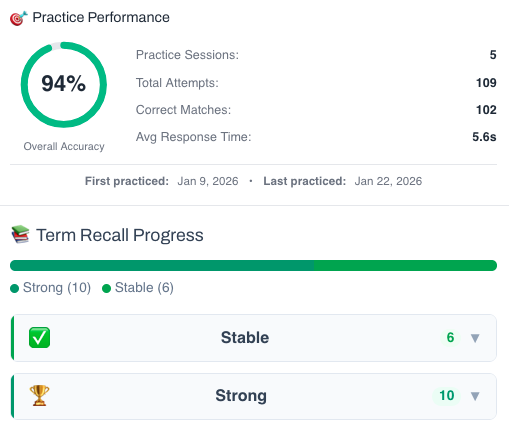
This isn’t a simple quiz — it’s a fully tracked learning system. You build knowledge through recognition, then recall, and your progress feeds directly into the Integrated Practice Bar (Writing tasks, AI Chat, and more).
- Practice sessions, accuracy, and response-time tracking
- Term strength levels (Learning → Stable → Strong)
- Personal progress history for each unit
This feature is available to YSP members.
Explore Membership Benefits🎮 Practice Games
Sentence Scrambler
Hospital Doctors – Sentence Scramble
Member-Exclusive Sentence Builder
Reconstruct scrambled sentences to practice word order and develop your grammar intuition.
This feature is available to YSP members.
Explore Membership Benefits